Name the song:
Let’s go upstairs and read my tarot cards
Answer: “Stay With Me”-Faces/Rod Stewart
Art is the music we make from the bewildered cry of being alive. ~Maria Popova
16 Nov 2012 2 Comments
in Lyric Quiz
Name the song:
Let’s go upstairs and read my tarot cards
Answer: “Stay With Me”-Faces/Rod Stewart
16 Nov 2012 1 Comment
in Songs You May Have Missed Tags: big star, september gurls
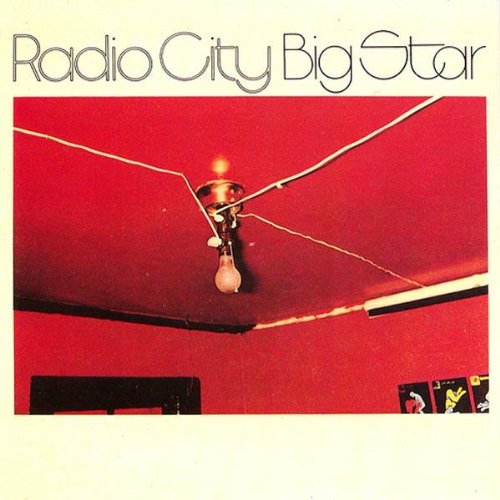
Big Star: “September Gurls” (1974)
From Radio City, Big Star’s second album. The ill-fated band led by Alex Chilton (The Box Tops) and Chris Bell were already crumbling here, and record distribution problems didn’t help matters. If talent alone dictated such things, they might have been big stars indeed. But instead their 3 album output was fated for cult classic status, revered and often covered by other musicians but never racking up the sales numbers the music deserved.
See also: https://edcyphers.com/2013/03/25/songs-you-may-have-missed-372/
16 Nov 2012 4 Comments
in General Posts Tags: jimmy page, Led Zeppelin
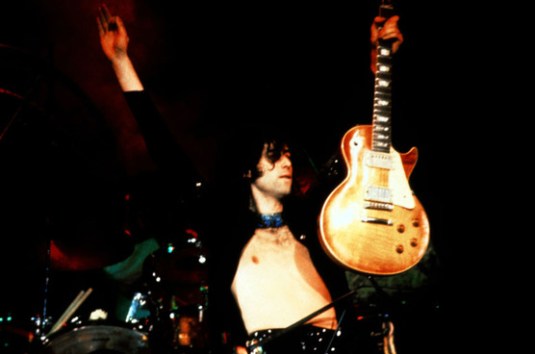
The following is a provocative post reprinted from NME:
Sacred Cows is an occasional series in which NME writers question the consensus around revered albums and artists
By Mark Beaumont
When I go for an expensive meal, I don’t want more side order vegetables than steak. At the cinema, I don’t want more credits than film. So as the NME office quakes to the sound of ‘Celebration Day’, the live album from Led Zeppelin’s O2 reunion show in 2007, I’m left increasingly baffled as to how this tiresome band’s plodding, self-indulgent arse gravy has managed to creep into the realms of respected classic rock.
I mean, don’t get me wrong, I like a good solo. Joey Santiago is clearly a supernatural hyper-wizard from a far wonkier dimension than our own. Matt Bellamy’s fingers must’ve been beamed down from Planet Acewiddle. But alongside virtuosity and melodic panache, a great solo displays restraint, doesn’t outstay its welcome. Except in Led Zeppelin’s world. Here’s a live album that’s approximately 80 per cent solo, 18 per cent aimless jam and two per cent actual song. Yes, Jimmy Page can play the guitar. The question is, can he stop?
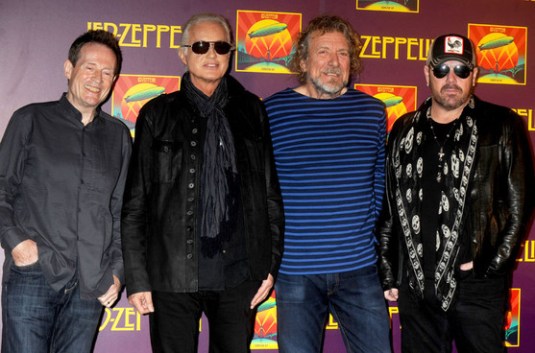
The live album merely serves to reinforce my feelings about Led Zeppelin – that they’re the worst excess of over-rated prog blues wank in rock history. They’re credited with inventing heavy metal (although ‘Helter Skelter’ arguably pipped them to that) but the shroud of black magic and mysticism that surrounded the band in the 70s was a smokescreen to disguise the fact that they were merely pomped-up, cock-fixated blues hacks recycling stolen riffs and hooks and plagiarizing willy-nilly from old blues, rock’n’roll and folk records like copyright laws were beneath them – “you only get caught when you’re successful, that’s the game,” said Plant after being caught with his hand in Willie Dixon’s lyric jar.
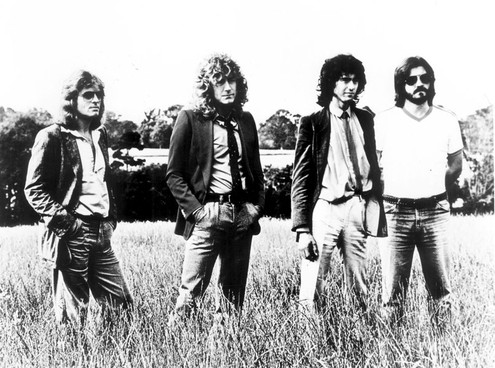
Yes they came up with some ass-annihilating riffs in their time, but – especially live – they’d often swamp their finest licks in extended trad jams, nails-down-blackboard whining and proggy pastoral wafts, dragging the burgeoning 70s hard rock explosion back into the hackneyed improvisational habits of ancient jazz and blues. The noxious ‘art’ of padding out arena gigs with tedious extended plank-spanking sections sprang from this period, and Zeppelin were at the forefront of making this mass wastage of precious audience lifespan acceptable. Their albums were tighter but, to these ears, no less dreary: walloping wads of muddy blues/folk rock that stared ever backwards at a time when so much more intriguing music was looking towards a glistening pop/punk/disco future.
Heavy rock crunch? The Who and Black Sabbath did it better. Glam-era glamour? Give me Bowie or Bolan any day. To this day, it’s only the rock’n’roll mythology of Led Zeppelin – the red snappers, in-room motorbikes and occult rituals – that keep their memory in any way interesting or edgy, and even these were ripped off the likes of Keith Moon, Robert Johnson and The Rolling Stones. Strip the myths away and you find that everything saggy, overblown and boring in rock music is Led Zeppelin’s fault – hardly a cause for celebration.
15 Nov 2012 4 Comments
in Articles, General Posts Tags: don't stop believin', journey
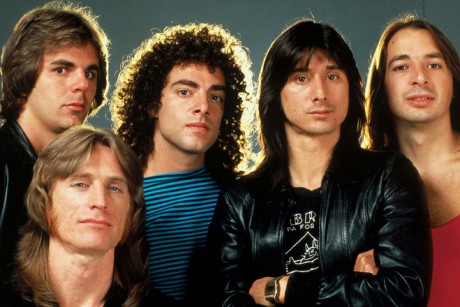
(This article by Stephen Deusner was printed in Salon Friday, Oct. 26)
The Giants and the Tigers should play for something real this World Series. Instead of compete for a big trophy and bigger bragging rights, the two teams should play for Journey: The winner gets to keep “Don’t Stop Believin’” as a stadium singalong, and the loser has to find some other song for its playlist.
Of course, San Francisco would have much more to lose in that wager, since singer Steve Perry is an avowed Giants fan who performed during the Giants run to the 2010 World Series title and even appeared in the team’s victory parade. (Perry’s “Lights” is also an AT&T Park favorite.)
For Detroit, however, it’s just one of many rousing numbers in its stadium playlist, albeit one with a shout-out to the Tigers’ hometown: “Just a city boy, born and raised in South Detroit.” Of couse, there is actually no such place as South Detroit, unless you count Lake Erie or Windsor, Ontario. In that regard, Detroit’s adoption of “Don’t Stop Believin’” seems awfully self-deprecating, as though the team is desperate for any song that mentions the city. (Why not rock to the MC5, the Stooges or pretty much anything from that small, obscure local label called Motown?)
So let the World Series loser stop believin’. In which case, we’d all win if both teams lost? That Journey hit has become ubiquitous, an inescapable part of watching TV, attending sporting events, going to the grocery store, or just listening to the radio (although, really, who does that anymore?).
How did this possibly happen? Rock critic Lester Bangs once observed that we don’t agree on anything anymore the way that we did on Elvis. But he was wrong: There was once a time when we all believed Journey sucked. So how did they go from corporate-rock pariahs and prom theme embarrassments to everyone’s not-so-secret guilty pleasure? After all, our seventh-inning stadium singalongs tend to be reserved for icons. It’s where we sing Kate Smith and Neil Diamond.
The story starts, of course, in San Francisco, back when the Giants were still playing in Candlestick Park. Neal Schon was a teenage guitar prodigy who dropped out of high school to join Santana, playing on one album, “Santana III,” in 1971. He left the band soon after, but the experience would prove helpful, if only for introducing him to keyboard player Gregg Rolie. Together, they formed a new band with bassist Ross Valory and rhythm guitarist George Tickner; they chose their name through a contest on local radio station KSAN-FM. Like Santana, they were primarily an instrumental act, which meant long jams and middling sales. In late 1977, they hired a drummer named Steve Perry to front the band.
That decision proved more than advantageous, as Journey quickly grew into a pop behemoth, notching multi-platinum and more or less owning radio with hits like “Anyway You Want It,” “Separate Ways (Worlds Apart),” “Open Arms” and “Lovin’, Touchin’, Squeezin’.” Such was their popularity that they even had their own video games, both in actual arcades and on the Atari 2600, where you had to guide the band backstage past shady agents and paparazzi to their limousine, while an eight-bit version of “Don’t Stop Believin’” played in the background.
Perhaps most important to Journey’s success was MTV, then a fledgling network hungry for videos of any quality by any band. Journey realized the possibilities of the medium before a lot of other bands, and some of their early clips have a certain DIY charm. For “Separate Ways,” the band flew to New Orleans, where they played invisible instruments on the docks: air guitar, air keyboards, air drums, even air microphone. It was a bit corny, but also pretty inventive, early music-video special effects at their cheapest and their finest. As the network grew, so did the band. Journey even participated in one of the network’s very first contests, “One Night Stand With Journey,” where a viewer was flown anywhere in the world to go backstage with the band.
“Don’t Stop Believin’” was only one in a series of hit singles, but it wasn’t even their most successful: The song peaked at No. 9 in 1981, but “Who’s Crying Now” and “Open Arms” both charted higher and longer. Despite their success, Journey were constantly derided by critics who viewed them as bland, dopey, opportunistic and worse. Reviewing their 1981 album “Escape” in Rolling Stone, Deborah Frost wrote, “Journey could be any bunch of fluff-brained sessioneers with a singer who sounds like a eunuch under assault from thrashings of a West Coast-style identi-riffer (Schon, Craig Starship or Steve Toto).” In the Los Angeles Times, Robert Hilburn listed “Don’t Stop Believin’” as one in the year’s “Cavalcade of Cringe-Causing Hits”: “These guys do touch on rock’s inspirational turf, but the lyrics are so hapless and Steve Perry’s vocal is so overblown that the record is a mockery of rock as a meaningful form of artistic expression.”
By the mid 1980s, Journey had stalled, unseated by a wave of younger, synth-based bands like the Eurythmics and Duran Duran, who crowded MTV’s rotation with bigger-budget videos. Perry embarked on a short-lived solo career, and his ’84 debut “Street Talk” produced two big hits: “Oh Sherrie” and “Foolish Heart.” But Journey’s 1986 album “Raised on Radio” was a relative flop, and a new vanguard of hair metal acts, including Bon Jovi and Poison, shunted Journey to the sidelines in the latter half of the decade. The group disbanded and reunited several times over the next 25 years, but never again achieved their former level of success — at least not with any new material. They seemed safely forgotten, or at least relegated to the state fair circuit forever.
But something funny — or, depending on your taste for the song, something incredibly discouraging — happened in the late 2000s. “Don’t Stop Believin’” found new life and a new audience, experiencing a resurgence of popularity and a new status as something like a rock ‘n’ roll classic, thanks primarily to two popular television shows. “The Sopranos” used it to soundtrack its confounding series finale, where Tony Soprano and his family are sitting at a diner eating French fries just seconds before the final blackout. Series creator David Chase, who directed the finale, seemingly chose the song for its intense banality, putting it on par with fresh-from-the-freezer fries, laminated menus and suburban dining. Chase was almost teasing his audience, playfully raising the question of what in the long-running series was worth believing in.
In other words, “The Sopranos” was aware of the song’s dubious place in pop culture. “Glee,” on the other hand, could see it only as a motivational anthem, shorthand for character development. In that series’ 2009 premiere, the members of the high school glee club perform a suspiciously polished a cappella version of the tune as a means of persuading Will Schuester (played by ex-boy band singer Matthew Morrison) to stay on as their teacher. It’s a pretty insipid version of the song, the kids’ squeaky-clean harmonies contrasting weirdly with Journey’s attempt at urban grit, but the “Glee” cover was a hit, propelling “Don’t Stop Believin’” back onto the charts. The song hit No. 6 in 2009, making it the rare single (alongside Queen’s epic “Bohemian Rhapsody” and Sheriff’s “When I’m With You”) to find not only new life but greater success long after its initial run.
Since then, “Don’t Stop Believin’” has shown up on numerous soundtracks (“Yogi the Bear” and “Moneyball,” for example) and as a staple on televised talent shows. It remains on radio playlists and blasts — well, secretes — from grocery store speakers. It was even a centerpiece on the sloppily revisionist musical-cum-flop movie “Rock of Ages.” The song simply won’t die. In 2012, 31 years after its initial release, “Don’t Stop Believin’” is deeply entrenched in current rock culture, such as it is, provoking a Pavlovian response in nostalgists old enough to associate it with the ‘80s and a raised glass from those who see it as an artifact from another era, on par with “YMCA” or “Celebration” as cheeseball anthems that everybody knows the words to and everybody can sing along with.
This sort of pop Lazarus rarely happens on this scale. As tastes change, of course, listeners reevaluate certain assumptions about the past and reconsider music that might once have been considered bad or, worse, uncool. Led Zeppelin were once considered hard-rock scourges, dumb playboys who assaulted the tastes and eardrums of stupid audiences; now they are revered by the same publications that once skewered them. In the 1970s and ‘80s, Hall & Oates were derided as slick faux-soul pioneers; now that stigma has been removed and “Rich Girl” has found new life as a hipster standard.
In the case of “Don’t Stop Believin’” it helps that the general listener isn’t old enough to remember when the song was first released. The song is older than almost all of the Tigers and the Giants, and it predates every single member of the William McKinley High School Glee Club (Morrison was barely 3 years old in 1981). Over the years, the song has shed its disreputable associations, yet retains its power as a pop cultural artifact with the weight of history behind it. A new generation ostensibly hears it for what it is: a shameless go-get-‘em-tiger anthem with a catchy chorus and a straightforward sentiment about not disbelieving. Modern-day listeners can ignore its pandering take on poverty and struggle (which is particularly ironic during the current recession), as well as such awkward phrasings as “streetlights people,” “living just to find emotion” and, of course, “South Detroit.”
They can do this because “Don’t Stop Believin’” was a blank to begin with. It wasn’t punk or new wave; it wasn’t muscle car rock or heavy metal; it wasn’t glam or lite pop or any other genre that can be popularly associated with a particular scene or era. It grew out of ‘70s and ’80s corporate rock, which tended to erase any regional traits or distinctive personalities to appeal to the broadest swath of listeners possible. Journey is more or less interchangeable with Survivor, Toto, REO Speedwagon, Mr. Mister and so many other anonymous bands of that era. In fact, those groups are so bland that they barely constitute an identifiable genre, which allows a song like “Don’t Stop Believin’” to live slightly out of time and out of style, unburdened by any identification with a larger movement good or bad, popular or obscure. The very traits that drew the most criticism have become crucial to Journey’s longevity: Their blankness allows for more than simple nostalgia. Subsequent generations can paint whatever they like on this blank canvas.
Furthermore, the lyrics to “Don’t Stop Believin’,” while ostensibly chronicling the romance of a small-town girl and a big-city boy, are so general they can apply to almost any situation and make it sound much more dramatic than it actually is: a baseball game, a plate of French fries, high school extracurricular activities. Sure, Bon Jovi’s “Livin’ on a Prayer” more or less made the song obsolete in 1986, with its similar dropped g and its much more detailed take on the struggles of youth in love — not to mention its unique vocal rhythm (ooh-wah-ooh-ooh-wah).
But Bon Jovi’s characters have names (Tommy and Gina) and jobs (he used to work on the docks, she’s a waitress); they’re almost too real, and whatever success they find is based on hard work and sacrifices rather than on their simple refusal to stop believing. “Don’t Stop Believin’” is a perfect storm of bland and vague and cheesy and catchy and inoffensive, but most crucially it exhorts listeners to “hold onto that feeling,” which is important. “That feeling” is not the victory, but the hunger, the struggle. Journey extols the journey, not the destination. In other words, whoever wins the World Series is less important than the passion of the players and their fans.
In a sense, the renewed success of “Don’t Stop Believin’” is a self-fulfilling prophecy, as though the song never stopped believin’ in itself. On the other hand, in 2012 it has taken on a whole new set of associations: an unsatisfying end to a beloved series, a big scene in a divisive one, and Schon’s recent elopement with Real Housewife and White House crasher Michaele Salahi. We’re stuck with it forever. But perhaps we can stop pretending that’s worth celebrating.
15 Nov 2012 Leave a comment
in Recommended Albums Tags: million seller, the pooh sticks

The Pooh Sticks: Million Seller (1993)
Welsh band The Pooh Sticks have been described as “rock’s most inside joke”. At nearly every turn they were slyly sending up rock mythology, whether by ironic image manipulation, outlandish marketing (putting out their own mock bootleg) or stealing bits of classic songs–copping a Who riff here, the guitar solo from Neil Young’s “Powderfinger” there, nicking the opening lines from Alice Cooper’s “Hello Hooray” or a chunk of Stephen Stills’ “Love the One You’re With”…but all in a spirit of fun, a sort of game of spot-the-stolen-bit for the knowing rock fan.
Their first release was a single. Their second? A box set. Ha ha. A couple of records later came the ironically titled Million Seller, which of course wasn’t. It was however their best, most polished album.
But sales were disappointing, probably because they’d built a reputation for a somewhat ragged, more guitar-heavy power pop sound on previous releases. This one may have been a little too poppy and polished for its own good. So, having no place on 1993 pop radio and not being what fans of the band expected, this album didn’t really find much of an audience at the time. It has since, however, earned a degree of acclaim as a pop classic.
As is the case with so many of the good ones, the Million Seller album is out of print.
Listen to: “Let the Good Times Roll”
Listen to: “Rainbow Rider”
Listen to: “Sugar Mello”
Listen to: “That Was the Greatest Song”
15 Nov 2012 1 Comment
in Songs You May Have Missed Tags: isn't life strange, the clientele

The Clientele: “Isn’t Life Strange” (2007)
Alasdair MacLean has one of my favorite names and one of my favorite voices. His London band, The Clientele, have a wistful and evocative sound that perfectly complements a contemplative mood and a cloudy day. Violins, cello and occasional gentle tremelo guitar punctuate a reverb-laced sound that always hints at heartbreak just around the next corner. The album, God Save the Clientele, is a thing of sad beauty, a quietly devastating record.
See also: https://edcyphers.com/2013/04/12/songs-you-may-have-missed-388/
See also: https://edcyphers.com/2013/10/29/songs-you-may-have-missed-495/
 Every Moment Has A Song