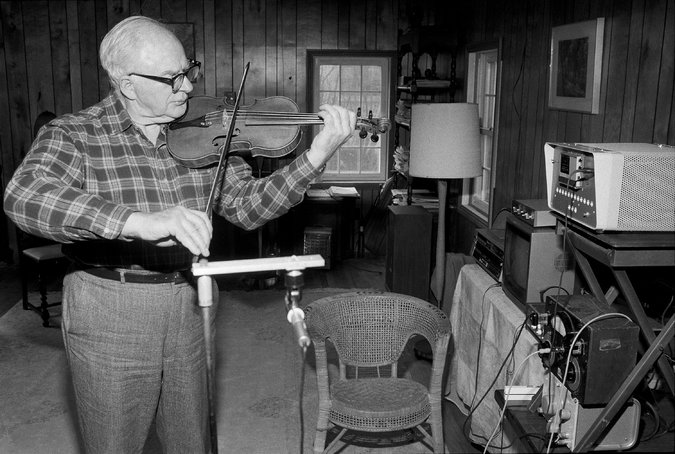
(via the New York Times)
by Bruce Weber
…In 1945, Mr. Pickering, who enjoyed listening to records and was frustrated by the sound quality of recordings, developed an improved pickup — that is, the mechanism that includes the phonograph needle, or stylus, and translates the information in the groove of a record into an electrical signal that can be reproduced as sound.
Previous pickups were heavier and more unwieldy; styluses were made of steel, they needed to be replaced frequently, and the weight of the mechanism wore out records after a limited number of plays.
The so-called Pickering pickup (and later, its even more compact iteration, the Pickering cartridge) was introduced just as the favored material for records was shifting from shellac to vinyl, which had a lower playback noise level.
Originally designed for use in broadcast and recording studios, it was a fraction of the size of earlier models, and it replaced the steel of the stylus with a significantly lighter and harder material — sapphire or diamond — which lasted much longer and traced a more feathery path along the record. Because of it, records lasted longer and original sounds were reproduced with less distortion…



 Every Moment Has A Song