Lessons From a ’90s CD Collection

 Getty Images

(Via InsideHook) by Mike Dunphy

“If I could just afford one new CD a week, I’d be a happy man,” I declared to a coworker at Pure Pop Records in Burlington, Vermont, where I worked between 1995 and 1998. In the first years of my 20s, this goal represented the peak of my aspirations, and the fluke of fortune that won me employment at the hip, indie, basement record store — right out of High Fidelity — made the achievement possible.   

Then I joined the Peace Corps and by September 1998 had landed in a tiny Estonian village to teach English for the next two years. The CD collection of about 600 I’d amassed from Pure Pop’s employee discount, promotional copies and trades could not make the journey, save a fistful of “desert island discs” slipped into a Case Logic and a backpack. 

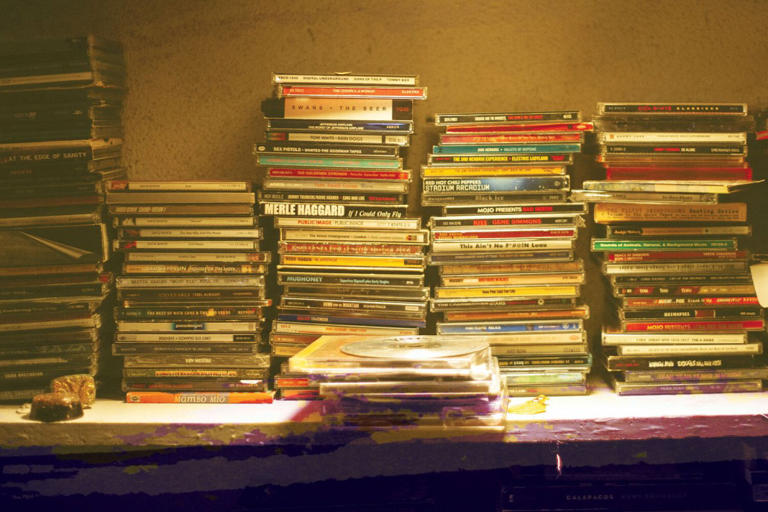
The rest of the collection took its own journey, staying tucked away in a variety of storage areas as I pursued collecting countries over the next two decades. In fact, most remained under literal wraps until 2023, when I finally was able to bring it all back home. By this point, the collection was much reduced. Many boxes had disappeared, some storage locations were forgotten or no longer existed, other discs were gifted and sold, and one box simply melted in the attic heat into plastic abstract art. Nevertheless, the 250 survivors now stand tall in the corner of my living room — the first time in 25 years.

To my surprise, as the ‘90s discs took their first spins in decades, more came from the speakers than just music. 

This Is Me

“What really matters is what you like, not what you are like,” Nick Hornby wrote in his novel High Fidelity, and ‘90s CD collections offered this window to the soul in a very public way, as most everyone kept their music collection in the common areas — if not making it a centerpiece. A simple scan of the titles and artists on display at any new person’s home, all clear along the spine, could reveal much about the person behind them. It wasn’t just the amount of classic rock vs. hip-hop vs country or other, but the method of organization (if any), condition of cases and the ratio of greatest hits compilations to proper albums.

With physical music collections far less common today and often packed away in storage, or secured behind platform passwords online, this powerful public expression of identity has been lost to many. Having the collection out in the open again returns it, proclaiming in a fulfilling way to the world — and myself — “This is me!” 

Escape from the Planet of the Algorithm 

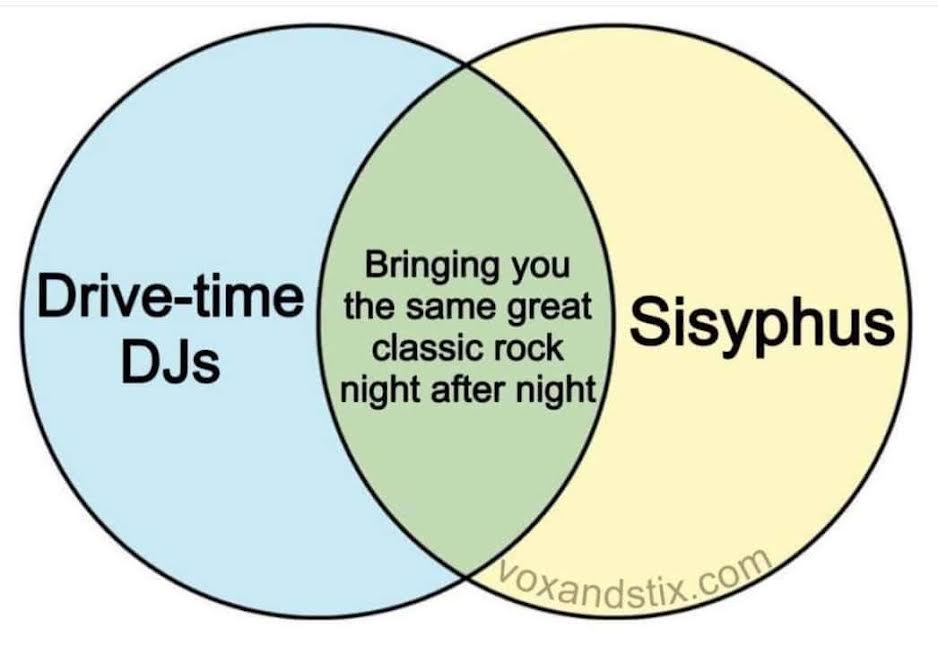
Under the great algorithm in the sky, our choices are shaped and directed by artificial intelligence and mathematical calculation. This is particularly true with music today, as platforms, playlists and channels push derivations of each other, as if part of a single musical family tree. That’s in stark contrast to the more human ‘90s approach that did not have these tools. 

My collection provides a tangible and tactile reminder of this more analog time — even in a digital format — when purchases were driven more from word-of-mouth, life experiences, cover art and sometimes simply throwing a dart and seeing where it landed. The result was music I pulled toward me, not that was pushed on me. With the pull comes a closer connection and greater meaning, enriching a listening session with more soul than the algorithm can ever provide. 
Read more: https://www.msn.com/en-us/music/news/lessons-from-a-90s-cd-collection/ar-AA1dRcj4?ocid=entnewsntp&pc=DCTS&cvid=069998b0e0cc4c55aa06fca42cc1c276&ei=40

Quora: Why did Peter Cetera refuse to associate with the band Chicago after he left including the induction into the Rock and Roll Hall of Fame?

(Answered by Adam Begun)

In Peter’s own words: “when it’s over, its over”.

Pete didn’t leave with a polite handshake and a “best to you all” attitude. He left with a “thank f*cking God I don’t ever have to do THIS/THAT again” attitude.

As for the R&RHOF: he was approached by the band to sing “25 or 6 to 4” for the group’s performance that evening. The song is in the key of A minor and has been played that way since it’s inception and the horn parts are (virtually) cemented in place in A minor. Pete wanted to change the key to E minor…deliberately…knowing that would be impossible for the horns to cope…and the band said: “no”. Pete shrugged and said: “ok, then…no”. The rest of the group said: “fine, then…it’s a shame, but I guess it’s not to be…”.

(For the record: you can’t “just” transpose a brass section down a fourth without major, MAJOR musical issues.

Pete might as well have said: “I’ll do it if you guys can swim fast in quicksand….no, faster than that…”)

Peter drew up his own terms to play in the R&RHOF induction and chose not to even show up when his “demand” couldn’t be met.

This really does show Cetera’s utter contempt for Chicago and his indifference to his time in the group…

…even if he wouldn’t perform he could have been in the audience cheering on his old group for finally getting the respect that they deserve.

Whatever. It’s (very) over by now and a reunion is completely impossible.

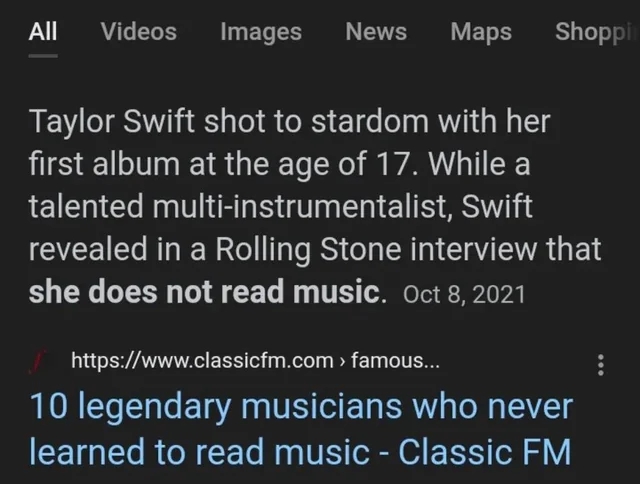
Snopes: Taylor Swift Can’t Read Music?

(via Snopes) by Aleksandra Wrona

“I’m not as much into technique as I am into the emotion of it,” the popular songstress has said.

For years, fans of Taylor Swift have speculated about the extent of her musical abilities, often focusing on the question of whether or not the extraordinarily popular singer-songwriter can read music.

“Fun fact: Taylor Swift Can’t Read Sheet Music. She Plays By Ear!” one Reddit post on the topic claimed, for example. “Does Taylor Swift actually read music notation?” a Quora user asked.

“She most likely writes a melody on a guitar or piano, and then the production is simply built around it. typical ‘reading music’ type of music is very mechanical to compose sometimes, taylor’s melodies are good because they come directly from her own creativity,” one Reddit user commented, while another wrote “I feel like this is the way she was shown doing it in Miss Americana [a documentary about Swift’s career]. She hums a melody into her phone when it comes to her and then works it out from there on a piano or guitar.”

Read more: https://www.snopes.com/news/2024/06/09/taylor-swift-cant-read-music/

Video of the Week: Cowboys Are Frequently Secretly Fond Of Each Other

On a Lighter Note…

Some Important Observations On Steeleye Span, Experiments In Folk Rock And Cows

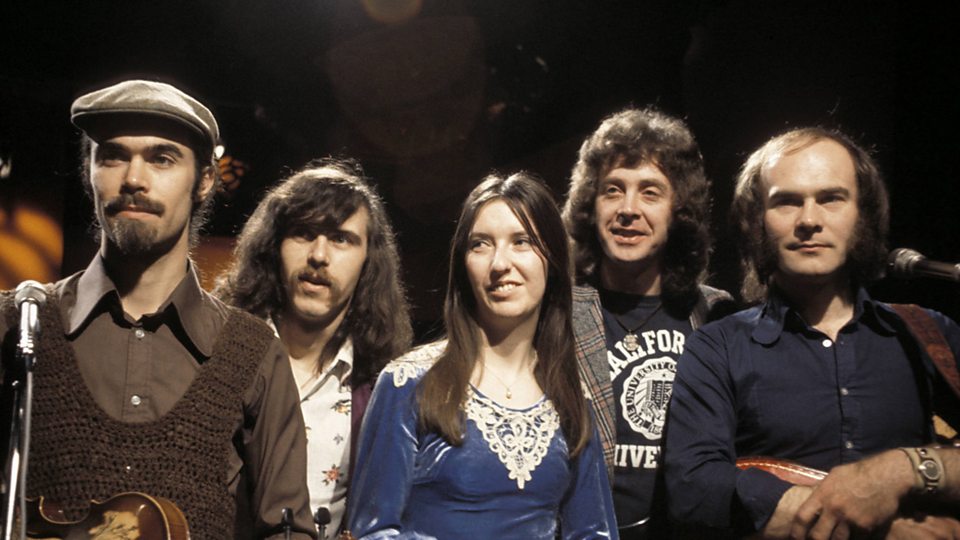
Maddy Prior (right) sings with the English folk-rock band Steeleye Span. (Stephen Cooke)

(via wbur) by Chris Braiotta

I want to talk to you about what it means to experiment. Let’s begin with the following sentence: “We did try a reggae ‘Spotted Cow’ and we weren’t terribly convinced by it, so we stopped doing it.”

You’ll be needing a little context for that. “Spotted Cow” is a song from around 1740. It’s about a woman who’s lost her cow. She complains about it to this guy she runs into. He’s like, “Lady, I am game to help you find your cow. Let us do this.” They go off to a field to find it. Obvious place to start, right? Before long … well, you know how fields are. Sexiest thing in nature. So they decide to do what comes naturally to a man and a woman in a field, which isn’t really looking for cows. From then on, whenever the lady’s looking for a bit of you-know-what, she finds some guy and tells him about her cow.

The speaker of that sentence was Maddy Prior, singer of the great English folk-rock band Steeleye Span. This is a band that she’s led since 1969.

So, to sum up: ‘70s English folk-rock band, cow used as cover story for Georgian booty call. And then: reggae.

“When you’re experimenting with things they can’t all be winners,” she says. “I’m pleased that we tried things.”

I don’t care how “out there” you think your favorite band is. This is what it means to be fearless. This is what experimenting is.

Now “experiments” aren’t something we think of when it comes to folk music. Learning the ancient craft of candle making? Sure. Experimenting? That’s the sort of thing that gets you booed at Newport.

Maddy Prior isn’t moved by any of that.

“The minute you bring guitar into it it’s not English anyways,” she told me. “I think as far as we were concerned the song itself was there and what you did with it was what you did with it. In my world we were never bothered by the way it should be. We took all these songs and made them our own, and then you pass them on and someone else makes them their own. You can mimic other people singing the songs but that’s what you’re doing and why would you do that?”

Read more: https://www.wbur.org/news/2015/07/20/steeleye-span

Next Newer Entries