Hatebeak is an American death metal band, formed by Blake Harrison and Mark Sloan, featuring Waldo (b. 1991), a grey parrot. Hatebeak is reported to be the first band to have an avian vocalist. They never tour so as to not distress Waldo. Hatebeak is signed to Reptilian Records. They released the album Number of the Beak on June 26, 2015, through Reptilian Records.
The band’s sound has been described as “a jackhammer being ground in a compactor”. Aquarius Records magazine called Hatebeak “furious and blasting death metal”. Hatebeak made its second record with Caninus, a band whose lead singers were two dogs. Hatebeak’s goal is to “raise the bar for extreme music”.
Band members
Waldo the Parrot – vocals
Mark Sloan – guitar, bass
Blake Harrison – drums (died 2024)
Discography
Beak of Putrefaction split with Longmont Potion Castle (2004)
Bird Seeds of Vengeance split with Caninus (2005)
The Thing That Should Not Beak split with Birdflesh (2007)
The Number of the Beak (2015)
Birdhouse By The Cemetery split with Boar Glue (2018)
On “Born Runnin’ Outta Time”, Lukas Nelson, who’s been making records with his band Promise of the Real and/or performing in his dad Willie’s band for about a decade and a half, wonders if his best years were given to the road life of a musician.
It’s about the inescapable sacrifices made in the pursuit of one’s ambitions. Indeed, a listener might hear Lukas’ song as the inevitable, somewhat penitential sequel to his dad’s “On the Road Again”.
Songwriters talk about a lyric that “sings well”. This song’s syllables roll along like a smooth ride on a newly paved highway. It “sings” extremely well.
Described by AllMusic as “an album that’s ridiculously big, overblown, and super fun”, the self-titled debut by international power pop band Hey! Hello! went to number 1 on the UK rock chart, and the hooky “Swimwear” is a prime example of why.
The album was a collaboration across the Atlantic, with English singer-songwriter Ginger Wildheart recording guitar, bass and drum parts and sending them to New York for Victoria Liedtke to add her vocals.
As I’ve written elsewhere, it’s astonishing to discover one of one’s absolute favorite artists as a sexagenarian. Typically the bands and singers we love most are locked in by age 25 or so, since the peak years of our musical curiosity, concert attendance and general socialization usually wind down along with the years of our formal education.
For most, taste lock has set in by about age 40. Musical rigor mortis. After that, you like what you like. And you hate what you don’t like.
Some of us are wired differently, never losing the love of discovery, always looking for the next thing to love. But even so we seldom attach ourselves to newly discovered music like we do in our chemically unbalanced, emotionally unregulated youth. And so we seldom discover absolute favorite artists at an advanced age.
But apparently there are exceptions.
Had it not been for that one employee at Blockbuster Music on McKnight Road in Pittsburgh, a treasure trove of Latin pop music would likely have never reached my ears–and so perhaps yours as well.
I was a DJ trying to have a go at a weekly Latin dancing night at a local Mexican restaurant. It was an ill-fated, poorly attended endeavor that lasted exactly one night.
But my music prep was earnest. Uncompromising. And expensive. Trusting the one guy in the CD store who knew what he was talking about regarding Latin music was a great move in the very long run–even if it never bore fruit at Cozumel restaurant.
His recommendations led me to Juan Luis Guerra, Ruben Blades, Carlos Vives, Los Manolos and, somewhat belatedly, Julieta Venegas. Guerra became my favorite Latin artist for the next twenty years. Venegas was more like a time bomb with an extremely long timer. She got buried in a CD drawer for two decades.
It was at that point that I signed on as one of the drivers of the company van my employer used to transport seasonal Guatemalan and Mexican coworkers who were in the US on work visas–several of whom had become friends.
In an effort to make the ride–and in a small way their American experience–a little more accommodating, I’d dug through an extensive music collection, full as it was of failed experiments like Cozumel.
Remembering a cute, catchy tune that had caught my attention all those years earlier, I pulled out two Julieta Venegas CDs and did a little research as I gave them a fresh listen.
I had no idea.
As the music began to stick in a way it never had previously, I read about the gold albums, the 8 Latin Grammys, the proficiency on 17 instruments…and realized Julieta Venegas deserved a deeper dive.
So why did I start by saying “this is tough”?
No matter what words I use to describe her music they’ll fall short of conveying how damn good it is.
Her first two albums, Aqui in 1998 and 2000’s Bueninvento were more jagged and rock oriented, earning critical praise from rock critics. In fact, Rolling Stone named Bueninvento the third-best album in the history of Spanish rock.
But beginning with Si in 2003 and this its 2006 follow-up, Venegas, in collaboration with producers Coti Sorokin and Cachorro López, has been making some of the most well-crafted, enjoyable Latin pop you’ll ever hear.
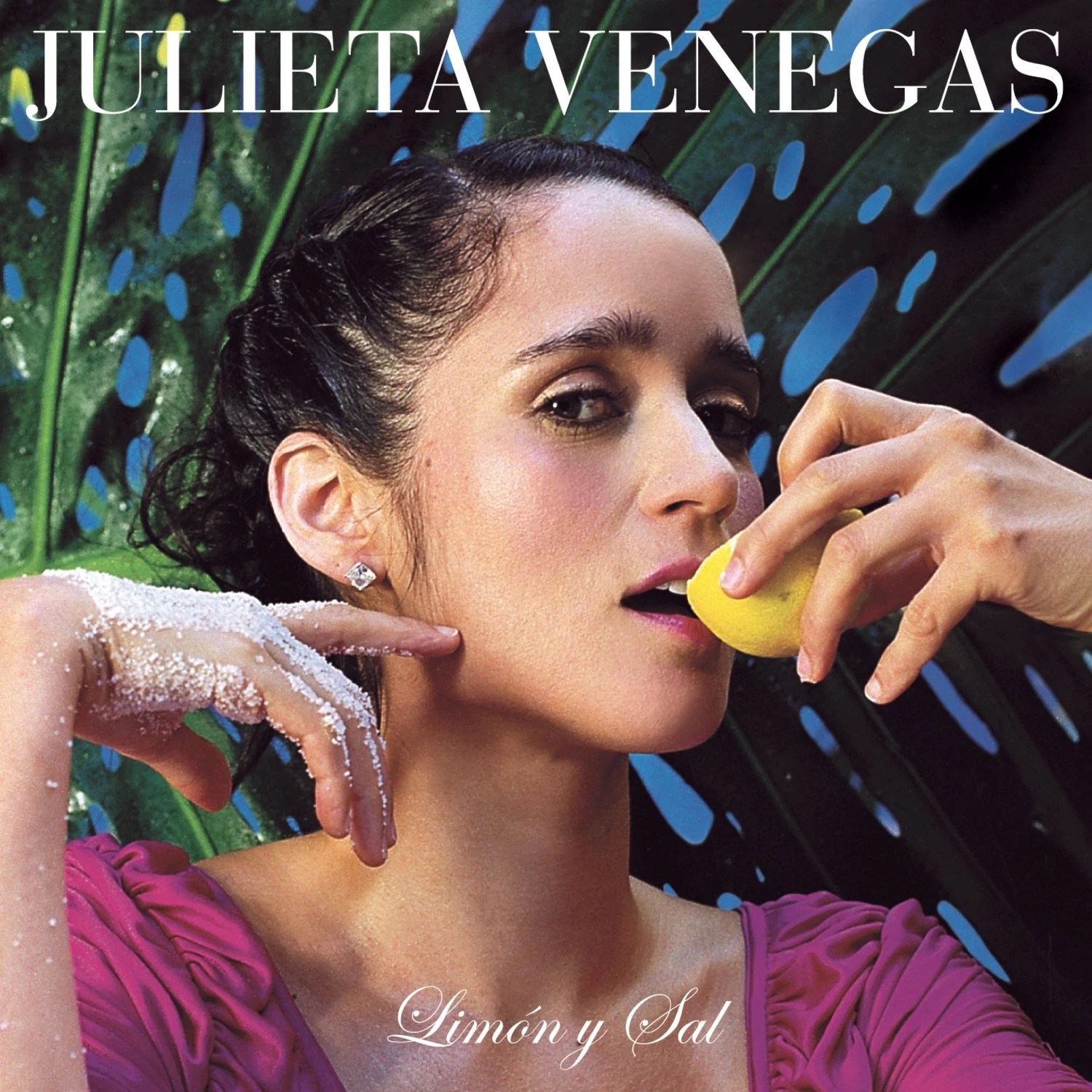
If Si was a commercial breakthrough, Limon y Sal was Venegas truly hitting her confident stride. Song after song it’s nothing but addictive melodies, harmonies and big, bright choruses that you don’t even have to know Spanish to enjoy.
If you do understand the words, or spend a little time looking up the translations, you’ll find the songs hitting you on another level.
Lead single “Me Voy”, a #1 single in Mexico and Spain, is probably the biggest hit of her career. And its sentiment–“you didn’t get me, so I’m leaving”–the simplest. But it does make a great singalong, especially at a Venegas concert.
The album’s second single “Limon y Sal” is about acceptance of a lover’s shortcomings and faults, but the message is couched in an exuberant, uplifting chorus that made the song a smash (#2 in Spain and Mexico):
I love you with lemon and salt I love you as you are There’s no need to change anything
“Dulce Compañia” too breaks out in a wonderfully ebullient singalong chorus:
You’re sweet company, and my soul thirsts I feel resurrected when you see me
Perhaps the most sympathetic performance of the beautiful “Mirame Bien” (“Look at me well”) was rendered for Venegas’ MTV Unplugged concert:
And single number three, the defiantly resolute “Eres Para Mi” (“You are for me”) matches a confident groove with self-assured lyric sentiment:
And I know that you are afraid and it is not a good time for you And for this that has been happening to us
But you’re for me The wind has told me
You’re for me I hear it all the time
Yes, the eight songs I include here are a lot. Truthfully, I cut a few others that I love. This album overflows with good songs, diverse arrangements and lyrics that explore all Julieta Venegas’ appointments with love, loneliness and self-discovery.
Oh, and we had some great sing-alongs in that van.
For fans of Rock and Roll Hall of Fame inductees Chicago who are too young to remember what a true Rock band they once were, and what a major role original lead guitarist Terry Kath played, here’s the full Tanglewood concert from 1970.
The band’s mix of jazz and rock styles was truly innovative, and Kath’s guitar work astonishing.








 Every Moment Has A Song