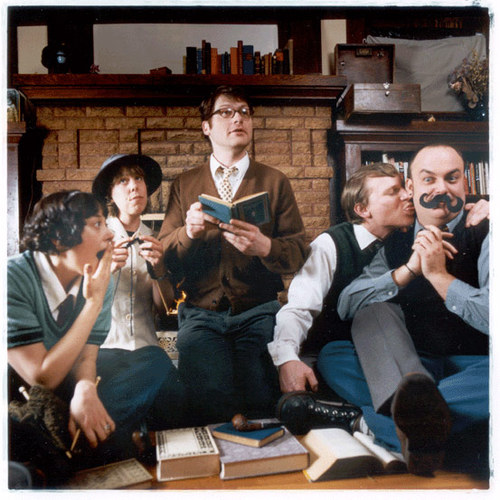
"There's a time in life for Hoagy Carmichael. There's a time in life for Claude Debussy. There's a time in life for Jerry Lee Lewis. There's a time in life for Destiny's Child. All these things have their moment." ~Elvis Costello
“I haven’t heard ‘Mr. [Wendal]’ two days in a row since the 1990s,” Shannon Norman tweeted at Pittsburgh-based radio station WYEP on Tuesday.
Norman, an apparent fan of the hip-hop act Arrested Development, isn’t the only Pittsburgher feeling a sense of déjà vu. The noncommercial station pranked listeners by broadcasting the same playlist from 6 A.M. to 5 P.M. on February 1 and 2, in an unannounced homage to the 1993 Bill Murray comedy Groundhog Day. Every song that aired on the first day aired on the second day, too, and in the exact same order…
RENTON, WA—Local man Paul Campbell confirmed Saturday he was raising his daughter Emma on a variety of media carefully selected to help her cultivate an appreciation for artistic quality, a move that will reportedly put the 12-year-old girl hopelessly out of touch with her generation.
Perusing his music and film collections and showing reporters distinctive, well-regarded works that will thoroughly alienate Emma from her sixth-grade classmates, Campbell said he wanted to make sure his daughter enjoyed the benefits of a cultural education he never received at her age…
Picaresque was the Decemberists’ final indie label album before they signed with Capitol records, released the rock opera masterpiece The Hazards of Love and followed it with a number one album, The King is Dead, among other accomplishments.
And although I just referred to the 2009 folk/prog conceptual Hazards as a masterpiece, I would call Picaresque their best collection of songs–perhaps the best any band produced in the decade of the 2000’s.
Lit rock…geek rock…British folk-infused Dickensian rock…whatever label you apply to this iconoclastic assembly’s music, songwriter Colin Meloy’s hyper-literate, hyper-imaginative tunes set them apart, and earn them more fans and critical acclaim with each release.
Meloy has always liked a good murder ballad, and death and tragic circumstance are staples of his dark-yet-alluring tunes. Put across with appealing melodies in a dialect seemingly all his own, his lyrics typically are as cheerful as the black plague, as exemplified by “We Both Go Down Together” and the epic “Mariner’s Revenge Song” here.
But unlike most bands who specialize in dark, sulky angst it’s clearly a vaudeville here. Of course, the character traits may ring familiar and the harsh lessons may apply in real life. But the songs themselves, constructed out of archaic language and given a veneer of Thespian melodrama, are like the rock music equivalent of unsanitized Brothers Grimm fairy tales. There’s danger, but it’s all ultimately charming, fanciful, bewitching.
If this album appeals to you, the good news is that there is a whole lot more Decemberists catalogue to explore. This band has yet to make a dud album. And my recommendation if you tackle The Hazards of Love next is to listen to the entire 60-minute piece uninterrupted and undistracted, with both lyrics and a concordance at hand. Then listen again. It’s jaw-droppingly brilliant and the best evidence one could cite to make an argument that the era of the ambitious art-rock concept album isn’t quite a thing of the past.
Eight-tracks gave way to cassettes, which gave way to compact discs, which gave way to streaming audio and hi-res files. If there’s one constant in the music biz, it is that every format eventually yields to newer, better technology. All but vinyl, that is. Somehow, records have not only endured, but lately they’ve enjoyed a renaissance.
It’s odd when you think about it. Records are archaic technology, a format that is not at all portable and subject to all manner of degradation, from scratches and skips to pops and clicks, if it isn’t properly and lovingly cared for. But audiophiles insist vinyl offers superior sound. We’ll stay out of that debate, but you have to admit it is pretty cool how vinyl works.
“Sound is converted into microscopic ridges and valleys, stamped onto vinyl, played back through an extremely sensitive needle and amplified thousands of times in your living room,” says photographer Alastair Philip Wiper. “It’s almost unbelievable.”
That’s a bit of a simplification, but you get the point. There’s a process to it that borders on artistry, something Wiper—who loves records—discovered during a visit to Record Industry, a pressing plant in the in the Dutch city of Haarlem. The British photographer followed every step in the process, from making the master to pressing the wax to shrink-wrapping the finished product. “Seeing how it’s done really makes you realize how amazingly clever this old-fashioned technology is,” he says…