Is there an artist you’ve followed loyally for most or all of their career despite diminishing returns in terms of listening pleasure?
Whether it’s athletics, art, or any other endeavor, one does not peak forever. Name your favorite musician or band and chances are you can easily pinpoint their (probably too brief) peak of creativity. And if your rose-colored glasses prevent you from doing so, I’ll be happy to do it for you.
It’s something you feel in your gut despite your devotion as a fan. It’s the moment Kiss recorded a disco song, the time Peter Frampton slipped on pink satin pants for an album cover shoot. It was the day Barenaked Ladies parted company with Steven Page, and it was Carole King’s decision to release any more records after Tapestry.
It’s just a fact of life: an artist is young and hungry, works hard and finds success, then becomes happy and complacent–and usually fat.
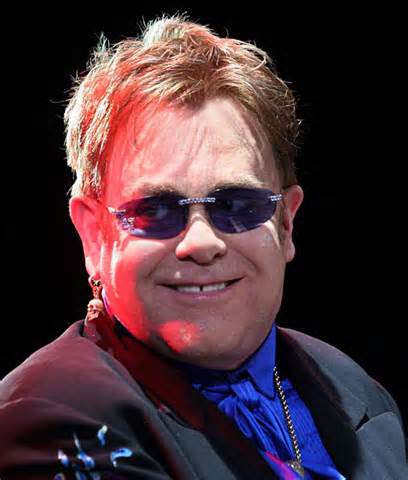
I suspect it’s been a while since Sir Elton sat on a roof picking off the moss…
And now we pay homage to great artists who lost the thread as we apply the timeworn Arthur Fonzarelli-inspired metaphor to pop and rock music icons and ask the question: exactly when did they “jump the shark”?
1. Elton John: “Don’t Go Breaking My Heart” (1976)
A perusal of Sir Elton’s chart history shows two distinct and dissimilar eras bordered by a somewhat gray area between. His early career is marked by essential albums and stone classic songs; by the 1980’s he’d lapsed into Adult Contemporary territory such as “Sad Songs Say So Much” and “I Guess That’s Why They Call it the Blues.” Quality pap, and popular songs, but pap nonetheless.
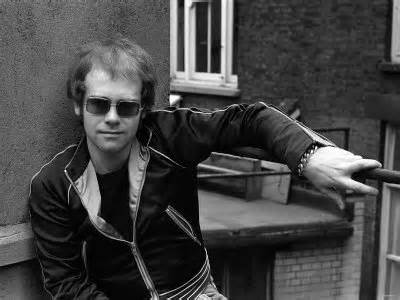
The Madman Across the Water
The gray area is the year 1976, just after the release of perhaps his last great single, “Someone Saved My Life Tonight” in 1975. The #1 “Island Girl”, certainly nothing to be ashamed of as pop hits go, followed next. Then he lost traction with the #14 “Grow Some Funk of Your Own” before pairing with Kiki Dee (known at the time as Kiki who?) for “Don’t Go Breaking My Heart”.

Just a madman
Now I’m not calling “Don’t Go Breaking My Heart” a bad song by any means. It’s undeniably catchy, and would have made for a fine 15 minutes of fame if recorded by a lightweight one-hit wonder. But shark-jumping criteria demands that we judge by the standard of what came before, just as Fonzie in a leather jacket and swimsuit must be compared with Fonzie in leather jacket, jeans, shades and slicked-back hair.

The guy singing with Pauline Matthews (a.k.a. Kiki Dee) had recorded “Rocket Man”, “Tiny Dancer” and “Goodbye Yellow Brick Road” just a few years prior.
After “Don’t Go Breaking My Heart” the legacy erosion continued with “Part-Time Love” and “Mama Can’t Buy You Love”, songs William Shatner would never have felt compelled to cover. And I don’t even need to mention Disney Elton, do I?
Again, nothing wrong with “Don’t Go Breaking My Heart” as a cheesy 70’s pop song (it’s no secret I like plenty of them) and I’m not the slightest bit bothered by the fact that it features a gay man promising his love to a woman–Johnny Mathis and George Michael sang “in character” too–but I do think the song was the clear harbinger of the musical tofu of John’s later career. A Tumbleweed Disconnection, if you will.
2. Neil Diamond: “You Don’t Bring Me Flowers” (with Barbra Streisand) (1978)

Young Neil even looks like early Fonz
Neil Diamond is in the Rock and Roll Hall of Fame. But Willie Mays is a Hall of Famer too, and did you happen to see the sad spectacle of his final years with the Mets?
The man who wrote “Solitary Man”, “Girl, You’ll be a Woman Soon” and, yes, “Sweet Caroline” was a bit of a badass. At least compared to the schlocky “Love On the Rocks” guy. And this duet with big-beaked songbird Streisand rather neatly divides the two eras of Neil’s great career.

After Diamond discovered the emotionally-unfulfilled housewife segment of his audience, it was on. “Love on the Rocks” and “Hello Again” followed soon after. And the hits kept coming for a while, even if the respect didn’t.
As an interesting sidebar, Neil Diamond’s real name is…Neil Diamond. Born with the perfect pop music name, he nearly decided to take the stage name Noah Kaminsky early in his career for reasons that could only have made sense to Neil–like the decision to duet with Barbra Streisand.
3. Chicago: “If You Leave Me Now” (1976)
If you want to make the argument that the loss of Terry Kath by a self-inflicted gunshot in 1978 was also the evisceration of a great band, I’m listening. Kath was, in every figurative sense of the word, the soul of the band.

But Kath was around for the recording of albums X and IX, and was therefore still present as the band began to veer off course. By this time, Kath was already a) being de-emphasized in the band’s sound, b) losing interest to some degree (he was working on a solo record and band members later said he would have been the first to leave the band) and/or c) unfocused due to heavy drinking.
So it wasn’t the death of Terry Kath that took a great band from us, it was more accurately Kath’s personal and musical decline which immediately preceded it.
All I know is “Another Rainy Day in New York City” , despite its faux-Jamaican vocals, sounds to my ears like the last really organic single the band released. “If You Leave Me Now”, which followed, and was from the same album, began the decline in respectability which is probably directly responsible for the length of time it took the band to be inducted into the Rock Hall.
There’s no doubting their credentials for induction based on their early albums: No rock band previous to Chicago boasted as many horn and woodwind players as fulltime members, nor brought horn charts into greater prominence in album rock. Not to mention the bold political statements they consistently made on their first three albums. These guys were (at least part-time) protest rockers. And songs like “Make Me Smile”, “Does Anybody Know What Time it Is” and “25 or 6 to 4” are classic rock, uh…classics.
Post-“If You Leave Me Now”, however, it was “Hard to Say I’m Sorry”, “Hard Habit to Break”, and “You’re the Inspiration”. Again, popular songs, and certainly part of the fabric of the 80’s pop tapestry. But also brimming with aromatic suck.