Luna Lee breathes new life into the classic rock of Hendrix, Led Zeppelin, Stevie Ray Vaughan and others by blending the modern with the traditional, and the western with the eastern. The results are dazzling. As she explains on her website:
The gayageum that I play is an ancient, traditional Korean instrument made for the purpose of playing traditional Korean music. My ancestors played the gayageum in a small room, so the sound did not need to be loud. But my music is performed with modern instruments such as the drums, bass and the guitar. So I had to redevelop my gayageum so that the sound would match that of the modern instrument. I had to increase the volume and pressure, develop tone and increase the sustain sound. And hoping to express the sound of gayageum more diversely like that of the guitar, I had to study guitar effectors and amplifiers and test them to see if they would fit to the sound of the gayageum. Playing modern music on a traditional instrument was not an easy process. I have come a long way from the beginning but still have a long way to go!
Most amazing of all is how she does it all without any trace of that ubiquitous rock guitarist painface that I assumed was necessary to hit those high notes…
The Explorers Club: “California’s Callin’ Ya” (2016)
Perhaps no band has paid more earnest homage to the Beach Boys than the Explorers Club. I mean, check out the cover of their 2008 debut Freedom Wind alongside its obvious point of reference, the Beach Boys’ All Summer Long.
And the cover art on their latest, Together, clearly seems to be a take on that of the Boys’ Friends LP:
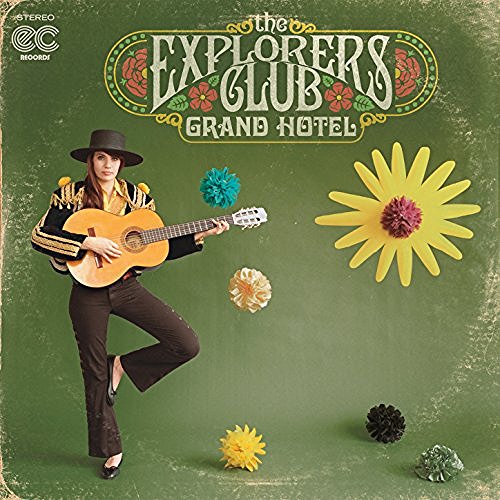
In between they released Grand Hotel in 2012, on which they actually commissioned Beach Boys engineer (and liner note writer extraordinaire) Mark Linnett to do the mixing.
Grand Hotel is the most diverse of their three releases. It’s like busting out your dad’s entire 60’s album collection in one swell foop (as my own dad used to say).
But interestingly, while Grand Hotel contains Beatles-era musical references aplenty, it seems everyone but the Fab Four are called back. And that’s ok–the Beatles have been paid tribute countless times. It’s far more fun to hear echoes of less ubiquitous 60’s artists such as the Association, Herb Alpert & the Tijuana Brass, the Grass Roots, the Cowsills, the Turtles, the Fortunes and others. Even 60’s lounge pop gets a reverential nod.
But Beach Boy harmonies are a staple of the Explorers Club sound, and on Together they’ve constructed an entire album around the songwriting style and sound textures of late 60’s/early 70’s Beach Boys music. Throughout the album, the Jason Brewer-led South Carolina band check one box after another: theremin, bass harmonica, flute, vibraphone and much more. The layered harmonies, the delightful key modulations–it’s all here.
“California’s Callin’ Ya” isn’t the most ambitious tune on the collection. But it’s perhaps the most appealingly melodic, and captures the southern California warmth that radiated from Brian Wilson’s most enduring work.
Note: A nice touch on Explorers Club CDs is the faux vinyl wear marks on the cover, ticking one more box for nostalgic fans of 60’s pop.
n May 9, 1964, Louis Armstrong’s recording of the title song from Hello, Dolly! became the best-selling single in America, leaping past the Beatles’ “Can’t Buy Me Love” and “Do You Want to Know a Secret?” to reach the top of Billboard’s pop chart. It would be the last jazz record, and the next-to-last show tune, to do so. When Armstrong’s “Hello, Dolly!” was replaced by Mary Wells’s “My Guy” a week later, an era—the one that has since come to be known as the “golden age” of American popular music—ended. Rock and roll, the preferred music of the baby boomers, thereafter supplanted golden-age popular song as the lingua franca of pop music in the U.S. and Europe.
Nothing stays popular forever, and by the ’90s, rock had in turn been supplanted by hip-hop as America’s top-selling pop-music genre. But the splintering of our common culture prevented hip-hop from developing into the new lingua franca. Instead, we now have many popular musics, none of which has anything remotely approaching the cultural dominance that was enjoyed by rock and roll for more than a quarter-century.
The surviving rock stars of the ’60s and ’70s are now in their own golden years, and their lives and work have become the subject of numerous biographies and journalistic histories. The latest, David Hepworth’s Never a Dull Moment: 1971, the Year that Rock Exploded, is a lively survey of the year that saw the release of such top-selling albums as Rod Stewart’s Every Picture Tells a Story, David Bowie’s Hunky Dory, Led Zeppelin IV, Harry Nilsson’s Nilsson Schmilsson, the Rolling Stones’ Sticky Fingers, Carole King’s Tapestry, and the Who’s Who’s Next.1 Hepworth, a veteran British rock journalist, contends that these albums constitute a “rock canon” that has proved to be of permanent artistic and cultural significance:
Many of the musicians who made those 1971 records are still playing today, in bigger venues than ever, in front of huge, multi-generational crowds made up of the children and even the grandchildren of their original fans . . . . These records are not just remarkably good and uniquely fresh; they have also enjoyed the benefit of being listened to more times than any recorded music in human history.


 Every Moment Has A Song