“Musicians’ musicians” the Empty Pockets have toured or performed as backing band for Al Stewart, Gary Wright, Richie Furay and Kenny Loggins among others.
But the Chicago band have topped the U.S. Billboard Blues chart twice in their own right, including with 2022’s Outside Spectrum.
The sound here is relatively stripped down, effects-free, and reliant on virtuosic performance, which the Pockets can cetrtainly deliver.
In the live performance below, they unassumingly demonstrate the commonality the song’s chord sequence shares with other better-known songs.
Toad the Wet Sprocket owes its band name to a couple Monty Python sketches featuring Eric Idle.
Quoting Wikipedia:
Toad the Wet Sprocket takes its name from a Monty Python comedy sketch called “Rock Notes”, in which a journalist delivers a nonsensical music news report:
Rex Stardust, lead electric triangle with Toad the Wet Sprocket, has had to have an elbow removed following their recent successful worldwide tour of Finland. Flamboyant ambidextrous Rex apparently fell off the back of a motorcycle. “Fell off the back of a motorcyclist, most likely,” quipped ace drummer Jumbo McClooney on hearing of the accident. Plans are already afoot for a major tour of Iceland.
There was also an extended skit about the fictional Toad the Wet Sprocket on one of Idle’s later shows, Rutland Weekend Television (Season 1, Episode 4, “Rutland Weekend Whistle Test”). RWT musician and regular cast member Neil Innes, ex-Bonzo Dog Doo-Dah Band and “The Seventh Python”, played keyboards with the fictional band.
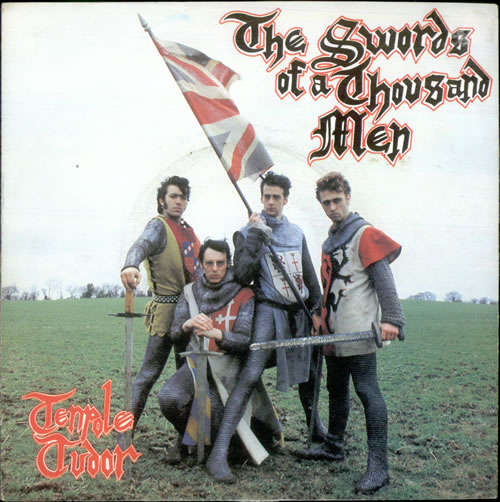
As their first gig approached, the band still had not chosen a name. The members facetiously adopted “Toad the Wet Sprocket” because they thought it would be “hilarious”. Vocalist Glen Phillips later called it “a joke that went on too long” and, according to their website, “it was probably meant to be temporary at the time.” The name had been used once before, by a short-lived British blues band of the late 1970s that had appeared on the 1980 Metal for Muthas compilation, although the earlier band had long since split up when Philips and company formed their band.
Eric Idle, the sketch’s original performer, reflected on the band’s name in a 1999 performance:
I once wrote a sketch about rock musicians, and I was trying to think of a name that would be so silly nobody would ever use it or dream it could ever be used. So I wrote the words “Toad the Wet Sprocket.” And a few years later, I was driving along the freeway in LA, and a song came on the radio, and the DJ said, “that was by Toad the Wet Sprocket,” and I nearly drove off the freeway.
Whatever the leanings of your playlist, Laufey’s bossa nova-inflected “Lover Girl” will leap off it as it did from the collection of rather mundane mainstream pop on which I first came across it.
Is the American pop music scene of 2025 broad enough to encompass an Icelandic-Chinese jazz-influenced cellist who sings like Peggy Lee?
Seems unlikely.
But if her accomplishments in her brief career’s span are any indication, Laufey (pronounced LAY-vay) isn’t someone to doubt or dismiss. To wit:
She was a cello soloist in the Iceland Symphony Orchestra at age 15.
She was a finalist on Iceland’s Got Talent in 2014.
Appearing on The Voice Iceland the following year, she was the youngest contestant in the history of that show.
She graduated from the Berklee College of Music in Boston.
(NME.com)
In 2020 her debut single “Street by Street” charted at number one in Iceland.
Her debut album Everything I know About Love led to a sold-out headlining North American tour.
Her second album Bewitched won the Best Traditional Pop Vocal Album Grammy Award in 2024.
In addition to her ability to render lushly arranged Chet Baker- and Billie Holiday-inspired jazz pop with a pitch-perfect, technically flawless voice; Laufey is effortlessly adept on cello, piano and guitar.
Her goals? “Bringing jazz back to my generation” and “doing for jazz music what Taylor Swift did for country music”.
Is it possible? Stay tuned. She’s not off to a bad start.
It’s hard to articulate what the Moody Blues have meant to me for the great majority of my life.
But on the occasion of the loss of singer/songwriter/bassist John Lodge, it seems like a good time to try.
Basically, since the day my older brother gave me a copy of the band’s 1971 album Every Good Boy Deserves Favour, no band or artist has been more important in my life.
So many things about the Moodies were different from anything I’d heard before.
The conceptual albums with each song fading into the next. The arty opening track, always a thing of musical ambition and lyrical profundity. The five songwriters, each capable of taking the lead vocals on his own material, giving each album a breadth of songwriting and vocals unmatched in rock.
That gorgeous, otherworldly vocal blend, with John Lodge’s falsetto on top:
To my young ears it was a revelation. The kind of music perfectly suited for the experience vinyl records allowed, and the best vinyl records demanded. I absorbed Moody Blues albums, one after another, total immersion style–often lying on my bedroom floor with headphones on, gatefold album cover spread in front of me, reading the lyric sheet, pondering the album cover art. Doing all the things that made it a richer experience than a kid today can get from a download or a stream.
This was a stream of another kind, on which I was swept away to “far away forgotten lands, where empires have turned back to sand”.
And always John Lodge’s stratospheric falsetto was on top. And always his bass was on the bottom. He supplied both the band’s angelic corona and its rock and roll bona fides.
Each writer in the band brought his own style. Flutist Ray Thomas was the most fanciful. Justin Hayward was the band’s lead romantic and also a songwriter’s songwriter. Graeme Edge was the poet. Mike Pinder represented the band’s social consciousness.
And Lodge? Lodge was somewhat enigmatic. To a greater degree than the others he had the heart of a rocker. On the other hand, he could compose songs of such beauty they rivaled even those of Hayward.
The song he wrote on the occasion of the birth of his daughter is as gorgeous and understated a lullaby as you’ll ever hear from (just) a singer in a rock and roll band. And John the rocker had the instinct to let cello and glockenspiel accompany his tender lyric:
My daughter Emily has her name because this song–“Emily’s Song”–conveys the tender feelings of a father for a daughter better than any I know.
It was appropriate that my introduction to my favorite band was Every Good Boy Deserves Favour, because the album cover conveys the essence of my relationship with that eldest brother, who not only turned me on to the Moody Blues but to many of my favorite artists and authors. Of course, at about 9 years old your senses are keen and your emotions come in a deluge.
Nevertheless nothing has affected me as powerfully in the fifty years since than the Moody Blues and J.R.R. Tolkien–both passed along to me by that brother, the one I lost too soon. The band and the fantasy author always seemed to link in my mind. In my imagination, one was a soundtrack for the other.
So when I read years later that the Moodies themselves were heavily influenced by the author of The Lord of the Rings it all made sense. Those “far away, forgotten lands” I imagined as I listened may have been the same ones they and I envisioned when reading Tolkien.
And oh by the way, my Emily’s middle name is Arwen.
With few exceptions, each songwriter in the Moody Blues sang lead vocals on his own songs. It’s always been a point of curiosity to me that Lodge handed “Candle of Life” over to Justin Hayward to sing. But in this case I think it was the right choice. And John’s voice is still–as always–discernable, especially in the plaintive bridge.
RIP John Lodge. You and your four mates provided–still provide–the most powerful, inspiring, awe-inducing listening experience this listener has ever known.
There’s so much more that should be said about the magic in the music, and I wish I had time to write more at length. We all wish we could take your advice to “burn slowly the candle of life”.
But it’s not that kind of world these days. The world is spinning faster, and the days spent lying on my bedroom floor, lost in the flood of beauty from the headphones, are a memory. I have to work in the morning.
But as long as we’re around, the music will be too.
Todd Rundgren recalled how John Lennon contacted him privately to end a public war of words that broke out in 1974.
The pair met during the ex-Beatle’s infamous “lost weekend,” a time when he was frequently drunk, stoned and out of control. It had been a disappointing experience for Rundgren, a massive fan.
“I met him at a party in the period he was drinking withHarry Nilsson and misbehaving all over Hollywood,” the guitarist and producer told the The Guardian in a recent interview…
Ah, Public Access TV–providing top-notch entertainment like Henrietta and Myrna who, as one commenter suggests, seem to have had a fight in the car on the way to the studio.
BUT at least there is no auto-tune and no lip-syncing in their performance, although karaoke accompaniment is used.
What these ladies lack in stage presence and singing ability and enthusiasm and fashion sense they make up for with their…with their…