From Leonard Cohen to Eva Cassidy, here’s how the audio experts at Sonus faber ensure the best sound for their line of speakers
(via Rolling Stone} by Tim Chan
WHEN PAOLO TEZZON puts his Sonus faberspeakers through the paces at the company’s headquarters in Italy, he has a very specific checklist of things he’s looking for, to make sure they’re sounding their best.
“There are many things I try to address any time I test a loudspeaker system,” Tezzon tells Rolling Stone, on a recent visit to the Vicenza factory where all Sonus faber audio systems are still designed and manufactured today. “First and most importantly, at least to me,” he says, “is the overall ‘tonal balance,’ meaning all the frequencies must be present and well-harmonized.”
“Sonus faber tailors the sound of our creations,” Tezzon explains, “so that our speakers will never sound artificial to human ears, but rather replicates natural sound as best as possible.”
Other things that can affect the way your speakers sound: “transparency,” a.k.a. “a speaker system’s ability to reveal every detail, down to the smallest ones, contained in the recording,” Tezzon says. To wit: during a listening session, Tezzo demonstrates how a speaker should reflect not just the main voice, but every background vocal and harmony too. Listening to a rock or jazz track? A good pair of speakers should let you hear the drum beat down to the distinction between hi-hats and snare…
How Robin Thicke, Pharrell, and T.I.’s cursed megahit predicted everything bad about the past decade in pop culture
(via Pitchfork) by Jayson Greene
“Blurred Lines” wasn’t supposed to be a meaningful song. It was, by design, a trifle: Pharrell, in imperial-superstar mode, goofing off with the white soul singer and textbook sex idiot Robin Thicke and tossing in a tongue-twisting T.I. verse later for good measure. It’s safe to assume that no one involved in the making of “Blurred Lines” assumed anything legacy-defining was happening in the room where Pharrell wrote the lines “I feel so lucky/You want to hug me/What rhymes with hug me?”
Now, 10 years since its March 2013 release, “Blurred Lines” is a poisonous time capsule. In many ways, all of them unfortunate, it could be considered the song of the 2010s. Pick any disheartening pop-cultural trend of the past decade and chances are it applies to “Blurred Lines”: The hollow outrage cycle in news, increasingly reliant on hot takes tossed out with superhuman speed, often without a speck of human logic? The predatory power dynamics of the entertainment industry, and American society’s ongoing dismissal of consent? The increasingly litigious pop landscape, in which lawyers and music publishers fight for scraps, and every pop song feels safely Xeroxed from the last one? Every decade gets the songs it needs and the songs it deserves…
(via Vintage Guitar Magazine) by Rich Kienzle from December 2008
Thomas Hoyt Bryant, known to family and friends as “Slim,” met Perry Bechtel in Atlanta 1929. “I heard your record, ‘Wabash Blues,’ and I want to play it just like that,” he declared. “I can teach you that in 30 minutes,” the older man responded. “But if you want to play ’em all like that, you gotta take lessons.” That conversation changed Slim Bryant’s life – and the nature of country guitar.
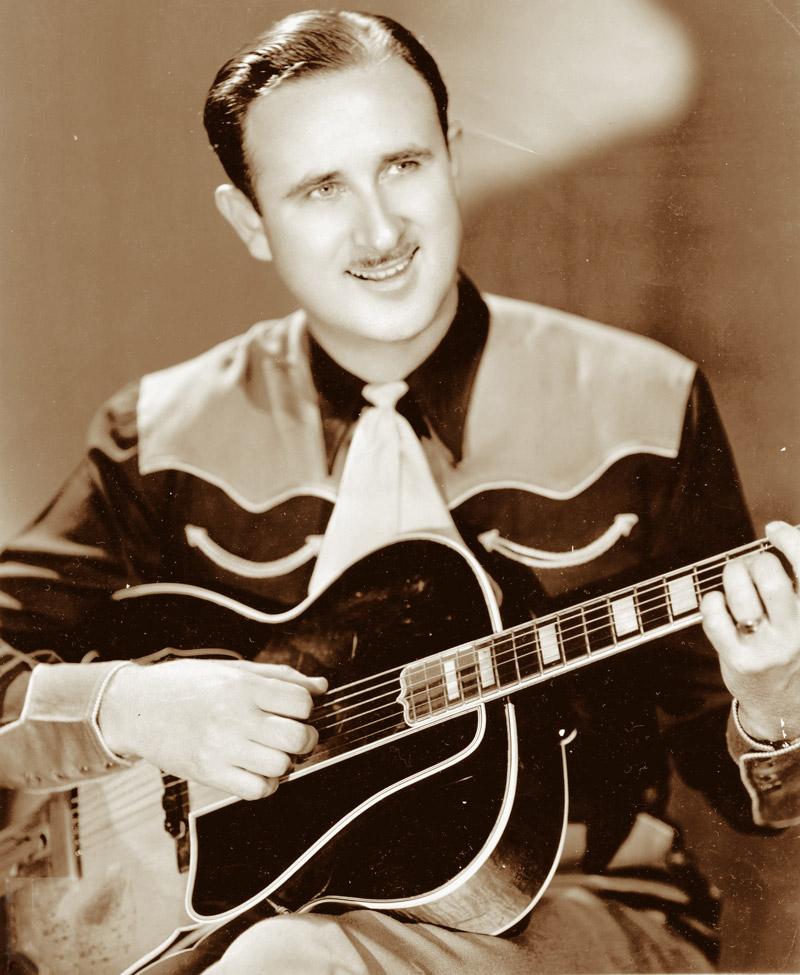
In December 7, 2008, Bryant will be 100. Widely credited as the first country guitarist to infuse jazz and pop harmonies into the music, he’s the last living link between pre-World-War-II country music and the 21st century. In a performing career lasting nearly 30 years, he worked with two country icons in fiddler Clayton McMichen and singer Jimmie Rodgers, father of modern country music. Later, leading his own band in Pittsburgh, Bryant made broadcast history and became a regional institution. When that ended, he left a lasting impact teaching guitar to generations of Pittsburghers into the 21st century. Residing in the modest home he bought nearly 60 years ago in the suburb of Dormont, he remains healthy and lucid, a result of physical and mental calisthenics – and a mother who lived to be 104!
Little about Bryant fits conventional wisdom about early country performers. A product of the “New South,” he was born in Atlanta, the eldest child of Posey Bryant, an electrician who enjoyed old-time fiddling. Posey’s wife, Auroria, wrote poetry and played guitar in the formal parlor style popular in the late 19th century. “She sang and played (songs like), ‘In the Baggage Coach Ahead,’ a little bit of ‘Spanish Fandango’,” he says. Jim Scott, a black man who delivered ice to their home, also impressed Slim when he’d take a break, play Auroria’s guitar and, according to Slim, sing “whatever came into this head.”
Slim worked out his first guitar chords himself. “I got them from listening to records. We didn’t have a record player,” he says. “But the people across the street did.
After graduating high school in 1926, he seemed destined to follow his dad into an electrical career, working as an estimator for the Georgia Electric Company and spending his nights studying electrical engineering at Georgia Tech, all the while absorbing music through records and the rising medium of radio. Nick Lucas, the singer and guitarist known for the original hit recording of “Tip Toe Through The Tulips,” became his first guitar hero. Seeing him perform in Atlanta, playing a steel-string Gibson revealed to Bryant the full potential of the guitar. “I never heard anybody who could sing and then play a chorus,” he declares. “I liked his playing when he played a solo. It wasn’t real complicated or anything, but it was first.” His second hero is less surprising. “For one-string stuff, I loved Eddie Lang. He was great. Too bad he died at such a young age, but he had a great influence on me. I learned his jazz tunes and played ’em on the radio. Of course, there were other people, but those two were the basic guys I was influenced by.”
Atlanta became the birthplace of commercial recorded country music after local fiddler John Carson performed on WSB Radio and recorded “Little Old Log Cabin in The Lane” in 1923. Soon, a younger giant of old-time fiddling emerged – Clayton McMichen. Born in 1900, McMichen, nicknamed “The North Georgia Wildcat,” grew up in Atlanta and joined the recording “supergroup” Gid Tanner and the Skillet Lickers, which included another pioneer country guitarist, Riley Puckett. While the group’s strong record sales boosted McMichen’s stature, he preferred playing pop and jazz with his other band, McMichen’s Melody Men. Slim, too, played in a local string band. “McMichen’s cousin, Elmer, and I and a boy by the name of Hoyt Newton and a banjo player by the name of Woods. We learned from each other. I got a book of chords and learned to play.” His first guitar, best he remembers, was a mahogany-bodied Martin Style 17 – the company’s first steel-string model. “I bought it at the Cable Piano Company for 30-odd dollars and paid (so much) a week on it. Perry Bechtel sold it to me. He was the salesman at Cable Piano.”
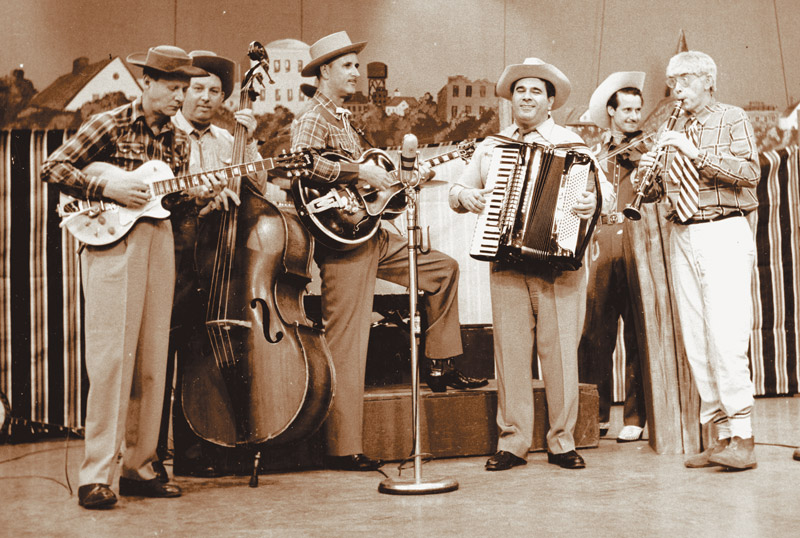
From the KDKA TV “Country Fair” TV show in the mid/late 1950s, with KDKA announcer/disc jockey/local jazz musician Sterling Yates sitting in on clarinet. Jerry Wallace is using his Les Paul goldtop with a Bigsby vibrato tailpiece.


 Every Moment Has A Song