"There's a time in life for Hoagy Carmichael. There's a time in life for Claude Debussy. There's a time in life for Jerry Lee Lewis. There's a time in life for Destiny's Child. All these things have their moment." ~Elvis Costello
McCartney was on the Oprah show in 1997. She seemed as much in awe of him as any fan. On her next show she talked about what kind of guest he’d been. She said something like: I have a lot of stars on my show, but nobody is bigger than Paul McCartney. Many of the stars are very demanding, wanting special things in their dressing rooms, champagne, wine, etc. Usually my staff handles their requests but I did it myself for Paul. I asked if there was anything special he wanted in his dressing room and he said he’d appreciate some bottled water, if it wasn’t too much trouble.
Then I asked him what he’d like to eat, as we could cater from anywhere in the city. He said he saw a buffet being set up in the back. I told him that was for the staff and camera crew. He asked if it would be OK for him to eat from that. No guest ever asked to dine with the staff before.
Despite their having won four Grammy awards, eight Latin Grammy awards and being the most successful Latin band of all time, Maná aren’t a household name to most Americans.
The affecting ballad “Cachito” (“A Bit”) is from ¿Dónde Jugarán Los Niños?, an album that sold over ten million copies worldwide and became the best-selling Spanish-language rock album of all time.
The lyrics:
Tan solo un adicto Un adicto de tu Sol Y es que con solo un cachito Un pedacito de tu luz Yo llegaría al cielo O me caería al suelo Por ti amor
Tan solo Un cachito de tu corazón Un cachito de tu corazón Un cachito de tu corazón Soy un adicto de tu corazón
Pedirle a mi cabeza Que deje de pensar en tí Es casi como pedirle A mi corazón que deje de latir Mas bien olvida eso No no repitas eso, te pido amor
Tan solo Un cachito de tu corazón Un cachito de tu corazón Un cachito de tu corazón Soy un adicto de tu corazón
Chiquitita de mi corazón Chiquitita de mi corazón Chiquitita de mi corazón Chiquitita de mi corazón
English translation:
Just an addict An addict of your Sun
And the fact is that With just a little bit A little piece of your light
I’d get to heaven Or I’d fall to the ground For you love
Oh, no
Just a little piece of your heart (ay-ay-ay, eoh) An addict of your heart (oh-oh-eoh) A little piece of your heart (ay-ay-ay, eoh) I’m addicted to your heart
Ask my head Stop thinking about you (you) It’s almost like asking To my heart to stop beating (beating)
Rather forget that Don’t repeat that I ask you, love
Just a little piece of your heart (ay-ay-ay, eoh) An addict of your heart (oh-oh-eoh) A little piece of your heart (ay-ay-ay, eoh) I’m addicted to your heart
Little girl in my heart Little girl in my heart Little girl in my heart Little girl in my heart
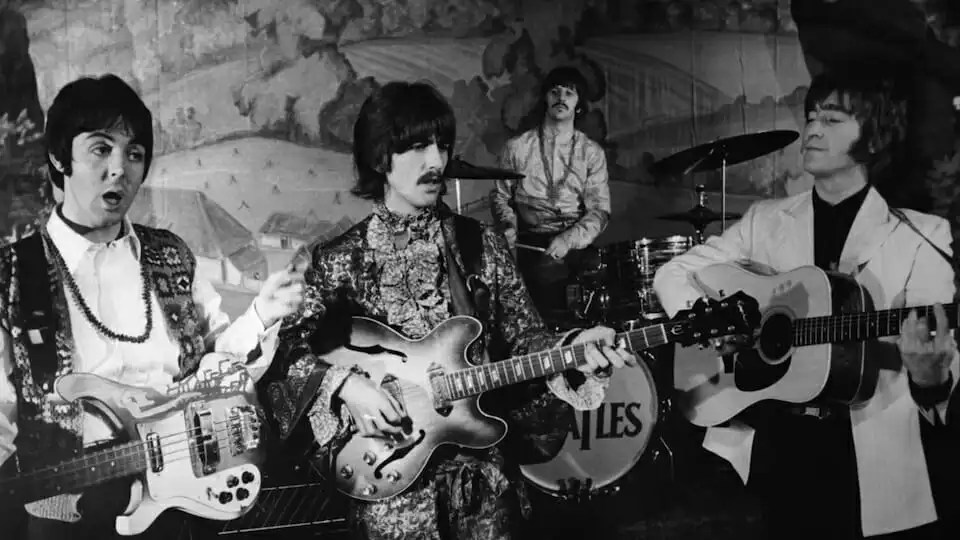
An often underappreciated element of the Beatles’ songwriting is their seemingly effortless ability to craft a truly memorable ‘intro.’ The art of writing a timeless song opening is a masterful skill. The Fab Four were particularly expert in doing so throughout their eight years together.
The band’s finest introductions are typically iconic in their own right, innovative for their time, and often acts of musical genius in and of themselves. Here are nine of the best intros by the Fab Four.
I Saw Her Standing There (1963)
One of the most simplistic yet impactful Beatles intros appears immediately on track one of their debut album Please Please Me.
Paul McCartney’s sharp and purposeful count of “One, Two, Three, Four!” injects raw energy into this relentless rock and roll classic.
The bouncing bassline and clanking guitar work are pure magic, perfectly setting the scene for the rest of the band’s first LP and also their formative years.
A Hard Day’s Night (1964)
“A Hard Day’s Night’s” intro is all about a single sound. This title track from the Beatles’ third album opens with a very distinctive note, created using a combination of twelve-string electric guitar, an acoustic six-string, bass, and piano. Strummed aggressively and left to ring out, the exact chord has become the subject of much speculation over the years.
“It is F with a G on top,” George Harrison would finally confirm in 2001. “But you’ll have to ask Paul about the bass note to get the proper story.”