When you think about it, a lot of hugely successful pop and rock acts actually have a very short heyday. In the 60’s the Mamas & the Papas charted all their top 20 hits over a period of about a year and a half. Ditto the Lovin’ Spoonful. The top 20 window for Creedence was less than three years.
The same held true in the 70’s. Most of Steve Miller’s greatest songs came from two albums, Fly Like an Eagle and Book of Dreams. All of Elton John’s great albums came between 1971-73, unless you’re going to argue for Caribou‘s classic status. Carole King? Tapestry.
Kansas was no exception. The Leftoverture album in 1976 propelled them into the realm of arena headliners. Then they eclipsed it with the next year’s Point of Know Return, an album that was among the decade’s finest and, as it turns out, the best the band was capable of creating.
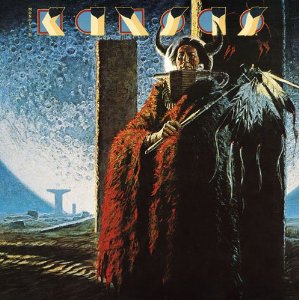
Following it up was probably a little like trying to follow up Boston or Frampton Comes Alive. Predictably, Kansas put out a very respectable album with 1979’s Monolith and, predictably, it was called a disappointment.
If songwriter Kerry Livgren’s lyrics are any indication (and they always are–he writes more autobiographically than most) ’79 finds him already beginning to ask himself ‘is that all there is?’. This song sounds like a thematic companion to 1982’s “Play the Game Tonight”, with Livgren questioning the meaning of rock star life in the bigger scheme of things. The bigger scheme in question was a spiritual search that eventually led him to leave the band to make Christian music.
But while he pulled off the balancing act of pondering the big questions while making gold and platinum records, Livgren created some of the best progressive rock songs of the era (see: ‘The Wall’, ‘Carry On Wayward Son’, ‘Dust in the Wind’, ‘Sparks of the Tempest’, ‘Portrait’).
…and note your response. I happen to believe “I Can Only Imagine” by MercyMe, a massive Christian pop hit by the way, is one of the most polarizing songs ever in the history of polarizing songs. Some feel it is a beautiful, inspiring, thought-provoking piece of praise music, worthy even of inclusion in Christian liturgy.
I think listening to this song is what death by stoning must feel like.
Musically, it’s more mantra than melody. Lyrically, well…I have a problem with being bludgeoned by one four-word phrase twenty (count ’em yourself) times in four minutes. This song feels like an indecent assault on my musical sensibilities, and assault isn’t a very Christian thing to do.
So is there so-called “Christian Rock” out there that is of significantly higher quality than pap like this? Beats me–I don’t listen. But there’s a little chicken-and-egg caveat to that statement: I don’t know if there’s better because I don’t listen to “Christian Rock”. But I don’t listen to “Christian Rock” because what little I have heard is, musically, an insult to someone who demands a little creativity and imagination in whatever music they listen to.
And I’m not willing to sacrifice that for weak songs with a Christian message. In other words: being a Christian, I’m willing to give any sacred music the same chance as any other kind of music. But–I’m sorry–it has to meet me on my terms. If it’s truly creative–if it truly inspires me somehow, I’m in.
If it’s MercyMe, I feel like I’m looking at the stained-glass windows from the wrong side.
I’m not going to go in the direction here of saying there’s more religion in a Marvin Gaye song than any church hymn or whatever. That’s BS and we both know it; besides, the truth is I’m a churchgoer who wishes he could find more music that truly does inspire and bring me closer to my creator.
On the other hand, any extraordinarily beautiful music, or voice, or performance…and any song which shows wondrous talent or insight into the nature of life and isn’t needlessly depraved or cynical can inspire me, can bring me to see a little more of my God.
Yes, I know about Creed. They sound like the Nickelback of Christian Rock to me. Not buying it. I share the opinion of the reviewer on Amazon.com who commented: “Warning!! If you listen to this CD backward, you’ll hear Satanic messages. Even worse, if you play it forward, you’ll hear Creed.”
No, I don’t think there’s much good “Christian Rock” out there, or at least I haven’t heard evidence of it. But what I do occasionally discover is openly Christian artists who make rock and pop that isn’t insulting to someone of reasonably discerning musical taste (not a catchy genre name, I realize). So I’ll name some names, just in the interest of evangelization…
Kansas. Yeah, midwest America Prog rock, “Dust in the Wind” Kansas. I realize I’m talking about oldies here, but if you only listen to “praise music” go back to Leftoverture and Point of Know Return and it’ll be new to you as you listen like the deaf man whose ears have been touched by…Kerry Livgren.
Kerry actually left Kansas to make Christian rock. But he had already been doing so within the band, only in clever, covert fashion.
When you’re in a platinum-selling arena rock outfit and you feel the need to write about your search for Christian truth, you have to make platinum-selling Christian rock–you just can’t call it that. Kerry Livgren was a great songwriter who happened to be a devout Christian, not a devout Christian who happened to be a songwriter. “Stealth Christian rock”, Kansas-style, sounds like this:
“The Wall”:
“Carry On Wayward Son”:
“Hold On”:
Much of Livgren’s writing with Kansas was artful and ambiguous enough to fool the part of his audience who would have preferred not to think they were listening to rock with a Christian message. “Hold On”, for example, sounds like a common power ballad, but was actually written by Livgren to his wife “as a plea for her to come to Christ”. It was also a Top 40 single. And if I may say so, one big difference between “Hold On” and “I Can Only Imagine” is a monster arena rock hook for a chorus–the kind that can make you shout along in your car, and maybe even bring you to tears.
David Wilcox. This mostly-acoustic, folk singer-songwriter has a rare lyrical gift, as well as the type of guitar virtuosity that has landed him on the cover of guitarist magazines. His writing has grown more overtly Christian seemingly with each album, but without sacrificing his lyrical edge and a truly superior gift for metaphor:
“Show the Way”:
“Farthest Shore”:
“Metaphorical Reasons”:
Flying Colors. This band’s brand-new debut album was reviewed on this site just a week ago (see: Recommended Albums #13). Kerry Livgren almost became a member of the band, and he’d have fit perfectly: Flying Colors makes the kind of uplifting, positive-message “stealth Christian rock” Kansas made years ago, with a pinch less of the 70’s Prog grandeur and profundity. This is Christian rock for people who hate Christian rock:
“The Storm”:
“Better Than Walking”:
“Everything Changes”:
Strawbs. This British Folk-Prog band whose popularity peaked in the 70’s can’t be adequately described (or lauded) in a paragraph. But Christian themes certainly permeated their music, and more uncompromisingly so than any of the aforementioned artists. Though the voice of David Cousins may be something of an acquired taste to some (and to others it will remain unacquired), his expressive and compelling songwriting is simply a treasure. Strawbs still attract enough religiously devoted admirers to tour both as an acoustic trio and as a full electric band across several continents. They’re truly one of Prog rock’s (and pseudo-Christian rock’s) best-kept secrets. The anthemic “Lay Down”, based loosely on the 23rd psalm, is the kind of song that would certainly inspire me in a liturgical setting!


 Every Moment Has A Song