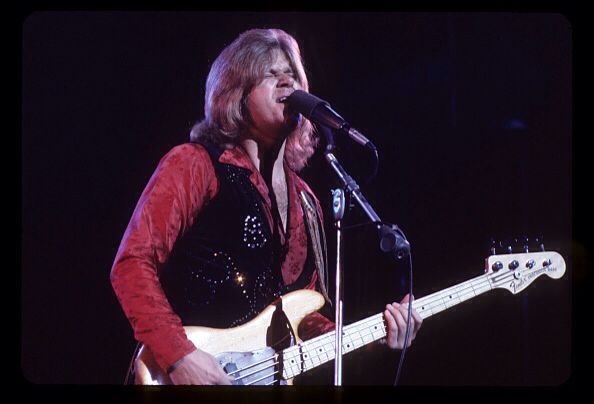
Quora: Why did Peter Cetera refuse to associate with the band Chicago after he left including the induction into the Rock and Roll Hall of Fame?

(Answered by Adam Begun)

In Peter’s own words: “when it’s over, its over”.

Pete didn’t leave with a polite handshake and a “best to you all” attitude. He left with a “thank f*cking God I don’t ever have to do THIS/THAT again” attitude.

As for the R&RHOF: he was approached by the band to sing “25 or 6 to 4” for the group’s performance that evening. The song is in the key of A minor and has been played that way since it’s inception and the horn parts are (virtually) cemented in place in A minor. Pete wanted to change the key to E minor…deliberately…knowing that would be impossible for the horns to cope…and the band said: “no”. Pete shrugged and said: “ok, then…no”. The rest of the group said: “fine, then…it’s a shame, but I guess it’s not to be…”.

(For the record: you can’t “just” transpose a brass section down a fourth without major, MAJOR musical issues.

Pete might as well have said: “I’ll do it if you guys can swim fast in quicksand….no, faster than that…”)

Peter drew up his own terms to play in the R&RHOF induction and chose not to even show up when his “demand” couldn’t be met.

This really does show Cetera’s utter contempt for Chicago and his indifference to his time in the group…

…even if he wouldn’t perform he could have been in the audience cheering on his old group for finally getting the respect that they deserve.

Whatever. It’s (very) over by now and a reunion is completely impossible.
Songs You May Have Missed #161

chi

Chicago: “Brand New Love Affair, Part I &II” (1975)

When Chicago, and the world, lost Terry Kath in 1978 due to an unintentional self-inflicted gunshot wound, they not only lost a most formidable and innovative lead guitarist (supposedly Hendrix called him the best he’d ever seen) but also the most soulful singer in the band. Without his gutbucket delivery to offset the sweeter vocals of the Robert Lamms and Peter Ceteras of the band, it quickly became a blander affair in his absence, and the downward slide (“If You Leave Me Now”, “Baby, What a Big Surprise”, “Hard to Say I’m Sorry”, “You’re the Inspiration”…) began.

The contrast between Kath and Cetera, though, made for great chemistry in the songs they shared the lead on. “Brand New Love Affair” was one such example, as was 1972’s “Dialogue”, in which Kath’s growl perfectly suits the pessimism in his lines, while Cetera’s sweet, high-register croon matches the sunny optimism of his character in the song:

If further irrefutable proof is needed of what the loss of Kath did to neuter a great band, watch the first four minutes or so of the long version of “Make Me Smile” with him (make sure you catch Kath cutting loose with his solo):

…and at least the first three-and-a half or so of the same song performed by a latter-day incarnation of the band:

https://www.youtube.com/watch?v=Yc_xD0dZG-w&feature=related

’nuff said.

See also: https://edcyphers.com/2013/01/24/songs-you-may-have-missed-301/

See also: Songs You May Have Missed #700 | Every Moment Has A Song (edcyphers.com)