Reprinted–nay, stolen from the band’s website whole cloth, out of fear it will be taken down there. (Hopefully they won’t force it to be taken down here. This is Dan Fan gold.)
In the 90s, Andy Mckay of ABC/Dunhill Records asked Donald and Walter if they’d write liner notes for a reissue of the their Dunhill albums. The notes appeared in sequence on each album as it was released. They are now collected here:
THE ORIGINAL ABC/DUNHILL REISSUE NOTES by Walter Becker & Donald Fagen
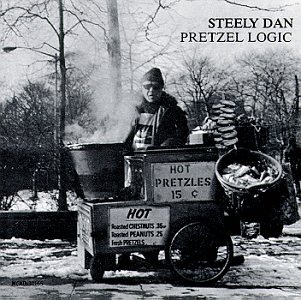
PRETZEL LOGIC
Comfort to the soul Inspiration to the senses Sustenance from one moment to the next These are the morsels we all crave –
Takashimaya Catalogue, Volume 6
Hey Andy – We’ve been working on the liner notes for the new reissues and we were wondering: What is the new series going to be called? Steely Dan Millennium Reissue Series? How about a sticker that reads: Special Repackaging for the New Romantic Generation? Or maybe the best thing to do would be to rename the tunes and the albums and reissue them as new product.
Because, let’s face it, they still sound pretty fresh, we were years and years ahead of our time (you said so yourself) and it’s not getting any easier to write and record these suckers, you know, in this, the post-postmodern era, when the average third grader is a bigger wiseass than we ever were. If you like this idea, let us know and we’ll start working on the changes immediately. As it happens, we’re years and years behind our time in royalties, so the advances would come in handy.
“Cross Collateralization”: This was not one of the terms we had mastered as we lurched down Laurel Canyon in Gary Katz’s Buick on our way to work back in ’72.
Not that Gary himself was unaware of the concept back then. Indeed, he had scrupulously avoided it, as witnessed by the fact that he was now, in 1973, driving not a humble Buick but a swank tomato-red Mercedes Benz roadster. At the time, Messrs. Becker and Fagen, whose publishing and recording deals were cross collateralized to a fair-thee-well, having been issued valid California driver’s licenses, were respectively driving a 1966 Chevelle and a late model Mazda RX-7 econo-sport-sedan with a fuel-gobbling Wankel rotary engine. It’s not that we were completely ignorant of sophisticated politico-economic concepts. We had, unfortunately for us, heard of democracy, and also socialism, and had organized the financial structure of the fledgling Steely Dan organization along the lines of the European-style social democracy we so admired.
Our aspiration toward socioeconomic justice was overdetermined as much by the heady egalitarian 60s zeitgeist as by some fierce internal Robespierre who demanded that we share the wealth, such as it was, equally with our fellow musicians. This utopian economic scheme, in stark contrast to the harsh despotism to which we subjected our bandmates in the province of aesthetics, promoted a feeling of fellowship and community. This pecuniary benevolence, in conjunction with the oppressive contract we’d struck with our corporate masters at ABC/Dunhill (not to mention the shamelessly colluding legion of middle men – personal manager, business manager, lawyer, agent – that we’d been forced to retain) had, as yet, produced uniform poverty. When, in 1974, we took on teenage session ace Jeff Porcaro as a second drummer, he became, at a cool $400 a week, the highest paid player in the outfit. The rest of us had to get by on a pittance.
By the time we were ready to start work on our third album, we were no longer the enthusiastic amateurs of the Can’t Buy A Thrill period, champing at the bit to get in the studio and record. Nor were we the shell-shocked road warriors of the Countdown sessions, shepherding our little troop through the jazz-rock underbrush. Rather, we had settled into a comfortable, frankly schizotypal songwriting groove. Fortunately, the vestiges of these same isolating tendencies and not a little gallows humor served to protect us from the relentless, soul-flattening sunny clime, the jive robo-culture in which we now found ourselves. We had our songs, some dandy axes, cool girlfriends, the shiny new drivers’ licenses, plenty of 24-track studio time and a warm place to compose. In other words, Miles was in his heaven and all was right with the world.
“Oh Lord, give me a bastard with talent…” Morris Levy
For us, there were no grander epithet in the English language than “session player” (“skin like milk” and “flavor-straw” were close runners-up). We often reminisced about our early session experiences in New York, especially the dates we played for our college chum Terence Boylan, who had somehow scored a miracle recording contract with Columbia Records. It was in the fabled studios of midtown Manhattan – A&R, ODO, Mayfair, Jerry Ragovoy’s Hit Factory – that we got to play with such icons as the legendary (if somewhat dyspeptic) drummer Herb Lovell, who showed us what professional musicianship was all about. Pianist Paul Griffin, bassists Chuck Rainey and Harvey Brooks, guitarist Hugh McCracken, drummer Bernard “Pretty” Purdie – these were names that were mentioned in hushed and reverent tones. Observing a session at ABC’s little in-house studio, we were mightily impressed by the awesomely steady pulse, the soulful forward motion of studio drummer Jim Gordon, even though the vanilla Dunhill staff producers had him playing the most moronic bubblegum music imaginable.
And, to be sure, during the making of our first two albums, we had on numerous occasions taken the liberty of bringing in a ringer when we felt we needed one. Naturally, there had been some resistance expressed by our bandmates to the notion that the earnest labors of one of our own faithful musketeers could be equaled or even bettered by the efforts of a mere hireling. But the pharaoh’s heart was hard, and feeling as we did that the facts spoke for themselves (Elliot Randall on Reelin, Victor Feldman on Do It Again, etc.), we could not be moved. Plus, there was the precedent of groups such as the Byrds or the Beach Boys or even the Beatles, who (we had heard) mercilessly replaced band members with session aces, and in doing so obtained outstanding results – not to mention the scrupulous meritocracy enforced by the rigorous past masters of the swing era and beyond.
Thus we hear the dynamic double-drum artistry of Jim Gordon and Jeff Porcaro on Parker’s Band, Michael Omartian’s crystalline piano on Rikki, Chuck Rainey’s sweet soulful bass on Any Major Dude, Dean Parks’ plangent banjo on East St. Louis Toodle-oo (and let’s not forget Victor Feldman’s plangent flapamba, also on Rikki), and so on. Once the neural floodgates had been opened to the possibilities of recording with any and all of our favorite studio cats, there was no turning back.
Reprinted–nay, stolen from the band’s website whole cloth, out of fear it will be taken down there. (Hopefully they won’t force it to be taken down here. This is Dan Fan gold.)
In the 90s, Andy Mckay of ABC/Dunhill Records asked Donald and Walter if they’d write liner notes for a reissue of the their Dunhill albums. The notes appeared in sequence on each album as it was released. They are now collected here:
THE ORIGINAL ABC/DUNHILL REISSUE NOTES by Walter Becker & Donald Fagen
COUNTDOWN TO ECSTASY
Thought + Feeling = Action – Dr. Eric G. Page
And how. Countdown to Ecstasy is unique amongst the Steely Dan albums in that it’s the only one written and arranged for a working ensemble. For this reason, the arrangements were influenced for the better by the known instrumental textures and musical personalities of the band itself, and for the worse by the raw horror and prolonged ennui of the odious weekend outings forced on us by our new manager (a schmendrick foisted on us by the record company) during the very recording process itself.
So, for example, the period charm of Jeff Baxter’s cunning Echoplex work was somewhat offset by the damage done to his amplifier (and nervous system) from last weekend’s debacle in, say, Tucson, or maybe Seattle, where we opened for the James Gang (Joe Walsh had already left the group and been replaced by our old NYC session mate Dom Troiano). As was typical in those days, we were blasted off the stage by a more practiced, experienced band, e.g, the Beach Boys, Frank Zappa, the Doobie Brothers, Elton John, Rare Earth, Chuck Berry (yes, even old, apathetic Chuck), Cheech and Chong and the Kinks, just to name a few (actually, the Kinks were so shitfaced that they weren’t that much of a threat).
In any case, the pleasing stretched-out quality of some of the charts was diminished by the fact that the lyrics were not written until the last moment, and then by a songwriting duo who were now certain that a steroidal Hellhound was on their trail. The public humiliation we were subjected to as a result of some of our appearances during this period – let’s say most or even all of our appearances in those days – while in the long run perhaps a powerful character-building element in the young lives of the authors – proved in the short term disruptive and generally detrimental to the creative process. Even our all-too-infrequent rounds of Percodan Scrabble™were increasingly useless in dispelling the unrelieved existential angst that surrounded our little excursions and the days and nights of shame and terror which preceded and followed them.
Nor was there any solace in the realization that our bandmates were having the time of their lives, up to their necks in weed, alcohol and “poozle”, as they called it. It’s a pity that there’s no textual sign available to us now which would be the equivalent of that plangent sound which Harvey Keitel made towards the end of The Bad Lieutenant – because that, o loyal fandom, would go a long way towards clueing you in on how we felt about touring in that long, heinous year.
Nonetheless, the recording process was not completely unrewarding. In truth, there’s a substantial body of opinion that would rank Countdown as one of our best albums. Generally speaking, the type of person who typically holds this position is not the sort of individual you want sitting across the table from you at a dinner party, especially one where hard liquor is being served. Nor would you be well advised to give one of these guys your email address or (gasp) your phone number. Should it happen that such a fan gets a hold of your street address or place of employment, caution would dictate that you inform the police, pronto, before the situation deteriorates any further. You get the general idea.
Having established that the Countdown album is not without its admirers, perhaps we should spend a few moments wondering why. Well do we recall our chagrin during the mastering sessions, when listening to the introductory drum beats on Bodhisattva. Mastering engineer Doug Sax certainly noticed, as we did, that, about halfway through, there was a slight, unwanted ritard. Did he not concur with us that the reverse tape echo effect in King of the World was a questionable idea, imperfectly executed? And what about that drum loop we used for Show Biz Kids? Was that the stroke of genius we originally thought it was, or just another regrettable miscalculation?
As a matter of fact, the loop itself was quite a tricky bit of business to put into practice. We were using four inch tape in those days running at 180 ips, and to make a thirty-two bar loop at that tempo required the construction of a special apparatus to accommodate the 1200-plus feet of tape which ran from one end of Studio A to the other, out the fucking door, into the hall, through the door of Ed Michel’s space-jazz production headquarters and back out into the entrance area where Spooky, our favorite receptionist, was ordering grilled cheese and bacon sandwiches for the gang.
Alright, actually two inch tape, 30 ips, four bars, 30 feet, out into the hall and back, that’s all. These notes are meant to be of a certain length, and we were encouraged to give the whole thing a folksy, mythic strain. Nevertheless, the loop still took a bit of doing.
One miserable weekend, we were forced to leave town for a gig in Phoenix where we’d been booked into some sort of outdoor venue at an amusement park which featured a huge saltwater pool with hydraulically generated waves. With the ambient temperature hovering at about 116 degrees, some band members undertook enthusiastic but misguided attempts to stay hydrated in these harsh conditions by imbibing large quantities of the local beer.
These factors and the Carnival of Souls-like quality of the gig itself conspired to produce a bizarre and dissatisfying performance, marked by some unintentional quarter-tone tuning effects as well as other anomalies. The upshot of this core-rattling experience was that the six-man configuration inaugurated towards the end of the recording of Can’t Buy A Thrill was deemed obsolete: the band reverted to its original five man lineup, with Dave Palmer departing for greener pastures without having sung a note on the actual Countdown recording.
Towards the end of the project, we were working on the intro theme of a tune, The Boston Rag. No matter how many times we punched in on the only available track, the same three notes of Denny’s guitar line would not record.. Finally, Roger made a spiffy little window edit (look it up), and we were able to punch in the missing notes. Curiosity (and a perverse sense of fun) demanded that we send the little piece of defective tape back to 3M for analysis.
Months later, they sent us their report. The piece of tape had a tiny blister where the oxide had bubbled up from the backing. Inside this little blister was a drop of dried mustard. Obviously, some ass-crack minion up in Minnesota had taken his disgusting hoagie or whatever into the room where the huge sheets of mylar were coated with oxide and dribbled a tiny drop of yellow mustard onto the mylar on the exact spot where we were going to put Denny’s guitar part. In effect, our efforts had been sabotaged in advance by a careless employee. This sort of thing was to haunt us over and over in the years to come.
Listening back to Countdown now (something we haven’t actually done ourselves), who could know that the track Razor Boy originally had a reggae-ish drum part that was replaced after all the other stuff was almost done? Or that Denny’s meticulous all-night-long mix of King of the World had to be scrapped because it was “too perfect”? Or that several figures were added to Dotty White’s original cover painting at the insistence of Dunhill’s cheroot-huffing president Jay Lasker, who found the discrepancy between five band members and three figures on the cover unacceptable?
When the album was finally completed and mastered, a playback was arranged for the executives and promotion staff. The idea was to get everybody excited about the new “product” and send the radio guys running out into the streets foaming at the mouths. Folding chairs were set up in the little studio upstairs and the big boys filed in, Hawaiian shirts, cigars and all. They listened in silence to the playback and at the end offered up some tepid congratulations. The confusion and disappointment that filled the room was as thick as a horny mother. Coming on the heels of a commercially successful first album, the company had been hoping for a second album blockbuster that would zoom to the top of the charts and stay there for weeks, months, years. Instead they found themselves with what must have sounded to them like some sort of strange, neo-Weimar art music, or worse. Later, when they found out that we’d fired our suave Daltryesque lead singer, stolen the proofs for the album cover during the dispute over the final layout and perversely insisted on choosing a tune that had a lyric containing the F-word as our choice for a “single” – this was a major taboo at the time – they were not really surprised. They’d seen this kind of spitework before. We were forced to edit out the offending line, leaving the setup line intact – a third-rate joke without a punchline.
Reprinted–nay, stolen from the band’s website whole cloth, out of fear it will be taken down there. (Hopefully they won’t force it to be taken down here. This is Dan Fan gold.)
In the 90s, Andy Mckay of ABC/Dunhill Records asked Donald and Walter if they’d write liner notes for a reissue of the their Dunhill albums. The notes appeared in sequence on each album as it was released. They are now collected here:
THE ORIGINAL ABC/DUNHILL REISSUE NOTES by Walter Becker & Donald Fagen
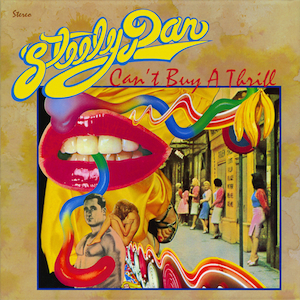
CAN’T BUY A THRILL
“Hebbel, in a surprising entry in his diary, asks what takes away ‘life’s magic in later years. It is because, in all the brightly colored contoured marionettes, we see the revolving cylinder that sets them in motion and, because for this very reason, a captivating variety of life is reduced to wooden monotony.’”
So says Ted Adorno, and in spite of the indisputable veracity of this dire pronouncement, or perhaps because of it, neither one of us is able to remember exactly what we were doing when the long-awaited phone call from Los Angeles finally came.
DF: Who did he call first? You or me?
WB: You mean Gary?
DF: Who else?
WB: Maybe we were together when the call came…
DF: Working on a song?
WB: Possible. So, as it happened, we were working on a song when we got the call about a job in California…
Now that Can’t Buy A Thrill is finally being released in its original 1972 packaging, complete with all notes, texts, photos, illustrations, etc., appropriately miniaturized for today’s digital medium, we would like to avail ourselves of this opportunity to set the “record” straight on a few important points:
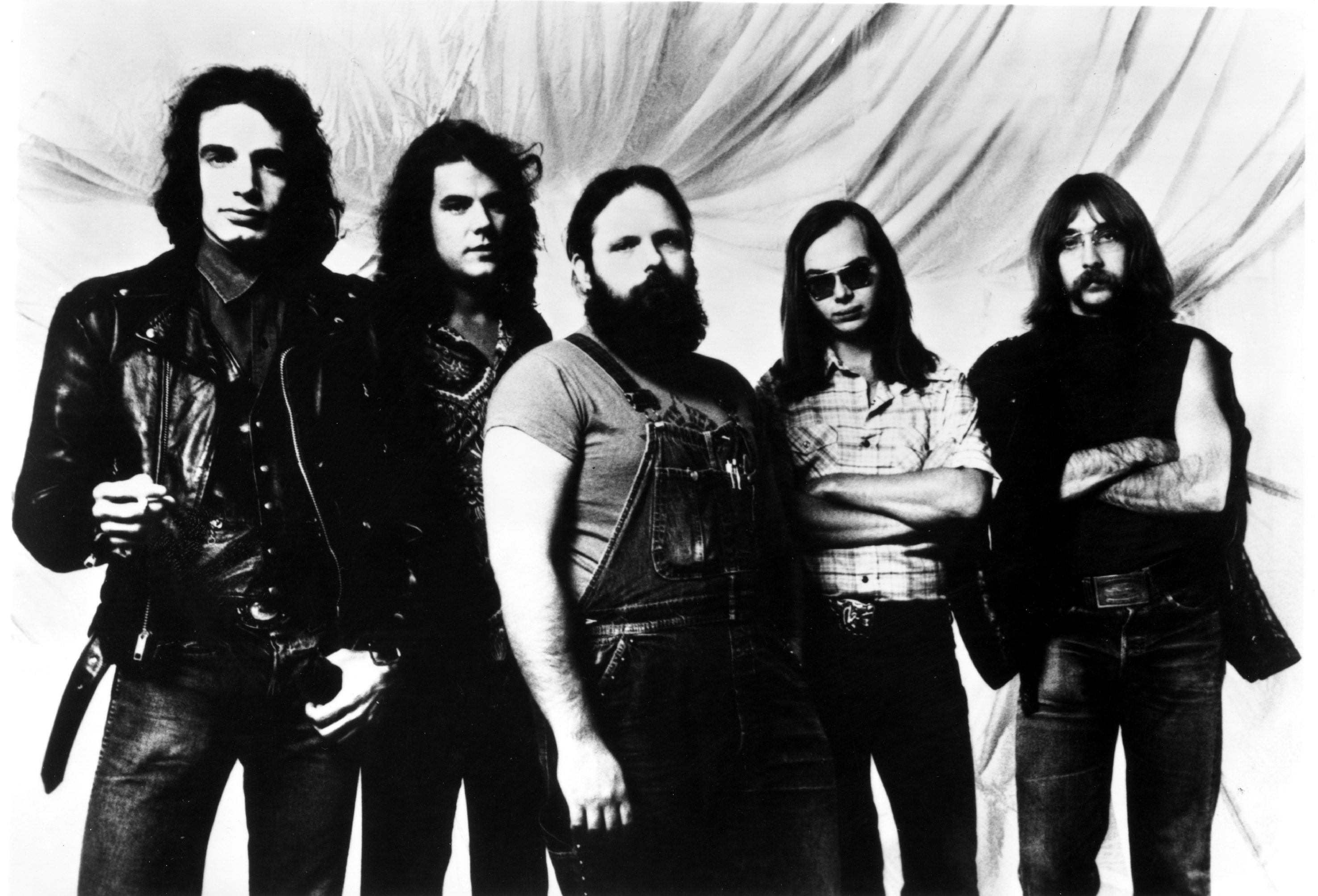
1. The original members of the band were Donald Fagen and Walter Becker. Realizing that this ensemble was a bit thin, we decided to import to Los Angeles a few musicians of our acquaintance. Our producer Gary Katz (AKA Gary Kannon in compliance with the old show biz tradition of de-Semitizing Jewish names) suggested Jeff “Skunk” Baxter, whom we had actually met and played with back in New York, and Jim Hodder, whom we had not met but had only seen at a recording session, through a glass, darkly. Jeff’s credentials included a brief stint with a Boston band called “Ultimate Spinach” although, to his credit, he was not an original member of that outfit. Long Islander Hodder was a member of a Katz-produced band called The Bead Game, named for the illustrious but unreadable Hesse novel. Once these two potent talents had been added to the mix, the ensemble was still found wanting in several areas. So the call went out to Denny Dias, also from Long Island. Denny was a jazz guitarist with whom we had once tried and failed to start a “jazz-rock” band. Hicksville’s loss was Steely Dan’s gain, and for the next several months we thought we had everything we needed. More on this point, later.
2. As for material, no problem. We had touched down in Los Angeles with a fat notebook crammed with what Kenny Vance used to call “The Dyno” (short for dynamite). It was our best hope that the lyrics and music in this notebook, our life’s work to date, would somehow be transmuted into classic albums, the proceeds of which would supply swank, lifetime careers, juicy bank accounts, opulent houses with heated pools, powerful mid-engine sports cars, happiness, security, girls, girls, girls – in short, everything we needed to get by. In fact, it turned out later that only half the songs on the first Steely Dan album were already in the book. The rest were written in California, in a style that had been modified to take into account the new musical environment in which we found ourselves; and also to reflect our belated understanding of the aesthetic shortcomings of some of our less-than-accessible, more doggedly surrealist efforts.
3. Our pal Gary Katz had preceded us in the move from New York to Encino and secured us work as “staff writers” at ABC Dunhill Records on the basis of some stinky demos we recorded at the tiny Peer-Southern studio in the Brill Building. Yes, it was Gary Katz who convinced Jay Lasker, the big. fat, scary cigar-in-mouth president of ABC Dunhill to hire us sight unseen. This was a good thing for us, because, as has been previously documented in story and song, New York in the early 1970s was a broke-ass, smut-ridden, crime-laden garbage planet. Gary picked us up at the L.A. airport and drove us to the terrible, dinky apartments he had rented for us in Encino. He had leased a nice Buick for himself on Dunhill’s dime – tobacco brown, same model that Kojak drove on TV. Because neither of us had cars or drivers licenses at that time. We drove to work with Gary in the morning, and back with him at night. It was during these drives that we became acquainted with the following record business concepts: “a buck-three-eighty” (that meant bupkis), “pick and roll” (from basketball strategy) and “keppelectomy” (don’t ask). Also: “Harvey you’re fired”; “I got a guy and the guy is good” (always followed about a year later by “That guy, he fucked me”); “power rotation”; the corrupt practice called “shlocking”; “mo’ kick, mo’ hat”; and “show business heaven.”
4. Skunk Baxter had a theory that one of the secretaries at the ABC offices had several sets of interchangeable breasts which she would alternate wearing from day to day. This turned out to be incorrect.
5. During our visits to the smallish but excellent recording studio adjoining the Dunhill offices, we were surprised and frightened to see a fellow dressed in an American flag shirt and matching pants working behind the console from time to time. This was recording engineer Roger Nichols. Later we found out that he drove a tiny yellow Lotus sports car which he referred to as the Screaming Yellow Zonker. Roger, who looked like an extra in Beach Blanket Bingo and who claimed never to have seen a Jew till he moved to Los Angeles, couldn’t help peppering his conversation with odd, disturbing Borscht Belt jokes. If you said, “Are you kidding”?, he’d say, “No, it’s just the way my shirt hangs”.
6. When our careers as staff writers didn’t take off, we naturally reverted to our original dream, a cozy but wildly optimistic projection: When our album became a runaway hit, it would insure us unlimited funding for future albums. All of this would take place without it becoming necessary for us to leave Los Angeles, where we could lead our modest but comfy lifestyles indefinitely. Our career template was modeled on the likes of stay-at-home studio moles like Stan Freberg, Ken Nordine (of Word Jazz fame) and, more recently, The Beatles.
So, when certain executives at ABC started pestering us about “the tour” – we were only halfway through with the recording of the first album – the idea that we were now expected to go out and perform in public came as a total surprise. This was not a nice surprise, especially for Donald, who had reluctantly agreed to be the band’s lead vocalist for the purposes of recording but who was horrified when confronted with the idea of singing in public and extremely reluctant to be pressed into service as the frontman for a touring rock band. That’s when Skunk called his buddy David Palmer, and Dave came out from New Jersey to try out for the job. Luckily, the remaining tracks -Dirty Work and Brooklyn – were in his key, more or less.
7. We had worked with guitarist Elliot Randall in New York City. Elliot was a big-time studio cat at the time, as far as we could tell. We had done a few sessions with him in NYC and noticed that, aside from his elegant playing style, he looked really good holding a guitar. When we found out he was in town, it was only natural for us to ask Elliot to “fall by”. His solo on one of our tunes sounded so good that we asked him to join the band, even though we already had two or three guitarists. He demurred.
Other people who turned us down: Joe Gordon, Loudon Wainwright III, Dom Troiano, Hank Medress (who used to be in the Tokens), Rick Derringer (who we knew as Ricky Zehringer back in NYC), Chevy Chase, we think maybe Nils Lofgren, and Janice Baker from college (a couple of times).
8. When we first met Denny out in Hicksville, he was playing a Gibson Barney Kessel hollow-body guitar through a Kustom amplifier. The guitar was a sunburst with double Neo-Venetian cutaways, an offense to the eyes and the ears alike. We prevailed upon him to find something a bit more, er, modern-sounding and he ended up trading in the Kessel for a Dan Armstrong guitar with a clear plexiglas body. This was okay for a while but by the time Denny came out to California we were hankering, on Denny’s behalf, for another sonic upgrade. So Denny went down to Sound City where Jeff Baxter was then employed as a guitar repairman and picked himself out a honey of a Fender Telecaster with a rosewood neck. Fitted with the appropriate humbuckers in neck and bridge position and amplified by a beefy Marshall 100 watt amp head and short stack cabinet, Denny was ready to rock.
Of course, for the occasion of Denny’s solo on Do It Again, we rented a Coral Electric Sitar. This novel instrument, replete with dual lipstick tube pickups, sympathetic strings and a special bridge that produced the sitar-like buzzing sound, added that extra something the tune called for. For the same track, Donald rented for himself a sad Yamaha organ that had, amongst other things, a felt strip for producing glissandos that was heretofore only available on their Electone living room models.
9. Because of our current location (an undistinguished Italian restaurant on Madison Ave.), we are unable to reacquaint ourselves with the Can’t Buy A Thrill album at this time. However, we do seem to recall a few highlights, which include the aforementioned Do It Again, begun in Encino, polished in our Dunhill writing dungeon and soon to be come a big hit. To say that the lyrics somehow expressed the desperate career gamble on which we were embarking, to say that would be more than a bit precious; let today’s listener draw his own conclusions. But it most definitely solidified what became a long and satisfying collaboration with percussionist/vibist/pianist Victor Feldman, known to and venerated by us for his work with Miles Davis. The aforementioned Elliot Randall solo on Reeling in the Years, also a huge hit, that was a helluva thing, wasn’t it? And lastly, the Veal Bird Special at Dolores’ Restaurant, a regular Thursday night favorite for the gang in Studio A, should not go unmentioned.
Hindsight bias is fascinating, particularly with students of a culture as opposed to those who experienced cultural events firsthand. Today, Steely Dan is regarded as two master craftsmen of studio sophistication – cynical jazz-heads with little patience for all but the cream of the musical crop.
The early-to-mid 1970s were a slightly different story, however. With the emergence of progressive bands like Genesis, Yes, and Jethro Tull, those not paying attention might have lumped Steely Dan in with any number of pedestrian rock bands of the day.
Sure, preemptive moves had been made to suggest the ultimate direction of the outfit. But as far as heady chords and swearing off the road, The Beatles had beaten them to the punch a decade earlier.
Today, listeners generally glean their interpretation of the Steely Dan “sound” from the group’s sixth LP, the high watermark, Aja. But during the first half of their career, a general pop audience may have been more likely to associate the group with their 1972 debut, Can’t Buy a Thrill…
Engineer Jay Marks’ comments: This is a rough mix that was made at Sigma Sound in New York the day Gary (Katz, producer) & Company came to check out our studio. I was the engineer. The tracks were cut by Al Schmidt except for the piano solo which I overdubbed that day.
The reason I know it’s my mix all these years later is because of the fade — Gary kept telling me to fade faster, and I was just too slow, never having heard the whole song before. So that’s why you hear that slight transition at the end — it’s not supposed to be there. (We also cut Kind Spirit that day as well as doing a rough mix on the “original lyrics” version of Third World Man, which at that time was called Were You Blind That Day.)
There are several excellent Steely Dan tribute bands out there. You can add the Brooklyn Charmers to that list.
Considering there are only five of them on the stage (I know you’re used to sixteen or more) these guys approximate Steely Dan classics–and choice deep cuts–remarkably well.
Wisely they don’t mess with the great original guitar solos. No band ever catalogued a greater collection of solos. And not tribute band ought to improvise their own or try to better them.
The only thing they lack is the thing every Dan tribute act lacks: the inimitable voice of Donald Fagen.
1:39 – Bodhisattva 6:46 – Peg 11:37 – Black Friday 15:55 – Turn That Heartbeat Over Again 21:43 – Kid Charlemagne 27:12 – Rikki Don’t Lose That Number 32:18 – Kings 36:18 – King Of The World 42:02 – Bad Sneakers 45:34 – Don’t Take Me Alive 50:24 – Midnite Cruiser 55:48 – Green Earrings 1:00:52 – My Old School 1:07:55 – Josie 1:13:59 – Hey Nineteen 1:21:52 – Boston Rag 1:28:36 – Reelin’ In The Years



 Every Moment Has A Song