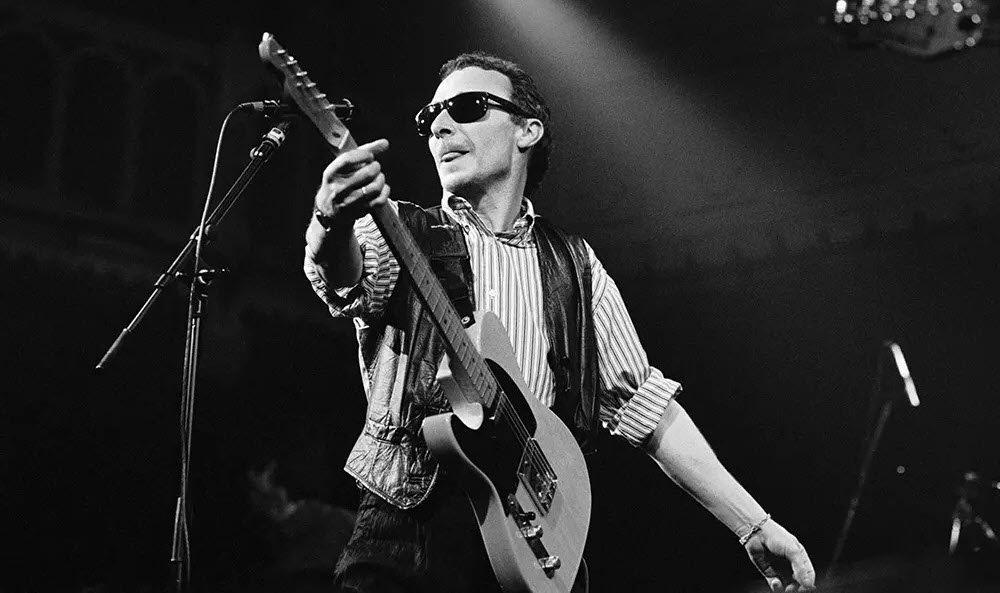
Songs You May Have Missed #300

Zach Sestili

Zach Sestili: “When the Lashes and the Stars Fall” (Year Unknown)

Frequently I hear musicians capable of producing enjoyable music. Occasionally I’m fortunate enough to come across someone with a true musical gift. Rarely is my soul graced by an artist who inspires true awe. And exactly once in my life I was blessed to be able to call such an awe-inspiring artist my friend.

Zach Sestili, whose performing name at the time was Zee Steel, used to haunt the weekly local (Pittsburgh) open stages in the 90’s. Since I also owned a guitar and wrote songs, we did this together. But we didn’t really do it together. More accurately, I played Salieri to his Mozart. Zach praised in earnest tones the melodies I came up with, but I always wondered if he was busting out in that mischievous Tom Hulce giggle behind my back. Because when Zee Steel took the stage, jaws dropped across the room.

_________________________

Zach Sestili was born in Pittsburgh and moved to Mobile, Alabama at age 6.

Beginning at age 7 when his dad taught him some drumming technique, Zach had quickly progressed in his mastery of: drums, saxophone, piano, guitar, bass, vocals, songwriting and music theory. At age 11 he sang lead vocals and played drums as his band performed Yes’ “Owner of a Lonely Heart” in his middle school talent show. By age 12, with his brother on guitar, Zach’s band was actually gigging, and he was developing his compositional skills.

Influenced mainly by progressive rock at the time, Zach’s next band (ages 14-16) covered Yes, Rush, Genesis and Mr. Mister and actually played in the 1988 Mardi Gras parade, and their accompanying outdoor courtyard performance placed them in front of a crowd of about 6,000.

Moving to Atlanta at age 16, Sestili met new friends who helped expand his horizons by introducing him to jazz fusion. For the next several years some major influences were Michael Hedges, Pat Metheny, Al DiMeola, Kazumi Watanabe, Chic Corea and Weather Report.

It was the intrigue this complex, colorful music held for him that sparked an interest in music theory and effectively charted the course of his subsequent musical interests. While beginning to read widely on  relationships between modes and scales, he found published sources to lack the explanations he sought regarding what he calls the “logical but intangible relationships” between musical moments within related scales and modes. His desire to understand the nature of the interconnectedness of modes and scales has led to his own original modal theory, which he has been working on for about two decades. He lives in Hawaii now and has presumably had his head so deep in modal theory that he’s only recently begun reconnecting with the outside world via the wonderful world of social media. I hear he’s married.

_________________________

When I first met Zach (then “Zee Steel” and later “Zach Pendulum”) he was back in Pittsburgh (temporarily) and around 21 years of age, managing the keyboard department of a now-defunct downtown music store, writing musically adventurous songs in a genre that seemed to blend jazz fusion complexity with new age optimism, and playing solo at open stages. While he was most enthusiastic about playing his latest compositions, he was a gracious performer and always willing to give a slot in his 3-song set to one of his older songs that we his friends and fans begged him to do.

One such song is “When the Lashes and the Stars Fall”, which Zach says he mainly wrote at age 16, finishing the guitar parts by age 17. Although this is only a demo, sourced from a cassette that must be at least 20 years old, you can still hear the complex interweaving of instruments–all played by Zach himself–in a song that is screaming for a modern digital upgrade.

There are so many moments of musical magic here, from the quite original drum pattern that opens and closes the song, to the echo-effect guitar that vaguely trails the vocal melody, to the little vocal exhalation that follows the line “caught in my mind, it’s impossible”, to the variety of keyboard sounds that begin to inhabit the corners of the song shortly after the first chorus, playing lines of such subtlety I only discerned some of them for the first time on recent re-listening.

Yes, it’s a muddy old analog recording. Yes, it might sound dated to your ears (although not to mine–I’ll admit to a complete lack of objectivity here.) But it’s hard to deny this is an imaginative composition wondrously arranged. On the  occasion of hearing it again for the first time in years I had all the mixed emotions I once had every Thursday night at The Artery in Shadyside: the awe of hearing someone who clearly seems to be touched by God, and the little twinge of envy that comes from knowing the same gift was not given to me, much as I desired it. I’ve always thought if I could write and perform just one song as good as “When the Lashes and the Stars Fall” in my life, I’d be content with that.

But I’ve come to accept that my destiny was merely to be witness to the Gift–to be Salieri.

See also: https://edcyphers.com/2015/04/27/songs-you-may-have-missed-529/
Top Ten Singles 10 Years Ago This Week

Week ending January 25, 2003

  1. Lose Yourself-Eminem
  2. Bump, Bump, Bump-B2K & P. Diddy
  3. Air Force Ones-Nelly
  4. Beautiful-Christina Aguilera
  5. ’03 Bonnie & Clyde-Jay-Z featuring Beyoncé
  6. Work It-Missy Elliott
  7. I’m With You-Avril Lavigne
  8. Cry Me a River-Justin Timberlake
  9. Don’t Mess With My Man-Nivea featuring Brian and Brandon Casey
  10. All I Have-Jennifer Lopez featuring LL Cool J

(Source: Billboard Hot 100)

Songs You May Have Missed #299

parsons

Alan Parsons Project: “Old and Wise” (1982)

Perhaps no one of his era straddled genres as seamlessly as Alan Parsons. Like all of his releases, Eye in the Sky is at least by loose definition a concept record, inhabiting the more commercial fringes of progressive rock. Beyond that it has the hooks of a pop record and the smooth sheen of an adult contemporary album.

Whatever his music is, Parsons thankfully seemed to focus on doing what he did well rather than fitting it into a niche–usually an approach that yields good results.

“Old and Wise” is a wistful, nostalgic lyric rendered beautifully by the breathy voice of none other than former Zombies vocalist Colin Blunstone.

Caution: attach this song to a personal relationship, add a pinch of goodbye, and you’ve got the perfect recipe for tears.

ELO Mix Baroque with the Beatles–And Other Treasures from Jeff Lynne Tribute Channel


Electric Light Orchestra’s live cover of The Beatles’ “Day Tripper” is from a 1974 live album called The Night the Light Went On (In Long Beach) which though recorded in the U.S. was, somewhat ironically, only released in Europe. Thus even loyal fans in this country have never come across this performance. 

Similarly to the band’s early covers of “Roll Over Beethoven” and “In the Hall of the Mountain King” this is another early example of Jeff Lynne’s fusion of classical music with rock and roll, later achieved more seamlessly on hits like “Livin’ Thing” and “Sweet Talkin’ Woman”.

Note Lynne’s sly amendment to the lyric, changing “she’s a big teaser” into “she’s a prick teaser” (probably what McCartney wanted to say.)

This and lots more great ELO tunes appear on the YouTube Jeff Lynne tribute channel movejefflynnelo with upgraded audio, and painstakingly synched with vintage videos. It’s a treasure trove for fans of ELO and Lynne’s previous band, The Move.

http://www.youtube.com/user/movejefflynnelo?feature=watch


Wedding Video Film Festival–Volume 1

New Year’s Eve Proposal–Freeze Mob Style

You’ve seen the old mid-dance switcheroo a thousand times by now. My question is: what is this wedding DJ doing in a T-shirt?

And finally:

Doctor Who fans really mean business! Check out this video and its countless references to the popular sci-fi show: 

http://vimeo.com/55763423


Recommended Albums #37

Graham Parker: The Mona Lisa’s Sister (1988)

I’ve always wondered about the tendency, when you discover an artist well into their career, to forever prefer the album that served as your introduction to that artist over the rest of their catalogue. Although it may be merely a sentimental, subjective attachment, there could also be valid reasons why this so often happens.

If that album was recommended by a fan of the artist it’s entirely appropriate that they should select that artist’s finest work in their attempt to evangelize you. And it just makes sense that, whether it’s word of mouth or a tendency for a music retailer (we used to call them “record stores”) to stock more copies of the better stuff, that a singer or band’s best work will be the most likely to blow through your transom at some point.

My introduction to Graham Parker was overlaid with all the symmetry of obsolete two-sided music media: a friend made me a cassette with the The Mona Lisa’s Sister on one side and Warren Zevon’s Sentimental Hygiene on the other. Each album has been described as a return to form by a long-established rocker, each served as my introduction to an artist, and each remains my favorite of the two artists’ respective catalogues.

I’m just gonna tell it like it is: as much as music critics rave about Howlin’ Wind and Squeezing Out Sparks–Parker’s early work from the late 70’s–to my ears The Mona Lisa’s Sister is his most satisfying record. But of course I must add the disclaimer that it was the one I heard first, so I may be biased.

This album features more acoustic guitar than on Parker’s previous work. As he described it, the desire to make a record that focused on the singer, the song and acoustic guitar in the era of blown-up Phil Collins, George Michael and Whitney Houston productions got him kicked off his record label. Sticking to his intentions to not sound like everyone else’s music, he signed on with RCA and proceeded to make an album “stripped of superfluous information, devoid of artifice, and free from the stamp of a ‘producer'”.

Cutting his vocals live as opposed to overdubbing, adding bass, keys and lead guitar only as spare enhancements, Parker made an album that still sounds good today, while much 80’s pop and rock sounds like it was buried under an avalanche of synths. Graham himself relates:

“Funnily enough, I bumped into two engineer/producers not long after the album had been released and they seemed confused by its popularity and good reviews. One thought it sounded ‘unfinished’ and the other one decided that there was something just plain wrong with it!  I knew then that I had attained Success.”

While I agree it was indeed a success (or, as Graham might say, “SUCK-sess”) in the interest of equal time I’ll reprint Allmusic Guide‘s brief and particularly unflattering review:

Graham Parker moves to his fourth record label (actually, his fifth, if you count Atlantic, which dumped him before releasing an album) for one of his less inspired efforts. When he sings “Get Started, Start A Fire,” he seems to be talking to himself, and when he resorts to covering the old Sam Cooke hit “Cupid,” he seems to be grasping for material.

Of course, I couldn’t disagree more strongly but, as a recent post on this site asserted, the appreciation of music is a very subjective thing, and one man’s “great” is another man’s “meh”. So listen and decide for yourself…

Listen to: “Don’t Let it Break You Down”

Listen to: “Ok Hieronymus”

Listen to: “Get Started, Start a Fire”

Listen to: “Success”

Listen to: “The Girl Isn’t Ready”

Listen to: “I Don’t Know”

See also: Songs You May Have Missed #685 | Every Moment Has A Song (edcyphers.com)

Previous Older Entries Next Newer Entries