Songs like “Judas Unrepentant” are why I hang in there with prog rock. Despite the fact that 95% of what I sift through disappoints, and notwithstanding the genre’s current overall metal leanings, there are occasions when an ambitious practitioner of the long-form rock song produces pure gold. Songs like this one, and bands like Big Big Train, reward repeated listenings and have greater shelf life than more ephemeral pop music.
The song does a remarkable job telling a story that requires quite a bit of detail, as well as the language of the art world–without sacrificing listenability. Let’s face it, if your story is “Bad, Bad Leroy Brown”, it isn’t difficult to keep it catchy. But weaving a tale with the complexity required here, well–that’s what we still have progressive rock for. That’s why it’s still essential, despite the multitude of claims that the only era of prog that mattered was the Yes/Genesis/Floyd heyday 1970’s.
Judas Unrepentant:
Venetian expertise Inspired by Titian Which he modified Fine tuned along dutch lines
He’s painting revenge Embittered by lack of success
With signature techniques Attention to details And fine tell tale brushstrokes Of badger and sable
Expressing contempt For greedy dealers Getting rich At the artist’s expense
Infamous forger and restorer Judas Unrepentant Branded a charming old lovable rogue Judas Unrepentant Hey Judas Unrepentant Hey Judas!
His time bombs are in place And anachronisms Clues pointing to the truth If ever they are X-rayed
Wrote legends in lead white To trick the experts And hoodwink Hoodwink the trained eye
Infamous forger and restorer Judas Unrepentant Branded a charming old lovable rogue Judas Unrepentant Hey Judas Unrepentant Hey Judas Unrepentant
Establishing provenance Acquiring old frames with Christie’s numbers Then paints a picture in the same style Specialising in minor works by major artists
All rise Thirteen watercolours by Samuel Palmer Have proven to be his undoing And so he confesses then he is arrested Charged him with conspiracy to defraud
Years of chain smoking and breathing in fumes from restorations The stress of the court case had taken its toll His trial was halted due to ill health
So now we can all buy Real genuine fakes That’s posthumous fame It’s always the same
Infamous forger and restorer Judas Unrepentant Branded a charming old lovable rogue Judas Unrepentant Feeling like Robin Hood Just as good As Rembrandt or Titian Hey Judas Unrepentant Hey Judas Unrepentant Hey Judas Unrepentant
Madonna defended her decision to use a swastika in a video during her current tour, saying it is a fit image for her message about “the intolerance that we human beings have for one another.”
The Nazi symbol is superimposed on the forehead of the French National Front leader Marine Le Pen during a video that Madonna has been playing while she sings “Nobody Knows Me” at her concerts during a world tour. Last week, the far-right party said it would sue Madonna after a concert in Paris and accused her of cynically insulting Ms. Le Pen to gain publicity.
Ms. Le Pen, who placed third in France’s presidential election in April, was one of several famous figures depicted in the video: others included Sarah Palin, President Hu Jintao of China and Pope Benedict XVI. In February, Ms. Le Pen’s father, Jean-Marie Le Pen, who founded the National Front, was found guilty of condoning war crimes after he said the Nazi occupation of France had “not been particularly inhumane.”
Madonna has not changed the video since the National Front threatened to sue her, and it was shown at least three concerts in Britain last week. Asked about the Nazi imagery by a Brazilian television journalist for a piece that was broadcast over the weekend, the singer said the image was justified because the song concerns intolerance and explores the question of “how much we judge people before knowing them.”
“Music should be about ideas, right?” she said. “Ideas inspire music.”
The use of the swastika is not the first controversial piece of theater Madonna has employed on her tour to promote “MDNA,” her current album. On Saturday, she brandished a prop pistol onstage in Edinburgh despite a warning from police not to do so. And on June 8, she exposed her breast during a show in Istanbul while singing “No Fear.”
________________________________________
I don’t even need to say it, do I? This is part of Madonna’s process–the cycle whereby she gets herself in publications like Rolling Stone and the New York Times once the attention of a (lackluster) new release has died down. She courts controversy, gets it, then justifies what’s offensive by saying something like “music is about ideas”. Does Madonna really impress you these days as someone who is all about ideas? I think it’s much more likely she’s about finding every possible way to maximize her earnings in an era when she’s been overtaken by so many younger, hotter artists–artists whose “ideas”, shallow though they may be, are connecting with young people in a more impactful way.
To quote Marine Le Pen, the politician whose image was superimposed with the swastika: “It’s understandable when aging singers who need publicity go to such extremes. Her songs don’t work anymore.”
In a sense, she’s taking the low road (resorting to shocking and offending people) while appearing to take the high ground (saying she’s concerned about “the intolerance that we human beings have for one another”). If she wants to examine such topics, why doesn’t she write a serious treatise on the subject? Why not do a benefit tour with all profits going to organizations that fight such intolerance? Is dance music even the best way to address her deep concerns for the human condition? Do you think about human intolerance and the terrible injustice of racist nationalistic regimes while you’re shaking your ass at a club?
Make no mistake, the only idea that concerns Madonna is the idea that you buy her product.
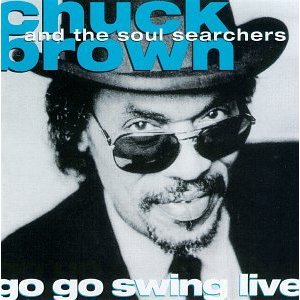
In the wake of the recent death of Chuck Brown, known as the “Godfather of Go-Go”, Chuck Thies, who identifies himself as a political analyst in the D.C. area, wrote the following in his First Read–DMV column:
John Phillip Sousa, Duke Ellington, Marvin Gaye, Henry Rollins and Ian MacKaye reside on the Mount Olympus of Washington musicians. Chuck Brown is Zeus.
Sousa, Ellington, Gaye, Rollins and MacKaye all mastered the genres of music for which they are known. Brown, alongside The Young Senators and Black Heat, invented his genre. Go-Go. A sound uniquely Washington.
Can we just hold up a sec?
I don’t mean any disrespect to Mr. Brown, who was certainly a giant in the field of Go-Go music. But how many people across the country can even describe what Go-Go music is? Aren’t we going a little beyond tribute to compare Brown to Ellington, for gosh sakes? To suggest that he was in any way a more significant figure than Sousa? Must our declarations of admiration for the recently deceased go to such reality-distorting extremes? Is such laughable tribute any real tribute at all?
Of course, Thies undermines his own claim for Brown’s importance by saying his music was “uniquely Washington”. True enough: Brown’s single national top 40 single, “Bustin’ Loose”, is far lesser known than the Nelly hit that sampled it:
In the real world, Marvin Gaye and John Phillip Sousa made music that made a lasting, worldwide impact. And the incomparable Ellington? One of the most significant musical figures of our century, to say the very least. But in the world of Chuck Thies these men are lesser lights in a musical universe ruled by the “uniquely Washington” Chuck Brown. Such, unfortunately, is the hype of eulogyspeak.
And here is the actual TV performance that first drew my attention to the man. This was during my four or five year phase of actually listening to popular country on the radio and watching The Nashville Network.
What impressed me about Wilcox here, in addition to the song’s lyric, was the musicianship he displayed–making eye contact with the audience while playing complex guitar lines throughout the song. This was not standard TNN fare.
So I went looking for his album (on cassette, my format of choice for most of the 80’s, sorry to say). But by the time I made it to the shop, I’d forgotten his name! Undaunted, I began browsing through the tapes, thinking I just might get lucky and recognize the guy’s name if his cassette happened to be there. Of course, looking alphabetically, it took a while to get to Wilcox, but I did indeed recognize his name. And the album’s title was completely appropriate: How Did You Find Me Here.
When I finally got a chance to see him live his guitar playing blew me away even more. I’d never seen a guitarist change tunings nearly every song or two, or use multiple capos. (Wilcox shaved down parts of his capos so they only touched certain strings. On a given song he’d use as many as three of them.)
David Wilcox is worth a listen if you prefer substance to gimmick–if you like a well-turned metaphor and a life lesson in a lyric.




 Every Moment Has A Song