Snopes: Taylor Swift Can’t Read Music?

(via Snopes) by Aleksandra Wrona

“I’m not as much into technique as I am into the emotion of it,” the popular songstress has said.

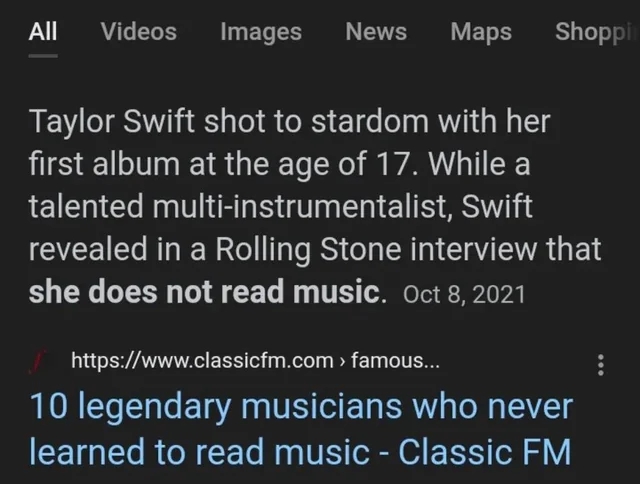
For years, fans of Taylor Swift have speculated about the extent of her musical abilities, often focusing on the question of whether or not the extraordinarily popular singer-songwriter can read music.

“Fun fact: Taylor Swift Can’t Read Sheet Music. She Plays By Ear!” one Reddit post on the topic claimed, for example. “Does Taylor Swift actually read music notation?” a Quora user asked.

“She most likely writes a melody on a guitar or piano, and then the production is simply built around it. typical ‘reading music’ type of music is very mechanical to compose sometimes, taylor’s melodies are good because they come directly from her own creativity,” one Reddit user commented, while another wrote “I feel like this is the way she was shown doing it in Miss Americana [a documentary about Swift’s career]. She hums a melody into her phone when it comes to her and then works it out from there on a piano or guitar.”

Read more: https://www.snopes.com/news/2024/06/09/taylor-swift-cant-read-music/

Some Important Observations On Steeleye Span, Experiments In Folk Rock And Cows

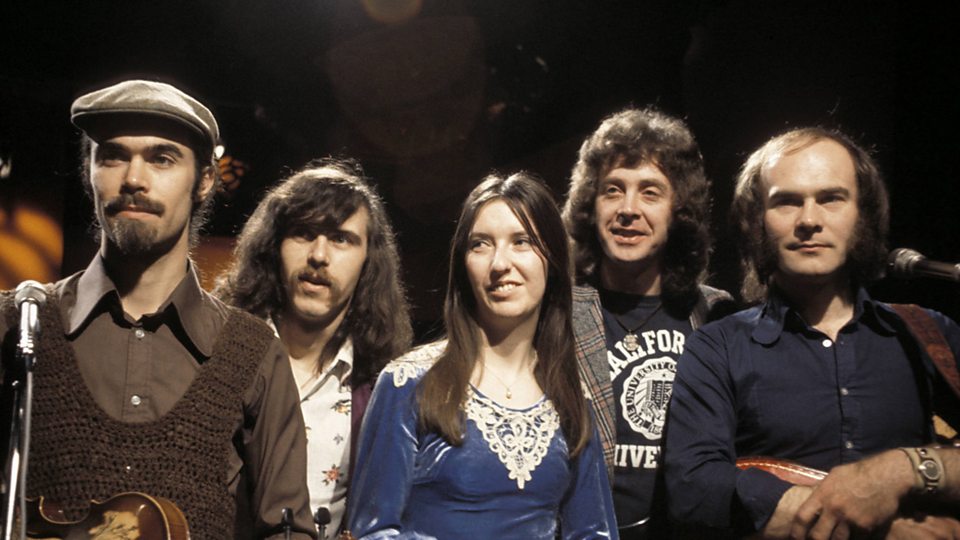
Maddy Prior (right) sings with the English folk-rock band Steeleye Span. (Stephen Cooke)

(via wbur) by Chris Braiotta

I want to talk to you about what it means to experiment. Let’s begin with the following sentence: “We did try a reggae ‘Spotted Cow’ and we weren’t terribly convinced by it, so we stopped doing it.”

You’ll be needing a little context for that. “Spotted Cow” is a song from around 1740. It’s about a woman who’s lost her cow. She complains about it to this guy she runs into. He’s like, “Lady, I am game to help you find your cow. Let us do this.” They go off to a field to find it. Obvious place to start, right? Before long … well, you know how fields are. Sexiest thing in nature. So they decide to do what comes naturally to a man and a woman in a field, which isn’t really looking for cows. From then on, whenever the lady’s looking for a bit of you-know-what, she finds some guy and tells him about her cow.

The speaker of that sentence was Maddy Prior, singer of the great English folk-rock band Steeleye Span. This is a band that she’s led since 1969.

So, to sum up: ‘70s English folk-rock band, cow used as cover story for Georgian booty call. And then: reggae.

“When you’re experimenting with things they can’t all be winners,” she says. “I’m pleased that we tried things.”

I don’t care how “out there” you think your favorite band is. This is what it means to be fearless. This is what experimenting is.

Now “experiments” aren’t something we think of when it comes to folk music. Learning the ancient craft of candle making? Sure. Experimenting? That’s the sort of thing that gets you booed at Newport.

Maddy Prior isn’t moved by any of that.

“The minute you bring guitar into it it’s not English anyways,” she told me. “I think as far as we were concerned the song itself was there and what you did with it was what you did with it. In my world we were never bothered by the way it should be. We took all these songs and made them our own, and then you pass them on and someone else makes them their own. You can mimic other people singing the songs but that’s what you’re doing and why would you do that?”

Read more: https://www.wbur.org/news/2015/07/20/steeleye-span

The band Tom Waits likened to “watching paint dry”

(Credits: Far Out / Press)

(via Far Out) by Tim Coffman

Tom Waits has never been known as someone who minced words about how he felt about music. Throughout his career in front of the microphone, there was no doubt that Waits would deliver something 100% authentic to the story he wanted to tell. Though his intuition may have led him to multiple classic records like Rain Dogs and Bone Machine, he wasn’t afraid to talk about songs that he thought were below average either.

When first cutting his teeth in the rock scene, Waits was a far more dynamic presence than what he would become known for. Although many may associate Waits’ cadence with its off-kilter demeanour, many knew him as the kind of lonely barfly on his first handful of albums, sitting behind a piano and delivering biting songs about loneliness.

Out of all the tracks he wrote during that period, ‘Ol 55’ remains a particular highlight from his early years. Taking the basic premise of the titular car, Waits paints a dark tale on top of it all, delivering the kind of gruff voice that only he could muster in those days. If there were anyone who knew a thing or two about both lonely songs and cars, though, it would be the Eagles.

As Waits was starting his career, Glenn Frey and Don Henley had already been two of the kings of the California rock scene. Having already made their living with songs like ‘Take it Easy’ and ‘Tequila Sunrise’, the band were looking to go beyond their country roots on the album On the Border...

Read more: https://faroutmagazine.co.uk/band-tom-waits-watching-paint-dry/

“He’s never done a band like us; he’s done a lot of heavy metal. But I thought the two could mix”: How AC/DC’s producer and synthesizers reinvented The Cars

© Mirrorpix via Getty Images

(via LouderSound)

“I always wanted our songs to pop and kick,” The Cars’ Ric Ocasek told me in 2005. And on the band’s fifth album, Heartbeat City, they did just that. 

You might think of the pop in Pop Art terms: bold colours, sleek lines; bang-vroom choruses, the kick of a lyrical subversion that sneaks up on you, hinting at fragile mental states, with elliptical drug references and some kinky S&M. 

Of that contrast in his songs, Ocasek said: “One kind of holds you down to earth, while the other takes you somewhere else.” 

After running the album-tour track annually from 1978-81, The Cars were looking to go somewhere else. The title of their fourth album, Shake It Up, hinted at just what they needed to do. 

The first major shake-up for Heartbeat City was bringing in producer Mutt Lange, best known for his high-gloss hit-making on AC/DC’s Back In Black and Def Leppard’s Pyromania. “I thought that the combination of the sound he gets and what we do would mingle pretty nicely,” Ocasek said in 1984. “Mutt’s never done a band like us; he’s done a lot of heavy metal. But I thought the two could mix.” 

Read more: https://www.msn.com/en-us/music/news/he-s-never-done-a-band-like-us-he-s-done-a-lot-of-heavy-metal-but-i-thought-the-two-could-mix-how-ac-dc-s-producer-and-synthesisers-reinvented-the-cars/ar-BB1l2Irj?ocid=msedgntp&pc=U531&cvid=99a38044cd604cd094c1e29851787288&ei=35

Quora: Does George Harrison even know how to play lead guitar compared to the likes of Eric Clapton?

(Answered by Rik Elswit)

Harrison had a rare ability that’s cherished in studio players like Louie Shelton, Brent Mason, and Larry Carlton. He could craft an unforgettable two bar phrase that becomes the signature to the song. Elliot Easton of the Cars and Keith Richards of the Stones, had this as well.

The classic example is Harrison’s intro to “Something”. Six notes with a released bend, all on one string. Anyone can do it. Even your little sister can do it. But he thought of it. This is a gift.

“Whenever I got accosted on the street by a crazy maniac, the best thing to do was walk away. I always felt threatened. We had to leave by the back door at a lot of places”: Devo’s battle for survival

(via LouderSound) by Paul Lester

The concept behind Devo was created during a single shocking event in 1970. From their earliest moments they had a point to make – but they also had a specific way of wanting to make it, and it wasn’t an easy journey. In 2015, Gerald V Casale looked back on the band’s career with Prog.

“God, those were exciting times,” says Gerald V Casale, vocalist, bassist, synth player and joint founder of Devo, über-geeks of the States’ late-70s new wave. “When you’re just so energised by what you’re doing and you’re the chief believer in your own vision.”

Casale is reminiscing about Miracle Witness Hour, a live album, previously unreleased, of his band performing in a biker bar in Cleveland, Ohio, in 1977. That was just before Devo’s “full bloom,” when they became America’s Public Anomaly No.1.

“It was a very strange place,” he says of the Eagle Street Saloon. “It was mouldy and decrepit. There’d be a towny bike-bar scene and then the music would start. Some locals would stick around and create tension and terror for the artsy punks there, and then we’d play to them – around 40 people. Then we’d just get out of there.

“I remember being really afraid. I had things said to me and figured the best thing to do was ignore them. Whenever I got accosted on the street by a crazy maniac, the best thing to do was walk away. I always felt threatened. We had to leave by the back door at a lot of places.”

Read more: https://www.msn.com/en-us/news/technology/whenever-i-got-accosted-on-the-street-by-a-crazy-maniac-the-best-thing-to-do-was-walk-away-i-always-felt-threatened-we-had-to-leave-by-the-back-door-at-a-lot-of-places-devo-s-battle-for-survival/ar-AA1fSrpb?ocid=msedgntp&pc=U531&cvid=e1512a2dfff6458cf384774c266fb0a5&ei=21#

Previous Older Entries Next Newer Entries