"There's a time in life for Hoagy Carmichael. There's a time in life for Claude Debussy. There's a time in life for Jerry Lee Lewis. There's a time in life for Destiny's Child. All these things have their moment." ~Elvis Costello
The Session Man is a captivating music documentary that dives deep into the life and career of Nicky Hopkins, one of rock and roll’s most influential yet often overlooked pianists. Known for his exceptional work as a session musician, Hopkins contributed to some of the greatest hits of the 20th century, collaborating with iconic bands and artists. This film aims to shed light on his remarkable journey and lasting impact on the music industry.
The filmmakers have taken a balanced approach, blending technical analysis of Hopkins’ music with personal stories and historical context. This not only highlights his professional achievements but also provides insight into his personality and the challenges he faced. The narrative is driven by a combination of voice-over narration (courtesy of “Whispering Bob” Harris) and on-screen interviews, creating a dynamic and immersive experience for the viewer.
Professor Stephanie Burt shares what she learned about the singer’s stardom, relatability, and her own course at a college famous for being famous.
Last fall I told Harvard’s English Department that I planned to offer a class this spring on Taylor Swift. No one objected; Harvard professors like me get lots of latitude in confecting electives as long as we also offer the bread-and-butter material our majors need. (Most of my work is poetry-related; I also teach our regular undergrad course about literary form, from Beowulf on.) I’d call my new class Taylor Swift and Her World, as in: We’d read and listen to other artists and authors (part of her world). But also as in: It’s her world; we just live in it.
I’ve been living in it ever since. I thought I’d be teaching a quiet seminar: 20-odd Swifties around a big oak table, examining and appreciating her career, from her debut to Midnights, alongside her influences, from Carole King (see her Rock & Roll Hall of Fame speech) to William Wordsworth (see “The Lakes” from Folklore). We would track her echoes and half rhymes, her arrangements and collaborations and allusions, her hooks and her choruses. We might sing along. We’d learn why “You Belong With Me” relies so much on its with (you don’t belong to me, nor I to you). We’d learn how the unease in “Tolerate It” speaks to its time signature (5/4). Maybe some English majors would get into songwriting. Maybe some Swifties would leave with old poems in their heads.
To be fair, almost all those things have now happened. We did sing along. Some undergrads learned to love the 18th-century poet and satirist Alexander Pope, or at least to pretend they did: Pope’s “Epistle to Dr. Arbuthnot” depicts his exasperation with superfans, false friends, and haters in ways rarely equaled until Reputation. We cracked open Easter eggs, and we studied her rhythms. But we couldn’t fit around a table. At one point 300 students signed up for the class; almost 200 ended up taking it. We met in a concert hall on campus, with a grand piano at center stage. I gave what I hope were engaging lectures, with pauses for questions, and stage props: a melodica, or a cuddly stuffed snake (for the snake motifs on Reputation). We had theater lights, and balcony seats, and the kind of big screen few humanities classrooms now need…
If you’re inclined to pine for days when music was purchased in the more tangible form of slabs of vinyl instead of the “invisible” format of encoded, downloaded “files”, I’ll remind you of one more thing to miss: The B-side.
The B-side or “flipside” had a significance to artist, fan and DJ alike. To a music consumer buying a “45” back in the day, the B-side was basically a freebie, a second helping from an artist, included for the price you paid for the hit song. For the artist, since songwriting royalties were paid equally for the A- and B-sides of a record, the B-side often represented the chance to cash in on the popularity of the hit, which they may not have written, by backing it with a composition of their own. And to a radio DJ worth his salt, the B-side was something else: an occasional opportunity to turn things upside-down.
Hence, the phenomenon of the Unintended B-side Hit.
Records were “flipped” by DJs for various reasons. Sometimes it was the lyric content of the A-side that made them look for another place to put the needle. The Rolling Stones’ “Let’s Spend the Night Together” was deemed too suggestive by some, so in the U.S. the song never did crack the top 50, while its B-side, “Ruby Tuesday” went as high as number one. For similar reasons Eric Clapton’s “Cocaine” was only released as a B-side–and in a live version at that–but it still didn’t stop the studio version from becoming an FM radio staple. (And now I’ve used “needle”, “crack”, “high”, and “cocaine” in a single paragraph that wasn’t about drugs. Thank you.)
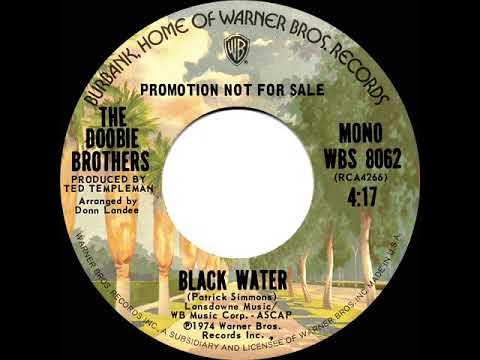
The Doobie Brothers’ 1974 single “Another Park, Another Sunday” contained the lyric “…the radio just seems to bring me down…” which (go figure) wasn’t a favorite among radio programmers. The song was pulled from many stations’ playlists in favor of its flipside. But for this set of circumstances, Classic Rock canon would probably never today encompass something of such stylistic subversion as the bluegrass-flavored “Black Water”. By popular demand the song was re-released as an A-side and rose to number one, a peak never reached by “China Grove”, “Listen To The Music”, or any other of the Doobies’ pre-Michael McDonald hits. Talk about dumb luck.
Lyric content aside, Pop music history is full of the stories of the unintended hits, especially from the vinyl era, and usually occuring as the result of a DJ taking matters into his own hands and checking out the backside (so to speak).
Take a listen to Gary Glitter’s “Rock ‘n’ Roll Part 1”
It was actually the A-side, the flip being eventual ubiquitous stadium anthem “Rock ‘n’ Roll Part 2”
Mostly-instrumental “Part 2” was an afterthought, never intended for regular airplay, much less Sports-Fans’-Call-To-Arms status. I don’t happen to know why DJs flipped the record in this instance, but I like to think it was just to hear less of Gary Glitter singing.
Speaking of sports anthems, not only was Steam’s 1969 hit “Na Na Hey Hey (Kiss Him Goodbye)”intended as a B-side, but its writer tried to ensure DJs focused on its A-Side by giving “Na Na…” a final repeating chorus which extended the song to over four minutes–at the time an unpalatable length for airplay. Still, DJs managed to find the hidden gem (its A-side is long-forgotten) compelling the record label to release a slightly shorter version which listeners made a number one hit. And once the song caught on at sports stadiums (beginning with the Chicago White Sox adopting it as their theme song in 1976) “Na Na Hey Hey (Kiss Him Goodbye)” became an unlikely perennial.
Rod Stewart claimed that he’d “still be digging graves in the cemetery” if some DJ in Cleveland hadn’t flipped “Reason To Believe” over to play what became Rod’s breakout hit, “Maggie May” in 1971. (Seventeen volumes of The Great American Songbook later, there’d be sharp disagreement on whether Rod would have better served the world with the shovel or the mic. But there’s no doubt that DJ’s fateful flip helped, um, vault Rod to stardom.)
Bill Haley and His Comets’ “Rock Around The Clock” became, in 1955, Rock and Roll’s first certifiable anthem and number-one record. But its first release was as a flipside to a certifiable non-anthem called “Thirteen Women (And Only One Man In Town)” in 1954. One might wonder if Rock and Roll would have charted a different path had the movie Blackboard Jungle not featured “Rock Around The Clock” in its opening credits, giving the song a wider audience and a second chance. Interesting to ponder that Rock and Roll began not with a Big Bang but with a false start.
Van Morrison’s classic “Gloria”, recorded by his band Them, was a B-side (to “Baby Please Don’t Go”) as was The Champs’ “Tequila” (“Train To Nowhere”). Thank you, DJs.
In the Eighties the phenomenon continued with Madonna’s “Into The Groove” (originally the B-side of the 12″ mix of “Angel”) and Bruce Springsteen’s “Pink Cadillac” (the flipside of “Dancing In The Dark”). U2’s “The Sweetest Thing” was supposedly written by Bono as an apology to his wife for having to work on her birthday (sweet) then interred as the B-side of “Where The Streets Have No Name” (not so sweet).
Gloria Gaynor’s Disco anthem “I Will Survive” was originally released as a B-side. More oddly, perhaps, the A-side was a cover of a Righteous Brothers song.
Which brings us to “Unchained Melody”, perhaps King Of All Flipsides. This now-hallowed recording did not appear destined for iconic status when first released. If I may digress about the song’s history: it first appeared in the 1955 film Unchained, which explains why its title and lyrics really have nothing to do with one another (haven’t you always wondered?). The first “hit” version was an instrumental by Les Baxter that went to number one that same year. Al Hibbler took a vocal version to #3, also in ’55. By the time the Righteous Brothers recorded it, the song had already charted six times by as many artists including, incredibly, Vito & The Salutations
…whose version today sounds like a Doo-Wop novelty cover of the Righteous Brothers–but only to those of us not old enough to have heard each version upon its release. All this backstory to explain that Bill Medley and Bobby Hatfield (or perhaps more accurately their record label) had no idea in 1965 they’d be releasing what would become the definitive version of a standard. From their perspective the song probably already seemed done to death. Still, it seems hard to believe they pegged it as a B-Side to the nice-but-forgettable “Hung On You” (See–you’ve forgotten it, haven’t you?). By now, “Unchained Melody” is said to have been recorded over 500 times in hundreds of languages. And while Baxter’s instrumental and Hibbler’s vocal version both actually charted higher, the Righteous Brothers’ treatment of “Unchained Melody” set the standard, going from B-side to All-Time Classic.
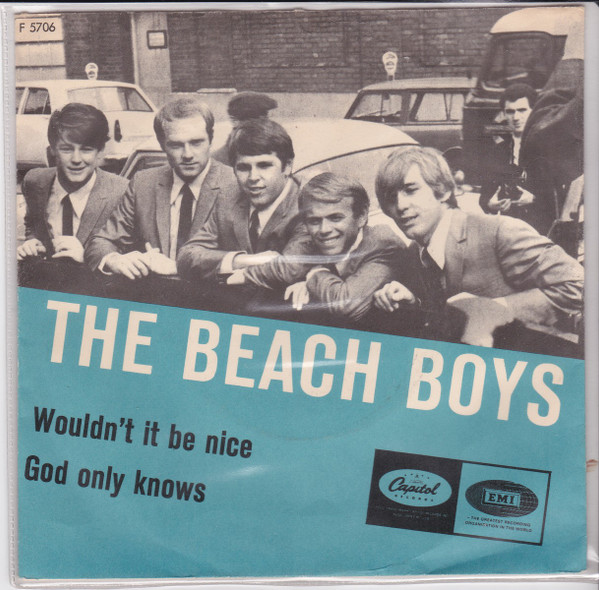
The vinyl “45” could be like your favorite shop having an unexpected buy-one-get-one sale. If you picked up the Stones’ “Honky Tonk Women”, you now owned B-side “You Can’t Always Get What You Want”. If you bought “Wouldn’t It Be Nice” you got “God Only Knows” in the bargain and if you dug “I Get Around” you’d flip when you heard “Don’t Worry Baby”. And if you bought a Beatles record? Sweet hook-ups abounded. I couldn’t resist citing a few of what were actually known as “Double A-sides”:
Penny Lane/Strawberry Fields Forever
We Can Work It Out/Day Tripper
Yellow Submarine/Eleanor Rigby
Hello Goodbye/I Am The Walrus
Hey Jude/Revolution
Come Together/Something
Elvis could pull that sort of thing off too, of course. How about “Don’t Be Cruel/Hound Dog”?
Try getting iTunes to do that for you.
Double A-sides aside, if the story of the Unintended B-side Hit has a salient point, it’s this: How many hit songs only became hit songs because we were buying them in twos, and not track by track as we do now? And also: the artist isn’t always the best judge of his work. Elton John notoriously had no intention of releasing “Bennie And The Jets” as a single until a Detroit DJ started playing it on an R&B station (yep, number one again). Record labels have uneven track records in terms of “hearing the hit”. Radio disc jockeys have seemed historically to be more, ahem, “in tune” to their listeners’ tastes.
But DJs have blind spots too, and I’m certain many records were flipped with no resulting hit song to tell the story of. Because ultimately flipside hits, like all hit songs, are a phenomenon of the People. Pop=Popular=Of the People. There are no stars without starmakers. Despite many factors which may have skewed music sales over the decades (payola, big label marketing, MTV…) it’s encouraging to know the ears of the DJ and most importantly the music fan have played their part in determining what are the “classics”, overriding at times even the judgment of the music’s creators. Pretty cool.
And this article recounts only a small number of Pop’s “unexpected hits”…there are many more be-sides!
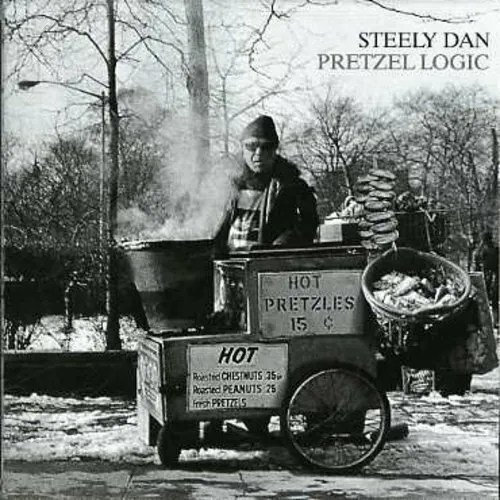
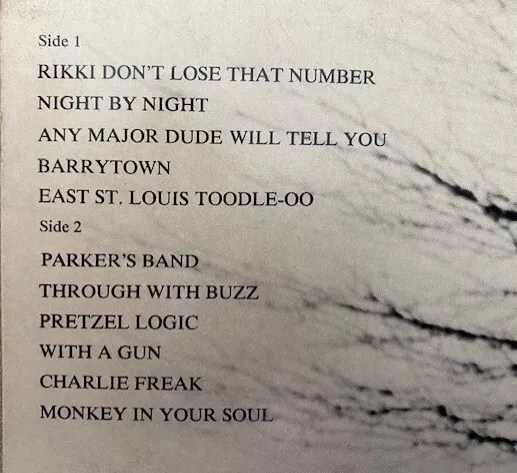
By 1974, Steely Dan’s two albums had helped established the band as a viable business proposition. With Pretzel Logic, they began a quest for studio perfectionism that would last for decades to come.
“If I could just afford one new CD a week, I’d be a happy man,” I declared to a coworker at Pure Pop Records in Burlington, Vermont, where I worked between 1995 and 1998. In the first years of my 20s, this goal represented the peak of my aspirations, and the fluke of fortune that won me employment at the hip, indie, basement record store — right out of High Fidelity — made the achievement possible.
Then I joined the Peace Corps and by September 1998 had landed in a tiny Estonian village to teach English for the next two years. The CD collection of about 600 I’d amassed from Pure Pop’s employee discount, promotional copies and trades could not make the journey, save a fistful of “desert island discs” slipped into a Case Logic and a backpack.
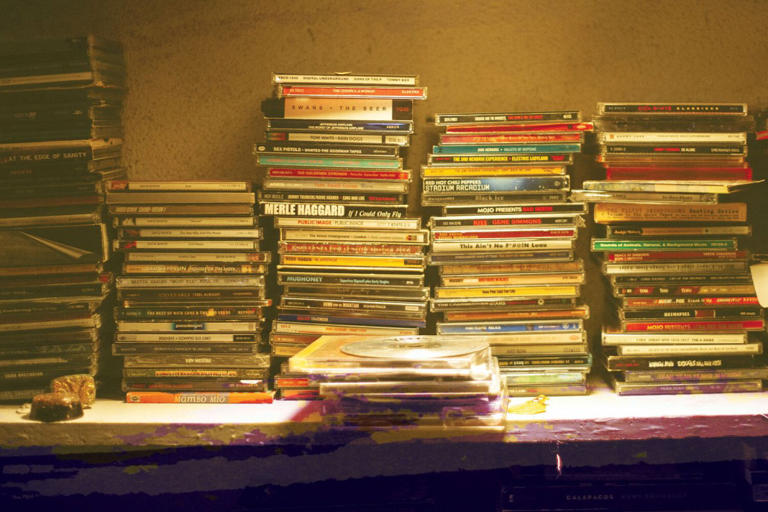
The rest of the collection took its own journey, staying tucked away in a variety of storage areas as I pursued collecting countries over the next two decades. In fact, most remained under literal wraps until 2023, when I finally was able to bring it all back home. By this point, the collection was much reduced. Many boxes had disappeared, some storage locations were forgotten or no longer existed, other discs were gifted and sold, and one box simply melted in the attic heat into plastic abstract art. Nevertheless, the 250 survivors now stand tall in the corner of my living room — the first time in 25 years.
To my surprise, as the ‘90s discs took their first spins in decades, more came from the speakers than just music.
This Is Me
“What really matters is what you like, not what you are like,” Nick Hornby wrote in his novel High Fidelity, and ‘90s CD collections offered this window to the soul in a very public way, as most everyone kept their music collection in the common areas — if not making it a centerpiece. A simple scan of the titles and artists on display at any new person’s home, all clear along the spine, could reveal much about the person behind them. It wasn’t just the amount of classic rock vs. hip-hop vs country or other, but the method of organization (if any), condition of cases and the ratio of greatest hits compilations to proper albums.
With physical music collections far less common today and often packed away in storage, or secured behind platform passwords online, this powerful public expression of identity has been lost to many. Having the collection out in the open again returns it, proclaiming in a fulfilling way to the world — and myself — “This is me!”
Escape from the Planet of the Algorithm
Under the great algorithm in the sky, our choices are shaped and directed by artificial intelligence and mathematical calculation. This is particularly true with music today, as platforms, playlists and channels push derivations of each other, as if part of a single musical family tree. That’s in stark contrast to the more human ‘90s approach that did not have these tools.
My collection provides a tangible and tactile reminder of this more analog time — even in a digital format — when purchases were driven more from word-of-mouth, life experiences, cover art and sometimes simply throwing a dart and seeing where it landed. The result was music I pulled toward me, not that was pushed on me. With the pull comes a closer connection and greater meaning, enriching a listening session with more soul than the algorithm can ever provide.
Pete didn’t leave with a polite handshake and a “best to you all” attitude. He left with a “thank f*cking God I don’t ever have to do THIS/THAT again” attitude.
As for the R&RHOF: he was approached by the band to sing “25 or 6 to 4” for the group’s performance that evening. The song is in the key of A minor and has been played that way since it’s inception and the horn parts are (virtually) cemented in place in A minor. Pete wanted to change the key to E minor…deliberately…knowing that would be impossible for the horns to cope…and the band said: “no”. Pete shrugged and said: “ok, then…no”. The rest of the group said: “fine, then…it’s a shame, but I guess it’s not to be…”.
(For the record: you can’t “just” transpose a brass section down a fourth without major, MAJOR musical issues.
Pete might as well have said: “I’ll do it if you guys can swim fast in quicksand….no, faster than that…”)
Peter drew up his own terms to play in the R&RHOF induction and chose not to even show up when his “demand” couldn’t be met.
This really does show Cetera’s utter contempt for Chicago and his indifference to his time in the group…
…even if he wouldn’t perform he could have been in the audience cheering on his old group for finally getting the respect that they deserve.
Whatever. It’s (very) over by now and a reunion is completely impossible.

 Every Moment Has A Song