Pink Floyd’s burning man: Aubrey Powell’s best photograph

(via The Guardian) by Joobin Bekhrad

Storm Thorgerson and I had created most of the artwork for Pink Floyd’s albums, including Dark Side of the Moon. One day we were asked to Abbey Road Studios to listen to tracks from the band’s new record. The lyrics were mostly about absence, and the album’s title, Wish You Were Here, was a reference to Syd Barrett, who had left the band some years earlier due to issues with LSD. They were also making a statement about record company executives who regarded musicians as money-making machines, demanding one hit song after another – an absence of a different kind.

We were talking late one night with our friend George Hardie, kicking around ideas. Storm said: “Have a Cigar [the album’s third track], is about insincerity in the music business. What about an image of two businessmen, and one of them is getting burned in a deal?” We all thought the image was a good idea, and I remember saying to Storm: “How are we going to do that?” He replied: “Set a man on fire.”

Read more: https://www.theguardian.com/artanddesign/2020/aug/12/burning-man-pink-floyd-wish-you-were-here-aubrey-powell-best-photograph

When Sha Na Na opened for Jimi Hendrix at Woodstock: ‘Hippies thought they were on a bummer!’

(via yahoo music) by Lyndsey Parker

When most classic rock fans think of the original Woodstock festival, held a half-century ago in Bethel, New York, certain iconic rock stars probably spring to mind. Grateful Dead. Janis Joplin. Crosby, Stills, Nash & Young. Joe Cocker. Sly Stone. And, of course, Jimi Hendrix.

Sha Na Na probably don’t spring to mind.

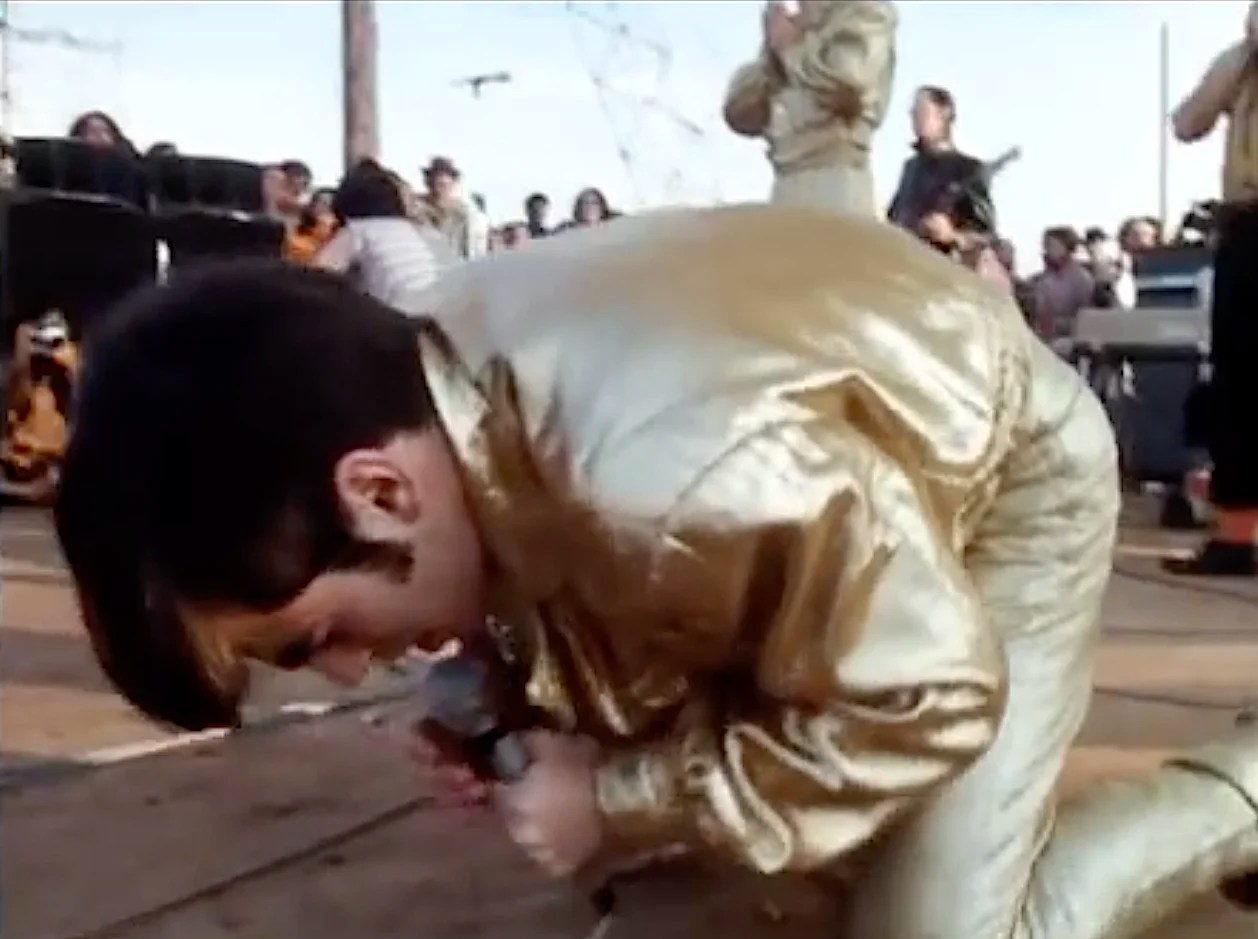
But the kitschy ‘50s revival act, who’d originally formed as an a cappella group at Columbia University in the late 1960s at the height of hippie counterculture, and had only played seven previous gigs, were unlikely breakout stars at Woodstock ’69 — after the virtual unknowns secured a prime slot right before Hendrix’s weekend-closing set on Aug. 18, 1969. And they went down in history as one of the coolest, most unique acts on the bill. “We were certainly against the grain at Woodstock,” says founding Sha Na Na member Jocko Marcellino.

And incredibly, this was all thanks to Hendrix himself, who discovered Sha Na Na at a Hell’s Kitchen nightclub called Steve Paul’s Scene and convinced Woodstock promoters Michael Lang and Artie Kornfeld to book them for the festival…

Read more: https://www.yahoo.com/entertainment/when-sha-na-na-opened-for-jimi-hendrix-at-woodstock-they-thought-they-were-on-a-bummer-040000126.html?guccounter=1

Quora: Why didn’t Paul and John attend the Bangladesh benefit concert that George Harrison put together at Madison Square Garden in 1971?

(Answered by Gene Popa)

George asked both of them. Paul said he would participate, but only if the other three Beatles agreed to legally dissolve their partnership (which is what McCartney was at that point suing in court to achieve). George declined.

John actually showed up at the rehearsal, but when he asked what Yoko’s role in the concert would be (obviously expecting she would get a solo set of her own), George replied, “I would like her to enjoy the show.” In a huff, John and Yoko stalked out and did not perform.

John and Yoko did attend the film’s premiere in New York City, and he seemed to be enjoying himself by clapping and cheering the performances on the screen. However, during Bob Dylan’s performance segment, John and Yoko suddenly stood up and left the theater without explanation.

Quora: What was Paul McCartney’s most intricate bassline in ‘The Beatles’?

(Answered by Thomas Luton)

Paul McCartney was arguably the most musically gifted out of all 4 Beatles. As the groups bassist, he used this ability to create wonderfully intricate and melodic bass lines.

Perhaps his most intricate bass lines are found on the last Beatles album ‘Abbey Road’. You have to remember that by this point in 1969, the Beatles were at the absolute pinnacle of their musical ability after producing several incredible albums.

Abbey Road is a masterwork of production and musicality and Paul’s bass lines reflect his abilities as a bassist. I think this is reflected in the song ‘Something’, maybe George Harrison’s magnum opus.

An incredibly written love song , ‘Something’ is a beautiful ode to love and commitment. Although the song was written by Harrison, I would recommend listening to Paul McCartney’s incredibly melodic and interesting bass line.

Busy and richly melodic, this bass line emerges as one of the most prominent features of the track. Although accused of some, including Harrison himself, of being too busy, I think it clearly reflects Paul’s incredible creativity and ability as a bassist.

On Music…

Quora: Why does the 70s classic rock sound so good? What caused it to go out of style?

(Answered by Dale Monzon)

There have been references to a couple of the biggest differences that I believe are the biggest contributors to the quality of the music.

In the 60s and 70s bands got together a lot to practice and play. Hours were spent on working on the music, playing together. Once you had enough songs you might play a small bar or club. Local clubs had open nights where several bands would each play a 30–45 minute sets. This was not paid, you just did it for the experience and exposure. Hopefully you’d win a few new fans, they would show up at your next gig with their friends and you would build a fan base. Once you got popular enough to draw a crowd you might start getting paid. In the meantime your band got tons of experience and time to work on performance quality.

The second part of this is that recording techniques were completely different. In the early 60s they were basically live performances where the whole band went in and played the music as a group. This evolved into single tracking where each player went into the booth individually – the drummer would record, then the bass player laid down his track, etc. The first studio album I did was done this way. Everybody had to know how the music fit together and sounded in live performance to put this together.

Flash forward to today. I just did some recording a couple months ago. Everything is now digital cut-and-paste. The song writer has constructed a synthesized version of his song – no interaction for the bass player to invent their part, as the sax player I’m not creating the music going on the album the way I’d naturally play it. Studio time was devoted to recording a couple short phrases which will be modified and edited on the computer. Non of the musicians have played this as a live composition or even with other performers in the room. Live performing is rare for this group. If we ever do play a public gig we will have to learn the music off of the recording. There is nothing organic or interactive about recording music this way, no soul or feeling to it.

Previous Older Entries Next Newer Entries