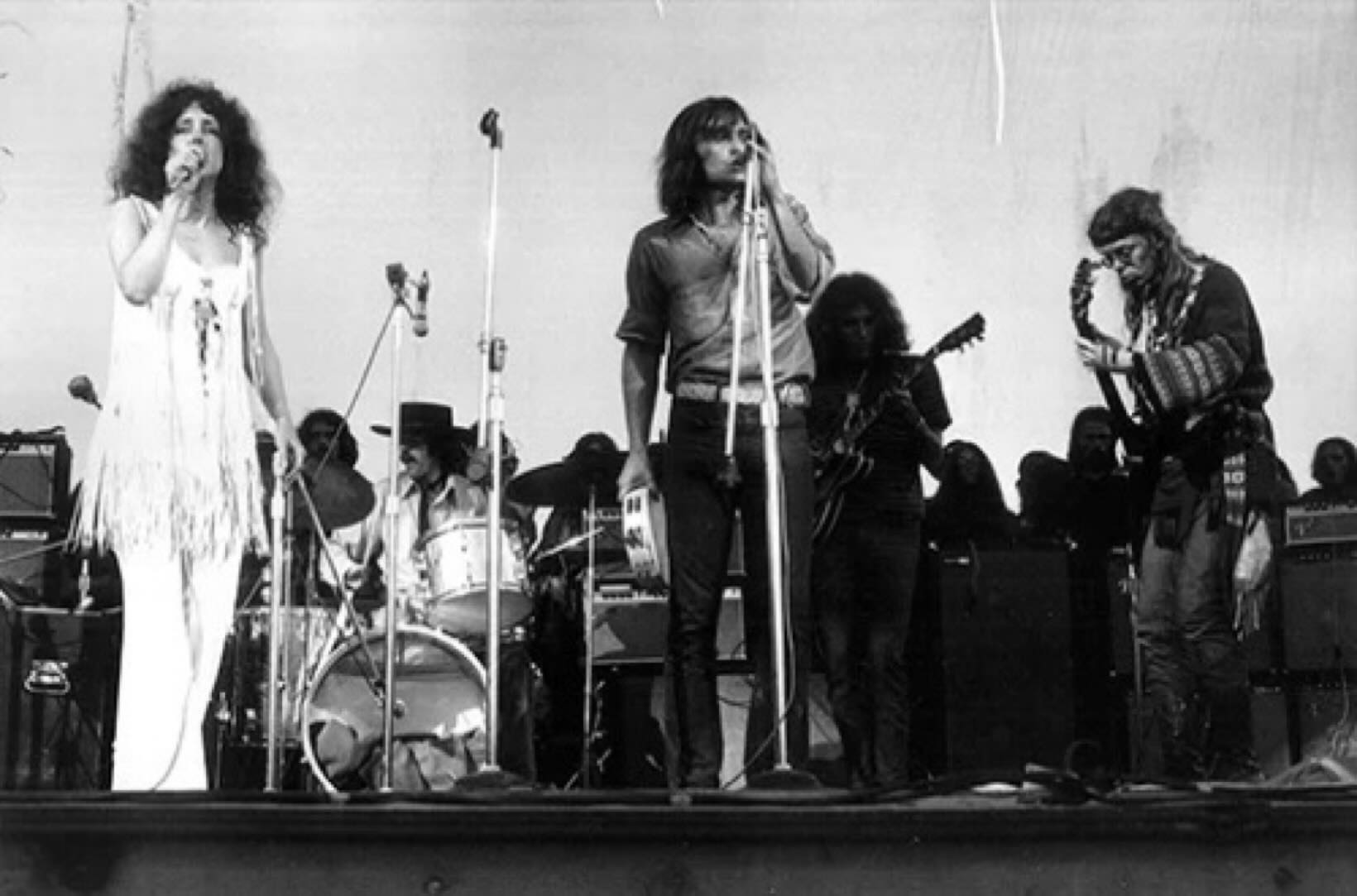
About six minutes into the song, a visibly stoned Jim Morrison bent over and pointed his leather-clad rear toward the Hollywood Bowl audience. Sensing trouble, keyboardist Ray Manzarek yelled “Jim!” The warning worked. Morrison stood up, retook the mike and completed the hit song: “Light My Fire,” as seen on “The Doors: Live at the Bowl ’68” (Eagle Rock), a newly restored DVD released Monday, Oct. 22.
Collaboratively written by the band in 1966, “Light My Fire” leaves a trail of history behind it. Originally lasting more than seven minutes, it featured one of rock’s first extended album solos. When the shorter single was released in ’67, it reached No. 1 on Billboard’s pop chart, and the following year, José Feliciano won a Grammy for his cover version.
Mr. Manzarek and Robby Krieger—two of the Doors’ surviving members—talked about the song’s famed keyboard intro, the Fats Domino connection, and why the single was faster-paced than the album version. Edited from interviews.
Ray Manzarek:By March 1966, we were running out of songs. Up until then, I had been putting chord changes to Jim [Morrison’s] sung lyrics. At a band rehearsal, Jim said, “Everyone go home this weekend and write at least one song.” But when we regrouped the following Tuesday, only Robby had written one. He called it “Light My Fire.”
Robby Krieger: I was living at my parents’ home in Pacific Palisades [Calif.] at the time. In my bedroom, I came up with a melody inspired by the Leaves’ “Hey Joe.” I also liked the Rolling Stones’ “Play With Fire,” so I wrote lyrics that used the word fire.
Mr. Manzarek: We had been rehearsing in the downstairs sunroom of a beach house at the very end of North Star Street near Venice [Calif.]. The people who lived upstairs were at work during the day, so we could bang away without disturbing anyone.
When Robby played his song for us, it had a then-popular folk-rock sound. But John [Densmore] cringed. He said, “No, no, not folk-rock.” He wanted it to sound edgier. He added a hard, Latin rhythm to the rock beat, and it worked.
Mr. Krieger: As Jim sang, he changed the melody line a little to give it a bluesy feel. Then he came up with a second verse right off the top of his head: “The time to hesitate is through/No time to wallow in the mire…”
Mr. Manzarek:Once the lyrics and melody were set, we realized we could jam as long as we wanted on the song’s middle two chords—A-minor and B-minor—the way John Coltrane did on “My Favorite Things” and “Olé.” All of us dug Coltrane’s long solos.
But we needed some way to start the song. At the rehearsal, I started playing a cycle of fifths on my Vox Continental organ. Out came a motif from the Bach “Two- and Three-Part Inventions” piano book I had used as a kid. It was like a psychedelic-rock minuet.
We didn’t use a bass player—I played the bass notes on a Fender Rhodes keyboard bass while my right hand played the Vox, which could be cranked up to a screaming-loud volume. My bass line for “Light My Fire” grew out of Fats Domino’s “Blueberry Hill,” which I loved growing up in Chicago.
Mr. Krieger: We started playing the song at the London Fog on the Sunset Strip in April and May 1966 and at the Whisky A Go-Go between May and July. Onstage, the song became this rock-jazz jam. Audiences loved it.
Mr. Manzarek: In August ’66, when we went into Sunset Sound to record our first album, producer Paul Rothchild wanted us to record “Light My Fire” just as we had been playing it live. We recorded two takes—each one lasting over seven minutes. Nobody was recording extended solos on rock albums then.
Mr. Krieger: Afterward, Paul felt the song needed a little more drama at the end. Because Paul loved what Ray had done with the minuet in the beginning, he said, “Hell, let’s put it at the end, too.” So he spliced in a copy of Ray’s minuet after Jim’s vocal, as an outro.
Mr. Manzarek: Paul brought in Larry Knechtel of the Wrecking Crew to overdub a stronger bass attack. Then the master was blasted into the studio’s cement echo chamber, which gave the song reverb.
Mr. Krieger: A few months after “The Doors” album came out in January 1967, Elektra founder Jac Holzman called and said the label wanted a single for AM radio. Dave Diamond, an FM disc jockey in the San Fernando Valley, had been playing the album version and was getting a ton of calls.
Mr. Manzarek: But a single meant our 7:05-minute album version had to be cut down to 2½ minutes. Everyone groaned, but Paul said he’d take a crack at it. When we heard the result the next day, the organ and guitar solos were gone. Robby and I looked at each other and said to Paul, “You cut out the improvisation!”
Paul said: “I know. But imagine you’re 17 years old in Minneapolis. You’ve never heard of the Doors and this is the version you hear on the radio. Would you have a problem with it?” Jim sat there and said, “Actually, I kind of dig it.” We agreed.
Mr. Krieger: It was gut-wrenching to hear my guitar solo cut, but I actually liked the single better. I was never crazy about the album version. It had been mixed at a very low volume to capture everything. On the radio, it wasn’t very loud or exciting. The single, though, snapped. The secret was that Paul had wrapped Scotch tape around the spindle holding the pickup reel, so the tape would turn a fraction faster. This made the pitch a little higher and brighter, and the song more urgent.
Mr. Manzarek: I first heard the AM single with my wife, Dorothy, in our VW Bug. Dorothy started bouncing up and down like a jumping jack. I was pounding on the wheel. What a feeling.
Mr. Krieger: At first, I didn’t like José Feliciano’s 1968 version. It was so different and laid-back. But after a while, I came to love it. He made our song his own, which got others to record it. Thanks to José, the song is our biggest copyright by far.
When one of his eyes doesn’t feel as if it’s wobbling up and down, or he doesn’t feel so depleted that he has to nap, Matthew Sweet still has moments of hope. Until last fall, one of the downstairs rooms in his Omaha, Nebraska, home was his music room, filled with guitars, a recording console, and assorted gear. But since he can no longer climb stairs for the foreseeable future, he now spends a good deal of his time in that room on a newly installed king-sized bed. What remains of his musical setup is still visible, reminders of a life and career on pause.
I guess I have a feeling that I will make music with all of it,” Sweet says, in his first interview eight months after he was rushed to a hospital. “In that way, it’s positive. It’s a vision of the time when I’ll be able to use everything. I don’t feel like it’s that far away. I don’t feel like it will be an impossible thing for me to write songs. Then again, I don’t really feel a burning desire to figure that out, because there’s just so much stuff making it difficult right now.”
For Sweet, 2024 was shaping up to be a reset. After several years off the road after the pandemic, the man who almost single-handedly kept power-pop alive had put together a new band and played shows in the spring. He was in the early stages of prepping his first album since 2021. In the fall, he started another round of gigs, this time opening for Hanson, whom he’s known and worked with for more than 20 years, and doing his own separate shows. “I really felt very positive about it,” he says. “I was doing two-hour-long acoustic shows playing songs from all during my career.”
Then, last Oct. 12, Sweet and his crew – his small acoustic band, his road manager – arrived at their hotel in Toronto. His tour with Hanson was into its second week, and Sweet had just driven up from the previous stop in Baltimore. As they were checking in, the singer, who had turned 60 a week before, felt a sensation he’d never experienced before. “The first thing I felt was really cool, like cold sweat,” he says. “And I remember saying to one of my band members, ‘Feel my arm. It’s freezing cold.’ Something wasn’t right.”
Slumping into a chair behind the front desk, Sweet began hearing what he calls “this kind of tinnitus, more like white noise, and that became really, really, really loud, in both my ears. And that’s the last thing I remember until I was in an ambulance and I heard a guy say, ‘Sir, you’ve had a stroke.'”
(via Billboard and People) by Steve Knopper/Rachel DeSantis
Connie Francis is having a moment six decades in the making.
If not for TikTok, Connie Francis‘ 1962 tinkly organ bop “Pretty Little Baby” may have been forever obscure. It was never a hit, and Francis, reached by phone at her Parkland, Fla., home, barely remembers recording it. “I had to listen to it to identify it,” admits the 87-year-old pop legend, who became the first woman to top the Billboard Hot 100 as a solo act in July 1960 with “Everybody’s Somebody’s Fool,” one of her three Hot 100 No. 1s.
“Then, of course, I recognized the fact that I had done it in seven languages.”
A friend recently informed Francis that “Pretty Little Baby” had turned up on TikTok as a “viral hit,” an upbeat soundtrack for people (including Kylie Jenner and Kim Kardashian) showing off babies, puppies, kittens and – befitting the lyric “you can ask the flowers” – flowers. Francis responded: “What’s that?” In a sense, TikTok is just a technological update of American Bandstand in the ’60s, when Dick Clark’s TV countdown regularly drew 8 million viewers and automatically turned songs into hits. “Without Dick Clark, there would have been no Connie Francis,” Francis says.
Connie Francis, circa 1960.Archive Photos/Getty Images
“Pretty Little Baby” was one of 40 songs Francis recorded during several recording sessions over four days in August 1961, according to her 2017 autobiography Among My Souvenirs: The Real Story Vol. 1. The track landed on her Connie Francis Sings Second Hand Love & Other Hits album.
Francis was 23 years old when the song came out as a B-side to the single “I’m Gonna Be Warm This Winter.”
On April 10, “Pretty Little Baby” was streaming 17,000 times per week in the U.S.; a month later, it was streaming 2.4 million times, an increase of more than 7,000%. The track has 10 billion TikTok views, hitting No. 1 on the app’s Viral 50 and Top 50 charts, and recently crossed over to streaming success, with 14 million global streams, landing at No. 67 on Spotify’s Global Top 100. Francis’ label, Universal Music, recently reissued the versions Francis had sung in Swedish, Japanese and other languages in 1962, when her label, MGM, hoped to score hits in regions outside the U.S.
Of her newfound virality, she tells Billboard: “I’m getting calls from everywhere: ‘You’re a TikTok phenomenon.'”
Editor’s note: This story parallels that of a tune called “Ladyfingers”, from Herb Alpert & the Tijuana Brass’ 1965 Whipped Cream & Other Delights album, which the 90-year-old Alpert reports has generated over two billion views on TikTok. And like Connie Francis’ “Pretty Little Baby”, “Ladyfingers” wasn’t a hit, or even a single.
And to put Connie Francis’ 10 billion TikTok views for “Pretty Little Baby” into perspective, the number is roughly 3 times the world’s population in the year the song came out.
Connie on recording her first hit, “Who’s Sorry Now”:
I didn’t want to record the song. My father insisted that I record “Who’s Sorry Now.” I did three other songs at the session first, in the hopes of not being able to get to “Who’s Sorry Now” in the four-hour time allotted to me. I had 16 minutes left in the session and I said, “That’s a wrap, fellas, there’s no time for ‘Who’s Sorry Now.'” My father said, “If I have to nail you to that microphone, you’re going to do at least one take of ‘Who’s Sorry Now.'” So that’s what I did – one take of “Who’s Sorry Now.” And I didn’t try to imitate anybody else, as I always had on my recordings. By the time I was 14, I did demonstration records, and a publisher would say, “Connie, give us some of that great Patti Page sound, give me some of that great Kay Starr sound, give me some of that great Teresa Brewer sound.” I didn’t have a style of my own yet. But on “Who’s Sorry Now,” I was so turned off on the song that I didn’t try to imitate anybody else. I just sounded like myself for the first time. And it was a hit.
The New Jersey native dealt with a number of tragedies over the years, including mental health struggles. She is now retired and lives in Florida, where she regularly posts photos of her day-to-day life.
Not ones for living in the past, Jethro Tull are back with their 24th album – and third in three years – Curious Ruminant. It finds frontman Ian Anderson embracing his love of sci-fi and issuing a warning about climate change. He tells Prog about building on the band’s legacy, hamming it up for the crowd and making sure all the semiquavers are in the right place.
Twenty minutes into his scheduled 9am Zoom interview with Prog, Ian Anderson has yet to appear. This is very unlike him and there is speculation about his whereabouts. Is he feeding his chickens? His pigs? Has he become absorbed in some music at his home studio? It’s a safe bet Jethro’s Tull’s venerable leader is up and doing something, because even now – or maybe especially now, given time’s year-stealing march – indolence is not this driven, 77-year-old flautist’s way.
Suddenly Anderson appears on screen, apologising that he has only just learned of a Google spreadsheet apprising him of the day’s many tasks. It turns out he’s been up since 6.30am (“A late start”) and has already replied to Derek Shulman of Gentle Giant’s email requesting a quote of endorsement for an upcoming memoir.
“I thought, ‘Okay, another end-of-life story,’” says Tull’s frontman, “but it’s what we do when we get older, right? You want to leave a legacy that isn’t just carved on your tombstone, but also carved in your own memory before it’s too late.”
After 24 studio albums and almost 60 years with Jethro Tull, Anderson’s legacy looks safe even before you factor in his not inconsiderable solo output. The band’s latest LP Curious Ruminant fulfils the contractual stipulations of their three-album deal with German prog label InsideOutMusic – but unlike 2022’s The Zealot Gene and 2023’s RökFlöte, it’s not a concept album; and it feels weightier, closer to home…
Matthew Baker/Getty Alice Cooper in London in October 2024
(via People) Story by Marina Watts
Alice Cooper is getting the band back together.
Cooper will be joined by Michael Bruce on guitar, bassist Dennis Dunaway and Neil Smith for the forthcoming album ‘The Revenge of Alice Cooper’
On Monday, April 21, the “School’s Out” rocker told Billboard that he and the original bandmembers Cooper, 77, Michael Bruce on guitar, bassist Dennis Dunaway and Neil Smith on drums would reunite for their first album together in over 50 years to release this July…