Carol Kaye, The First Lady of Bass Guitar

(via Culture Sonar) by John Montagna

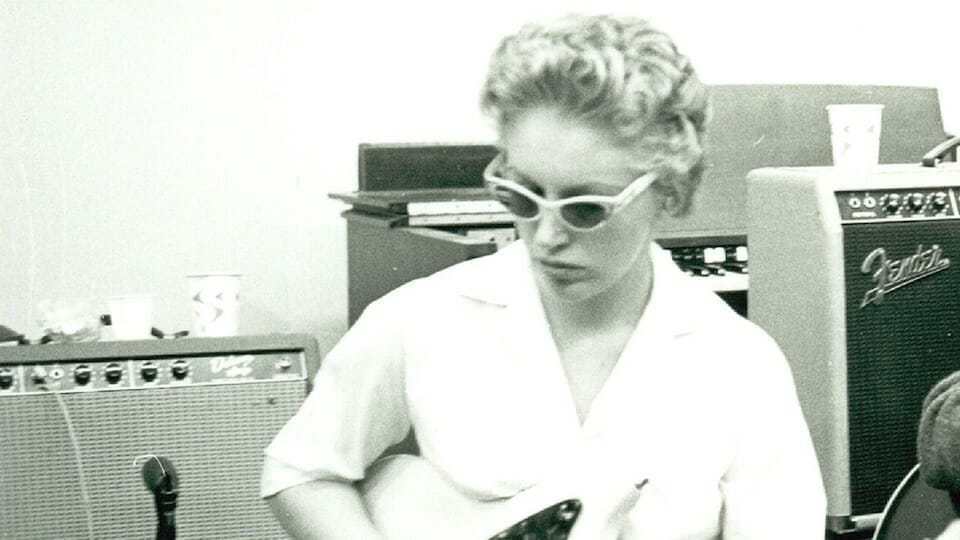
The Fender “Precision Bass” Guitar first appeared in 1951, and within a few short years the bass guitar created a seismic shift in popular music thanks to a number of forward-thinking musicians. Chief among these bold explorers is female bass player Carol Kaye, born in Everett, Washington in 1935.

Initially, on the fast track to success as a jazz guitarist in Los Angeles, Kaye was thrust into the lucrative Hollywood studio scene at a 1957 recording session with Sam Cooke. One morning at Capitol Studios the bassist didn’t show up, and Kaye spontaneously picked up a “Fender bass” and took over. Plectrum in hand, she immediately seized upon the creative potential of the instrument and became an indispensable member of the now-famous “Wrecking Crew” collective of session musicians. The Crew defined the sound of American popular music in the 1960s, but Kaye’s musicality, creativity, and distinctive tone (the result of flatwound strings and a pick) helped redefine the bass guitar’s role in the rhythm section. Some might not know Carol Kaye’s name, but if they’ve ever been near a radio (or a TV set) you’ve heard her bass playing. Here is some of her signature work.

Read more:

https://www.culturesonar.com/carol-kaye-first-lady-bass-guitar/

Battle of the Ax Men: Who Really Built the First Electric Rock ‘n’ Roll Guitar?

(via Collector’s Weekly) by Ben Marks

Many places deserve to be called the birthplace of rock ’n’ roll. Memphis often gets the nod because that’s where Sam Phillips of Sun Records recorded Elvis Presley belting out an impromptu, uptempo cover of “That’s All Right” in 1954. Cleveland makes the list since it’s the place where, in 1951, a local disc jockey named Alan Freed coined the genre’s name. Chicago’s claim precedes Cleveland’s by several years; in 1948, McKinley Morganfield, aka Muddy Waters, took the tiny stage of a neighborhood tavern called Club Zanzibar, pulled up a chair, and played his hollow-body electric guitar so loud, the sounds emanating from his small amplifier crashed upon the sweaty crowd in waves of soul-stirring distortion.

Those would all be good choices, but for author Ian Port, whose new book, The Birth of Loud, has just been published by Scribner, the birthplace of rock ’n’ roll could also be the former farming community of Fullerton in Orange County, California. That’s where an electronics autodidact name Clarence Leonidas “Leo” Fender founded a radio repair shop in 1938. By 1943, Fender and a friend named Clayton “Doc” Kaufman, who was Fender’s business partner in those days, had taken a solid plank of oak, painted it glossy black, attached a pickup at one end, and strung its length with steel strings

Read more:

Battle of the Ax Men: Who Really Built the First Electric Rock ‘n’ Roll Guitar?

They Really Don’t Make Music Like They Used To

CreditCreditPeter Dazeley/The Image Bank, via Getty Images

(via The New York Times) By Greg Milner

It’s Grammy time, and as always, watching the awards ceremony on Sunday will include a subtext of cross-generational carping: “They don’t make music the way they used to,” the boomers and Gen Xers will mutter. And they’ll be right. Music today, at least most of it, is fundamentally different from what it was in the days of yore — the 1970s and 80s.

Last year, the industry celebrated a sales milestone. The Recording Industry Association of America certified that the Eagles’ “Their Greatest Hits (1971-1975),” was the best-selling album of all time, with sales of 38 million. (The formula took account of vinyl, CD and streaming purchases. Purists will have to put aside the fact that a greatest hits collection is not really an LP album as most of us know it.)

It was a full-circle moment — the album, released almost exactly 43 years ago, was the first to be awarded platinum status (sales of one million), an evocative reminder that songs were once commodities so valuable that millions of people would even buy them in repackaged form. It was also a taken as a quiet victory for people who believe that music today is too loud…

Read more:

A History of the Moody Blues

The Lost Steely Dan Song: ‘Gaucho’ Outtake “The Second Arrangement”

After the 1977 release of Steely Dan’s massive commercial and artistic triumph Aja, band masterminds Walter Becker and Donald Fagen, having taken most of 1978 off, reconvened in 1979 for a follow-up, which would be Gaucho.

One of the first things they got on tape was a song called “The Second Arrangement”, and all involved in its creation were extremely proud of the song. In fact, Backer and Fagen are said to have considered it to be among their best.

But in cueing the song up for playback, a junior studio engineer accidentally erased most of the recording.

The band attempted to re-record the song, but they couldn’t come up with a take that satisfied notorious perfectionists Becker and Fagen. The song, which might have given Gaucho a third hit single, never appeared on record. It was replaced on Gaucho with the more somber and shadowy “Third World Man”.

Over the years demos and bootlegs of the song have turned up, giving fans a glimpse of how glorious the Gaucho album could have been with the inclusion of this gem.

Below are two representations of “The Second Arrangement”. The first is a muddy working demo from the Gaucho sessions. The second, a live performance by Steely Dan tribute act Twelve Against Nature, is fleshed out with a horn section in an attempt to show what the lost final version may have sounded like.


Pour out the wine, little girl
I’ve got just two friends in this whole wide world
Here’s to reckless lovers
We all need somebody
Stashed in the yellow Jag
I’ve got my life and laundry in a Gladstone bag
You should know the program
Just one red rose and a tender goodbye
[One last goodbye]

And I run to the second arrangement
It’s only the natural thing
Who steps out with no regrets
A sparkling conscience
A new address
When I run to the second arrangement
The home of a mutual friend
Now’s the time to redefine the first arrangement again

It’s a sticky situation
A serious affair
I must explain it to you somehow
Right now I’ll just move back one square

Here comes that noise again
Another scrambled message from my last best friend
Something I can dance to
A song with tears in it
Old friends abandon me
It’s just the routine politics of jealousy
Someday we’ll remember
That one red rose and one last goodbye
[One last goodbye]

Then I run to the second arrangement
It’s only the natural thing
Who steps out with no regrets
A sparkling conscience
A new address
When I run to the second arrangement
The home of a mutual friend
Now’s the time to redefine the first arrangement again

Steely Dan’s Quiet Hero: Inside Walter Becker’s Troubled Life, Wry Genius

(via Rolling Stone) by Henry Diltz

For years, anyone who wanted to use the bathroom while visiting Walter Becker’s studio in the countryside of Maui was directed outside. There, mounted on one of the walls of a white outhouse, they’d find a gold-record plaque for Steely Dan‘s Aja – which, over time, began oxidizing and tarnishing in the ocean air.

It was a prime example of the irreverence, unflashiness and dark humor that Becker, who died at 67 on September 3rd, displayed his whole life. There were few, if any, rock stars like him. He looked and acted like a droll college professor, and in conversation he could expound on Samuel Beckett’s plays, delve into the details of the Manhattan Project or rattle off the names of sidemen on obscure jazz records.

Becker was as much an architect of Steely Dan’s airtight sound and skewed sensibility as his friend, singer-keyboardist Donald Fagen. The two co-wrote the Dan’s songs, oversaw their legendary persnickety recording sessions, and shared a love of Beat writing, sci-fi and other topics that resulted in the parade of freaks and geeks that inhabited their songs. (With his long hair, wispy beard, and diffident air, Becker even resembled one of those weirdos, especially in his youth.) A behind-the-scenes maestro, Becker often let others play his parts on record, and few fans knew the dramatic arc of his life – his painful childhood, and the addiction, seclusion and rebirth he endured as an adult. “His relationships were difficult, and his relationship with life was difficult,” says a friend, American-born Hindu devotional singer Krishna Das. “But music was always there for him. It was the most dependable source of beauty he had in his life.”

Read more:

https://www.rollingstone.com/music/music-features/steely-dans-quiet-hero-inside-walter-beckers-troubled-life-wry-genius-199094/

Previous Older Entries Next Newer Entries