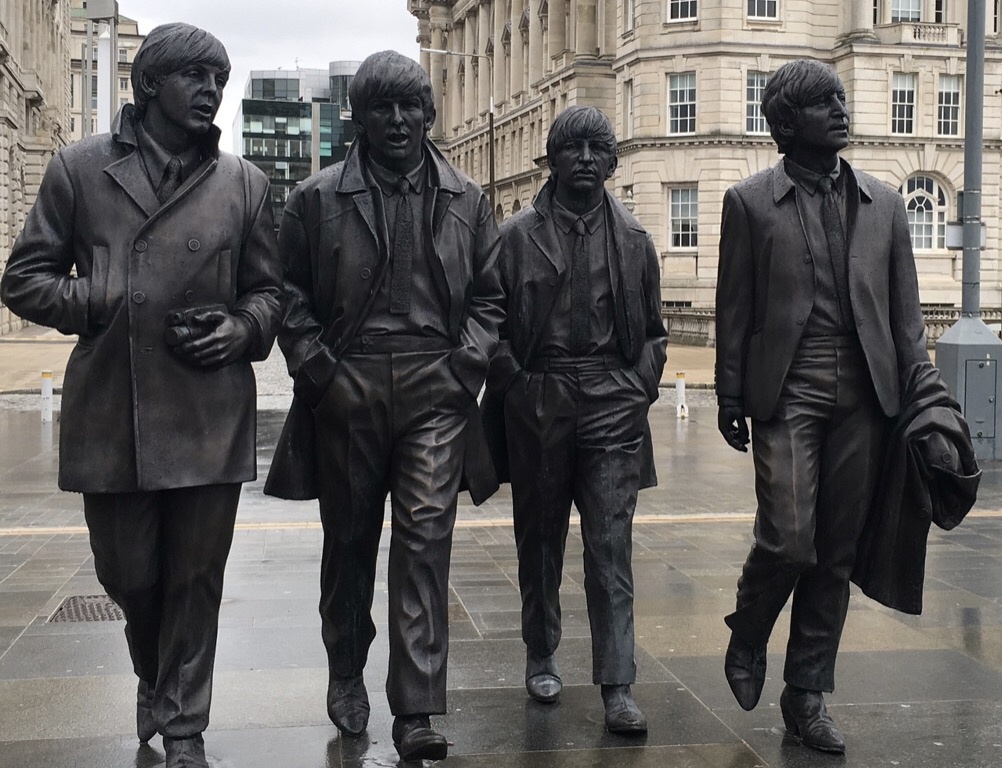
Quora: How was “Free as a Bird” by The Beatles Recorded?

(via Quora) Answered by George Paolini

It all started with a cassette version of the song recorded by John Lennon in his apartment in New York in 1977 …

To put a bit of context behind this time in his life, John was a homebody, taking care of Sean and baking bread. He was getting pretty good at the baking and apparently even thought about opening a bakery. Meanwhile, Yoko was investing John’s money in things like cattle ranches. Also, during this time, John and Paul had reconciled and had even considered, as a lark, taking up Lorne Michael’s farcical offer to pay the Beatles $1,000 each to reunite on Saturday Night Live.

So, given this period in his life, it is amazing he was still writing…

Read more:

https://www.quora.com/How-was-Free-as-a-Bird-by-The-Beatles-recorded

Bob Dylan Is Not a Fan of You Taking His Photo Onstage

© Provided by Penske Media Corporation 17th Annual Critics’ Choice Movie Awards – Show

(via msn entertainment) by Andy Greene

Bob Dylan has had a strict “no photos” policy at his concerts for years, but that’s rarely stopped fans from taking our their cellphones and trying to snap a few images before security swarms. But on Tuesday night at a show in Vienna, Austria, he finally reached his boiling point when he stopped singing “Blowin’ in the Wind” after one verse to admonish the audience.

“We can either play or pose,” he barked into the microphone according to multiple reports. “It’s your decision!”

Read more: https://www.msn.com/en-us/music/news/bob-dylan-is-not-a-fan-of-you-taking-his-photo-onstage/ar-BBW2EKb?ocid=spartanntp

40 Years Ago: Supertramp Blow Up with ‘Breakfast in America’

(Via Ultimate Classic Rock) by Jeff Giles

After toiling in obscurity with their earliest releases, Supertramp managed to score a few hit singles and albums during the mid-to-late ’70s — but they were only a warm-up for their sixth album, Breakfast in America.

Released in March 29, 1979, Breakfast found the band moving away from the more serious, prog-influenced fare that anchored records like 1974’s Crime of the Century and 1977’s Even in the Quietest Moments in favor of a more concise, radio-friendly approach that often emphasized the tongue-in-cheek humor of bandleaders Rick Davies and Roger Hodgson.

As Hodgson explained in an interview with Melody Maker later that year, “The songs on this album were chosen because we really wanted to get a feeling of fun and warmth across. I think we felt that we had done three pretty serious albums, and it was about time we showed the lighter side of ourselves.”

That didn’t mean Breakfast in America was all laughs, however; it was nearly titled Hello Stranger, due to a preponderance of songs about relationships broken by a lack of communication — a subject Davies and Hodgson knew well, given how poorly they were getting along during the making of the album…

Read more: https://ultimateclassicrock.com/supertramp-breakfast-in-america/

A brief history of why artists are no longer making a living making music

(via Roots Music Canada) by Ian Tamblin

Today’s column from veteran Canadian singer-songwriter Ian Tamblyn is adapted from a speech he gave at a symposium at Trent University.  It’s a long read, but we decided to post it here all at once it its entirety because, well, it’s just that good. 

I would like to begin this talk on the future of “popular” music with a few cautionary notes about our ability to see into the future clearly. The fact is, it would appear we are not very good at it. Somewhere back in our Savannah DNA, we got very good at reacting to danger when it presented itself — say a lion or tiger. However, it seems we are less capable of looking ahead to avoid danger. In other words, we are a reactive rather than proactive animal. The contemporary analogy in relation to climate change is that we are similar to the frog in a pot of hot water who does not have the sensors to recognize the increasing temperature and the fact that he should get out of the boiling pot.

Yes, there have been a handful of futurists – H.G Wells, Aldous Huxley, and given the state of many current governments I would grudgingly include Ayn Rand. Probably the most successful futurists in our lifetime may have been Marshall McLuhan and Stanley Kubrick, but even so, all of these writers and film makers have been only partially successful gazing into the crystal ball. Given that the past is no more fixed than the future I begin this conversation with you.

What I hope to discuss in this time with you is the relationship between technology, the gift of music and the commodification of that gift and how that gift and the commodification of the gift has been eroded in the digital age, and as I see it, could continue to be eroded well into the 21st century…

Read more: https://www.rootsmusic.ca/2019/03/14/a-brief-history-of-why-artists-are-no-longer-making-a-living-making-music/

On Music…

1

FB_IMG_1547236543564
3

MusicSpeaksQuote


tumblr_njz0d0LRE51snexhzo1_1280.png


How ReadyToPlay Can Save Your Music Collection

(via Seagate blog) by Steve Pipe

Quick — when was the last time you listened to music on a compact disc? If you’re like many consumers, you probably have stacks of CDs gathering dust at the back of an entertainment cabinet or boxed up in a closet. You’d like to get them all onto your computer and smartphone, but that’s a daunting task… How can you easily digitize hundreds or thousands of CDs?

CDs — a once-dominant format — have lost ground to streaming services like Spotify, Apple Music and Pandora. That doesn’t mean CDs are dead — far from it. For the first time since 2011, sales of physical media surpassed digital downloads, according to new data from the Recording Industry Association of America. Physical media (which includes CDs and vinyl) declined 4 percent in 2017, compared to 25 percent for digital.

More people are streaming music, but many still want to digitize their favorite CDs

That’s good news for Jeff Tedesco, president of ReadyToPlay, a Palo Alto, California-based company that “rips,” or digitizes, CD collections. Tedesco started his company in 2004, when more and more people were making the switch to digital, thanks to MP3 players like the iPod…

Read more:

https://blog.seagate.com/human/readytoplay-can-save-music-collection/?utm_source=FBPAGE&utm_medium=social&utm_content=100024802

Previous Older Entries Next Newer Entries