‘Hello Spud!’: How a Conversation About Potatoes Ultimately Led To Devo

via Spin.com

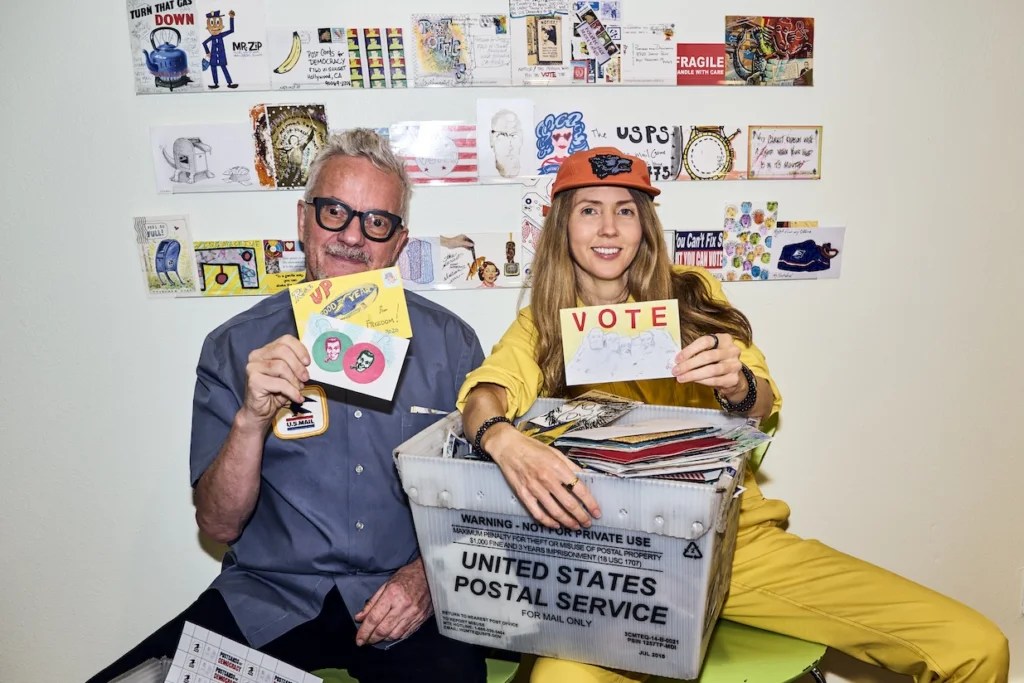
Three days had passed since the 2024 presidential election and, like millions of other Americans, Devo co-founder/frontman Mark Mothersbaugh was baffled by the outcome. One of the masterminds behind the Postcards for Democracy art project, Mothersbaugh has been deeply interested in politics since the 1970s. Devo itself is short for “de-evolution,” the idea that mankind has stopped progressing and is instead now regressing.

With Donald Trump headed back to the White House, for half of the country it’s difficult to argue otherwise. But for now, Mothersbaugh is doing his best to embrace an alternate perspective.

“I’m just impressed with how many people could be attracted to the president that’s elected now,” Mothersbaugh tells SPIN with a sense of bewilderment. “He’s going to be our president next year. I’m just impressed because his techniques all seem like warning signs of reasons why not to honor him.

“I’m curious to see where it goes because over half the country seems to be approving. Maybe this is a year I learn something that I didn’t know before. I guess it’ll be interesting to see which things he was telling the truth about and which things he was lying about.”

Postcards for Democracy, launched alongside artist Beatie Wolfe in 2020, carries on Mothersbaugh’s tradition of making postcard art, something he did even before the early days of Devo. In fact, it was a postcard that brought Devo bassist Gerald “Jerry” Casale and Mothersbaugh together while studying art at Kent State University…

Read more: https://clubdevo.com/hello-spud-how-a-conversation-about-potatoes-ultimately-led-to-devo/

Mozart Meets Bob Dylan: Amadeus VS A Complete Unknown

(via WETA) by James Jacobs

I recently saw A Complete Unknown. Bob Dylan is one of my favorite artists, and I actually got to meet and work with Pete Seeger (in fact I visited his log cabin that Dylan spends the night in early in the film, and I can attest that they got those details right) so I was excited to see those two icons acknowledged in our current popular culture and introduced to a new generation. Judging from reactions to the film on social media, the movie was a resounding success on that front (though Joan Baez seems to be the artist depicted in the film who’s really resonating with the younger generation.)  

There is no such thing as a perfect biopic that will satisfy both the people who know the history going in and those for whom the film acts as an introduction to the subject. I knew the film would take liberties, and that my reaction would be colored by my own feeling of connection to the period and milieu it depicts. The movie opens in 1961, the year Dylan arrived in New York at age 19, and also the year I was born on Long Island approximately 35 miles east of Greenwich Village. 31 years later I moved to New York and I played at some of the same clubs Dylan played in and got to meet icons like Pete, and Alan Lomax, and Theodore Bikel. I figured that’s the world I would be obsessed with upon exiting the film. 

Courtesy of Searchlight Pictures. © 2024 Searchlight Pictures All Rights Reserved.rchlight Pictures

But instead I left the film thinking about another artist I am obsessed with but had never previously associated with this universe: Wolfgang Amadeus Mozart. 

Actually I thought about TWO Mozarts: the real one and the one dreamed up by the demented Antonio Salieri in Peter Shaffer’s play and screenplay Amadeus.  

Both Amadeus and A Complete Unknown are about immature genius savants who produce art that contains a deep well of wisdom and humanity completely lacking in their social personalities. The main characters are almost supporting players in their own stories, because what they’re really about are the people who try to connect with them but just can’t make sense of the profound disconnect between the sublime music and the selfish brats that produced it.  

Bob Dylan’s journey from provincial Minnesota to exciting New York is remarkably similar to Mozart’s escaping Salzburg for Vienna. They were both young, hungry, probably on the neurodivergent spectrum, had a justified confidence in their own abilities that made them both impatient with those who didn’t “get” them and distrustful of those who did, craving attention but unwilling to follow the established protocols necessary to cultivate their reputation and status within the industry – though they intuited that their rebelliousness actually helped their celebrity status even as it aggravated those managing their careers…

Read more: https://weta.org/fm/classical-score/mozart-meets-bob-dylan-amadeus-vs-complete-unknown

Wolfgang Amadeus Mozart (seated at piano) with his sister Maria Anna (left) and his father Leopold

Jimmy Longhi Remembers Woody Guthrie

In 1996 Smithsonian Folkways Recordings released That’s Why We’re Marching, a collection, mostly, of folk songs dating from the first half of the 1940’s.

Among the album’s trove of rare and seldom heard songs of both pro- and anti-war sentiment is one memorable spoken-word track: a story by Vincent “Jimmy” Longhi about his friend, a folk singer by the name of Woodrow Wilson Guthrie–better known to the world as Woody.

Attorney, playwright and author Longhi’s story is also recounted in his book Woody, Cisco, and Me: Seamen Three in the Merchant Marine, which chronicles his time traveling with convoys of troops during the Battle of the Atlantic with Guthrie and folk singer Cisco Houston.

The Guthrie song referenced in the story in its entirety:

…and another reminiscence from Longhi about the time their ship struck a mine in the Mediterranean, killing one person aboard:

Man mocks woman wearing band t-shirt by asking her to name three songs but has no idea who she actually is

(via Tyla) by Jen Thomas

If you’ve ever worn a band t-shirt out in public, there’s a very high chance you’ve been asked this question.

A woman has gone viral after sharing a video on TikTok of the aftermath of a hilariously awkward encounter that has had commenters rushing to suggest appropriate replies.

It’s the bane of every female music fan’s life, when you’re just trying to mind your own business and someone challenges you.

The woman, called Jo, shared a TikTok video captioned: “I don’t know how I should feel about this…” of her sitting in a diner moments after the incident.

Wearing a t-shirt emblazoned with the logo for the band Bad Habits, she sits awkwardly wondering what just happened.

On the video she explained: “Guys, I was casually waiting for my food wearing my band’s merch and a guy came up to me and asked me to name three songs.”

Problem is… Jo is the singer of the band he’s asking about…

Read more: https://www.tyla.com/entertainment/music/tiktok-band-bad-habits-man-asks-name-songs-398336-20250106

Was the First-Ever Gold Record Awarded to Glenn Miller or Perry Como? Answer: Both (Sort Of)

If you Google Perry Como’s “Catch a Falling Star” you’ll likely read that the 1957 hit song received the Recording Industry Association of America’s first-ever Gold Record Award.

Trouble is, if you look up Glenn Miller’s “Chattanooga Choo Choo” you’re probably going to see a similar claim made for the 1941 tune.

So what’s the deal?

The deal is this: The early Gold and Silver Record Awards were given by record companies (RCA Victor in the case of Glenn Miller) in order to both recognize and publicize artists’ achievements.

Miller was presented a gold-sprayed record for sales of 1.2 million copies.

Harry Belafonte’s Calypso album and Elvis Presley’s “Don’t Be Cruel” single also received this type of award.

The RIAA’s official Gold and Silver Record program began in 1958, using independently verified sales statistics and codifying the standard (500,000 units sold for a Gold Record).

Thus “Catch a Falling Star” was the first official Gold Record, with the Oklahoma soundtrack becoming the first Gold album a few months later.

Platinum certification followed in 1976, with the standard being 1 million copies sold for albums and 2 million for singles.

The first Platinum Album was awarded to the Eagles for Their Greatest Hits (1971-1975).

1980 Queen Concert Review–and Brian May’s Response

Previous Older Entries Next Newer Entries