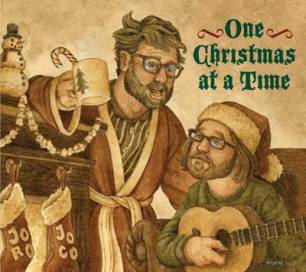
1. Jonathan Coulton and John Roderick: ‘The Week Between’
This may be the first holiday song dedicated to the week between holidays. This one’s endearing for being a little more slice-of-life than usual:
It’s almost time to eat again/The first ham sandwich shows up
Beats some of the stilted language you’ll find in some of the classics. Let’s face it, even quaintness can’t compensate for a bizarre lyric like:
In the meadow we can build a snowman/And pretend that he is Parson Brown/He’ll say ‘Are you married’ we’ll say ‘No, man, but you can do the job when you’re in town’

1. The Bobs with Jonathan Katz: ‘Santa’s Got a Brand New Bag’
One good Jonathan deserves another. This one is also known as ‘Dr. Katz’ from his self-titled Comedy Central show of years back. Great show, by the way. And Katz is in character here, playing the Jewish dad explaining Santa to his child while a cappella group The Bobs rework James Brown behind him.
Laying a finger upside his nose–and this is where he loses me–up the chimney he goes…

3. The Killers: ‘Boots’
Most of these songs stand alone. This one is made more affecting by the accompanying video.
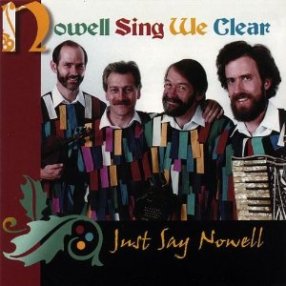
4. Nowell Sing We Clear: ‘I Saw a Maiden’
Nowell Sing We Clear are an English four-piece group who specialize in traditional English folk song and especially traditional Christmas carols. They turn in a nice a cappella performance here.

5. Over the Rhine: ‘Darlin’ (Christmas is Coming)’
From Snow Angels, Over the Rhine’s excellent 2007 collection of holiday originals. This is the rare Christmas song that straddles the sacred/secular border gracefully (though I’ll admit graceful straddling is difficult to picture).
So you look beyond Santa and Black Friday for the real heart of Christmas…but Anderson Cooper keeps reminding you Peace On Earth is a lofty, improbable ideal?
The idea here is that some of the season’s Big Picture concepts–hope, forgiveness and making a new start–often come down to two people. Maybe we’re all just responsible for Peace on our own little speck of Earth.
Anyway, nice song.

6. Aliqua: ‘O Come Emmanuel’
Canada’s choral group Aliqua blend many styles but arguably sound best doing sparely-arranged traditional music, such as this almost-a cappella ‘O Come Emmanuel’.

7. Squirrel Nut Zippers: ‘Winter Weather’
like this holiday chestnut because, unlike so many seasonal favorites, it’s never become so ubiquitous that I’ve had a chance to tire of it. It has been recorded several times though: Peggy Lee, Jo Stafford and Fats Waller all had a go at it in decades past, and it reappeared a couple years back in a rendition by Vanessa Williams. But my favorite version is by that band named after a candy bar.

8. Maddy Prior with The Carnival Band: ‘Lord, in the Morning’
It’s hard to imagine a time when even the oldest hymns we sing now were the subversive “new” music of the church–actually even illegal until about 1700 in merry old England. Charles and John Wesley helped to lead the transformation by writing music such as the Easter hymn ‘Christ the Lord is Ris’n Today’ and ‘Hark! The Herald Angels Sing’ for Christmas, songs whose words weren’t limited to Scripture text and allowed working class churchgoers a greater freedom of expression. It was like an earlier, Anglican version of the movement toward the “Folk Mass” spurred by Vatican Council II in the last century.
‘Lord, in the Morning’ dates from the earlier pre-Wesley form, from the psalter known as the ‘Old Version’ by Sternhold and Hopkins, which dated from 1562. As Christmas songs go, you can’t get much more old school than this.

9. Half Man Half Biscuit: ‘It’s Clichéd to be Cynical at Christmas’
I appreciate Half Man Half Biscuit for so many reasons. Their references are uncompromisingly British; they don’t really care if we ‘get’ them. They have songs with titles like ‘Look Dad No Tunes’ and ‘With Goth on Our Side’ and ‘Shit Arm, Bad Tattoo’, and album titles like Trouble Over Bridgwater. (Almost as good as Kirsty MacColl’s Electric Landlady)
And only these guys are ironic enough to come up with a post-secular, counter-cynical Christmas song–and put it in the middle of a non-Christmas album. It’s rather lo-fi, so in case you have trouble hearing lyrics I’ve included them:
Now how did I guess/You were going to express
Your disdain at the crane/With the bright fairy lights
And you moan at the snow/‘Cos your car wouldn’t go
Oh it’s cliched To be cynical At Christmas
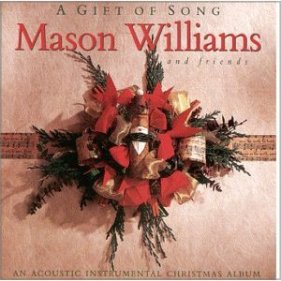
10. Mason Williams: ‘Coventry Carol’
Yes, it’s the ‘Classical Gas’ guy, doing a nice baroque arrangement of the late 15th-century ‘Coventry Carol’. The carol came from the mystery play Pageant of the Shearman and Tailors, and was originally a lament for Herod’s slaughter of the innocents.
Quoting the site Remembering the Old Songs:
The Coventry Carol…came about as close to extinction as it possibly could; the only surviving ancient copy was burned in a library fire in 1875, and we are dependent upon two very bad transcriptions from the early nineteenth century. We literally aren’t sure of either the words or the music; either may have been copied in error.
By adding the antiphonal verse for solo guitar and brass, for which the song switches to major mode before going back to minor for the ending, Williams tastefully gives a fresh twist to a familiar song.

11. Aqua Teen Hunger Force: ‘I Sure Hope I Don’t Have to Beat Your Ass This Christmas’
I don’t need to explain this one, do I? Even to someone who was never a fan of the show (me) this is damn funny.

12. L’Ensemble Choral du Bout du Monde: ‘Descend From the Heavens’
Ancient sacred Christmas music from Brittany (Celtic northern France). The language is Breton, not French, although the beauty of the music transcends language. The refrain translates as:
Descend from the Heavens, joyful spirits
Come once again to sing praise to Jesus
Proclaim his goodness in hymns of glory
Peace has just arrived on earth