Roy Orbison hides a rifle inside his guitar and uses it to kill countless Native Americans as he makes his way across the old west. Adding insult to injury, he then proceeds to appropriate their culture as part of his stage show.
We realize this movie was made almost a half-century ago and it was a different time, but it’s still hard to even watch the trailer for this film without cringing constantly. Also, we’re surprised that having a rifle hidden inside his guitar didn’t throw the instrument out of tune.
Halloween seems the perfect time for the haunting voice of Alasdair MacLean. And Autumn as fitting a time as any for the band Spin magazine called “Aggressively, gratuitously lovely”.
Back into that falling night the birches and the silhouettes the haunted plain sweet lord, here I am again
You flower through my nails and skin moving like the sunlight in the alleyways but in this life we won’t meet again
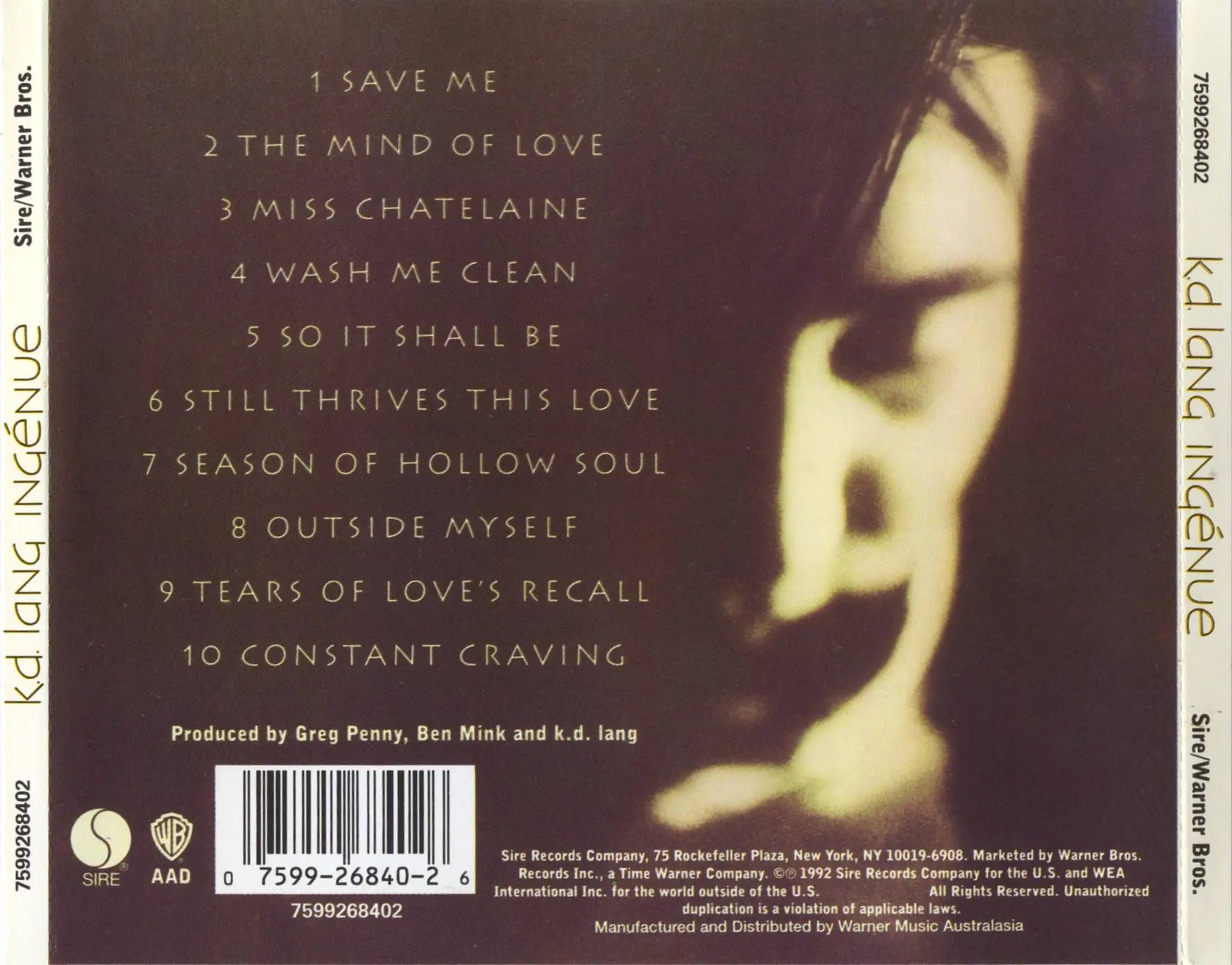
When my (former) wife and I married and combined households in the mid-1990’s my burgeoning CD collection merged with her one-and-only CD, k.d. lang’s Ingénue.
“You own one CD?”
I scoffed (silently, to myself). Then I gave her single CD a listen and scoffed no more, realizing it was a masterpiece and better than 90% of my collection.
Actually, it did take a few listens. Most of the album is downtempo and brooding. This isn’t exactly beach party music. It’s a song cycle of consonant tone, with one contemplative mood piece following the next until the perfectly-sequenced affair concludes with the cathartic “Constant Craving”, the album’s only “hit” and a song I used to try to irritate the wife by rendering as “Instant Gravy” (never worked).
Producer and co-writer Ben Mink created a chamber pop album of such meticulous craftsmanship and consummate taste it reminds me of Elvis Costello’s Imperial Bedroom, to which the word “masterpiece” was affixed on its release.
Mink places the subdued but compelling songs in elegantly adorned settings: strings, accordion, vibraphone, mandolin, slide guitar and many other instruments make their subtle way into a mix and bow out in turn, ensuring things never get tedious.
The songs are the best batch k.d. ever assembled on one LP. From this record on, one could hear echoes of Ingénue here and there on subsequent records, but never the consistent tone or quality of songs throughout an entire album.
Ingénue marked a transition from her early, rather hokey “cowgal” period into her art pop/torch singer incarnation. It’s a unique album in lang’s career and in all of pop music’s canon.
Incidentally, the Rolling Stones inadvertently appropriated the melody of “Instant Gravy” “Constant Craving” in their 1997 hit “Anybody Seen My Baby”. Quoting Wikipedia:
Written by Mick Jagger and Keith Richards, the song also carries writing credits for k.d. lang and Ben Mink.The song is known for its chorus, which sounds strikingly similar to lang’s 1992 hit song “Constant Craving“. Jagger and Richards claimed to have never heard the song before, only having discovered the similarity prior to the song’s release. As Richards writes in his autobiography Life, “My daughter Angela and her friend were at Redlands and I was playing the record and they start singing this totally different song over it. They were hearing k.d. Lang’s ‘Constant Craving.’ It was Angela and her friend that copped it.”The two gave lang credit, along with her co-writer Mink, to avoid any lawsuits. Afterwards, lang said she was “completely honored and flattered” by receiving the songwriting credit.
A recent Metafilter post introduces us to Galeazzo Frudua, a musician from Bologna, Italy who, “possesses an uncannily good ear for harmony, and has produced a series of videos that painstakingly and expertly analyze and demonstrate for you the vocal harmonies employed in various Beatles songs.” These detailed tutorials, writes the Metafilter poster, are made all the more watchable by Frudua’s “perceptive commentary, capable singing voice, unassuming manner, impressive video editing skills and, hey, his charming Italian accent.”
In his first tutorial, for “Nowhere Man” (above), Frudua begins by introducing “Lennon voice”: “Lennon voice is very simple, and it goes like this.” And, handily, flawlessly, it does. Frudua, who seems to be recording in the back of a restaurant, matches the tone of Lennon, McCartney, and Harrison’s harmonies separately and together impressively. He particularly favors Rubber Soul. Hear his “In My Life” below. He calls it “one of the best performances ever of John Lennon in the Beatles” as well as “a fantastic campus on learning how to sing.”
Anecdotally, having worked with choir singers, opera singers, and a capella singers, I can say that Frudua’s ability is not particularly rare but is the effect of constant practice. One Metafilter poster puts it well: “It’s not hard if you have a bit of an ear, and some experience…. Harmonies are a kind of language. Spend some time learning the grammar and a few phrases and it can open up quickly.” Frudua’s not only a master of vocal harmony, he’s also an expert luthier and builds custom guitars for dozens of Italian artists. In his breakdown below of “You Never Give Me Your Money,” the intro to the Abbey Road medley, Frudua takes on a particularly difficult harmony, as he explains in great detail in his careful introduction to the song’s harmonic grammar. He tells us we can use this tutorial “as a guide for your Beatles’ tribute band or reproduce them in your home recording.” You may do those things if you wish. Or you could watch Frudua do them better. See his full series here.
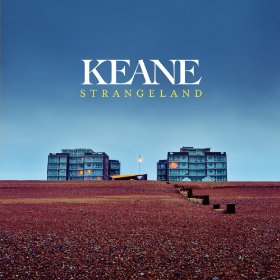
Keane retreats to familiar territory on their fourth album after some experimentation on 2008’s Perfect Symmetry. It’s for the best–this is exactly what they do well.
Mayer Hawthorne’s latest funk-soul offering sprinkles more 70’s sounds into the stew of retro-soul (or is it “neo-Motown”?) he’d been serving up on his previous two albums. I appreciate the man’s willingness to try a number of styles, sounds and lyrical themes, although what it produces is a real mixed bag. The difference between Where Does This Door Go and its predecessors is that the high points point a little higher.
“Wine Glass Woman” is like Steely Dan Lite, which is hardly a bad thing. “Robot Love” mimics the falsetto croon of the likes of Curtis Mayfield. And “The Stars Are Ours” thieves the rhythm of Stevie Wonder’s “Higher Ground” just as Robin Thicke’s “Blurred Lines” borrowed that of Marvin Gaye’s “Got to Give it Up”.




 Every Moment Has A Song