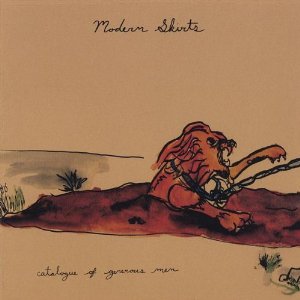
This is a little elegy for another band that deserved a little more love. Athens, Georgia’s Modern Skirts were built around the vocals of guitarist Jay Gulley and the keyboards of JoJo Glidewell, and for a couple albums their winning melodic indie pop formula showed great promise. The Skirts could muster two disparate moods effectively, and both the affecting melancholy and the rollicking feel-good piano driven vibe are represented in the attached songs.
The band’s third album, Gramahawk, however, was a pointed musical retrenchment. They weren’t the same gentle folk pop band they had been–it was like having a Pet Sounds dropped on fans waiting for another “Help Me, Rhonda”. Except I’m not sure it was good.
But Catalogue of Generous Men, their full-length debut, is heartbreakingly so, and deserved to break them on a wider scale. The frustrations of being a fan of such a band–seeing the CDs go out of print, watching in vain for a concert tour that brings them out of their own region to a nearby town–culminated for me today when I read they’d broken up just a couple months ago.
A song like “City Lights” is the perfect soundtrack for the moment of losing a band you love. Pardon my wallowing for a moment.
I invite you to share the high point in the career of one more talented group–and by all accounts a great bunch of guys too–who never grabbed the brass ring, but left us with a few golden moments.
What a joy it is to belatedly discover a really good album that you’d previously missed from a decade gone by.
Another great feeling is that of associating a newfound piece of music with a newfound friend (an “F.N.T.” if you will) who makes their entrance onto the stage of your life on cue just as the metaphorical needle hits the groove. Life is beautiful in that moment…
Recently I experienced the magical confluence of both experiences on one unforgettable day and evening. It was a reminder of just how much both friends and music can enrich our lives. Certainly I feel abundantly blessed on both counts.
So, about this album…
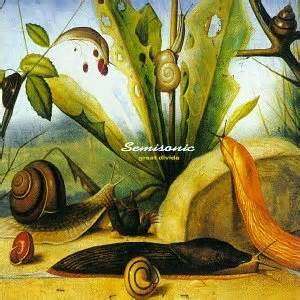
Semisonic are known mostly for their top ten 1998 hit “Closing Time”. And so often when a band’s career climaxes with a single massive hit, the work they did previous to it remains undiscovered by the masses. I won’t argue for Great Divide to be recognized as some kind of lost masterpiece–just a real enjoyable listen for fans of 90’s rock. Or, as Rolling Stone described it, “a record of simple but sparkling modern pop.” Hard to imagine this one missed the album charts completely.
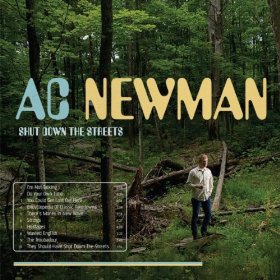
Vancouver’s A.C. Newman, front man and main writer of New Pornographers, deserves mention, along with James Mercer and Colin Meloy, as among the most gifted melodists of the contemporary indie rock scene. His always-interesting arrangements juxtapose ear-catching flourishes of all things angular, reedy and jangly with a firm rock backbone, placing it into the same baroque pop territory inhabited by Mercer’s Shins and Meloy’s Decemberists.
The lyrics are quirkily confounding at times, but set into wonderfully unforgettable melodies as they are here it somehow all feels right. “I’m Not Talking” in particular is a thing of beauty, the kind of song that renders music evangelist-types unable to sit still until they’ve shared it with as many people as will listen. With an intro that deliberates for just the right duration, making you wonder what the song is going to be, the payoff is that much bigger at the 30-second mark as the full band comes in on a reverb-sweetened riff. Newman knows the art the curtain-opening track.
Neko Case joins in on backing vocals, adding an always-welcome depth to the songs. She’s especially prominent in “Encyclopedia of Classic Takedowns”, which demonstrates right from its introductory hook Newman’s penchant for doubling instruments to create new textures–a hallmark of his work with the band as well.
Although 2004’s Slow Wonder is perhaps the most critically acclaimed of his three solo albums, to my ear this is his most mature and best work.
Ironically in the era of music’s greatest-ever availability, more quality stuff goes unheard than ever before. The proliferation of releases today, combined with the rock genre’s less dominant status in the marketplace, have resulted in some very good rock albums going almost unnoticed.
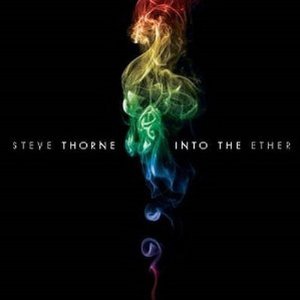
British songwriter Steve Thorne’s Into the Ether is just a few years old and already out of print. I’m convinced it’s a better album than 90% of what sat on record store shelves for years in any of the past few decades–but so it goes for a musician whose style almost seeks out those cracks to fall between. He’s too British to be mass-marketed to Americans, too prog for straight rock fans, not prog enough for hardcore prog fans, too rock to be marketed as a singer-songwriter, too much of a singer-songwriter to be marketed as a rocker. And he’s way too low-profile to get much notice.
But he’s too good to be ignored.
The multi-instrumentalist Thorne enlisted a who’s who of high-caliber prog talent to record his third solo record: Pete Trawavas (of Marillion, Kino and Transatlantic) Nick D’virgilio (Spock’s Beard) Gavin Harrison (Porcupine Tree, King Crimson) Tony Levin (King Crimson, Peter Gabriel) John Mitchell (Arena, It Bites, Frost, Kino)…and on and on. They insure that there’s no fill, break or solo that’s merely dashed off. Each song is well-served with cracking performances by this all-star progressive rock lineup.
But is it a progressive rock album? I’d say it merely straddles the prog’s border with singer-songwriter rock. Although rather dark and dour in tone, it doesn’t set out to be particularly challenging, and other than the 7/8 time signature of “Black Dahlia” and a 5/4 moment here or there, it mostly lacks the rhythmic complexities that typically mark that genre.
The upside of that is, while prog album reviewers often commend an album that they refer to as “a thoroughly uncomfortable listen” or some such, Thorne’s clear objective is to make appealing music, even if his message is often a less than cheerful one. It’s hard to imagine any fan of melodic 70’s rock not appreciating a song like “Victims”, even if it is a rumination on the void we create by our self-imposed isolation from each other.
But if “Victims” isn’t hopeless enough, “Curtain” ought to do it. So convincing is its album ending “all is futility” statement and so heartfelt is Thorne’s lyric about the desire to bring down the thick red drapes (I was born by such fluke and I’m ready to die…) I honestly wondered if he’d make another album following Ether (he did). Still, it is beautifully rendered, as is the rest of Into the Ether.
First, a point of clarification: The similarity in name to American jazz rock band Steely Dan is purely coincidental. British folk rockers Steeleye Span, who formed three years earlier in 1969, took their name from a character in an English folk song, “Horkstow Grange”–a song they oddly never got around to recording until 1998.
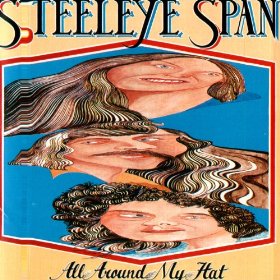
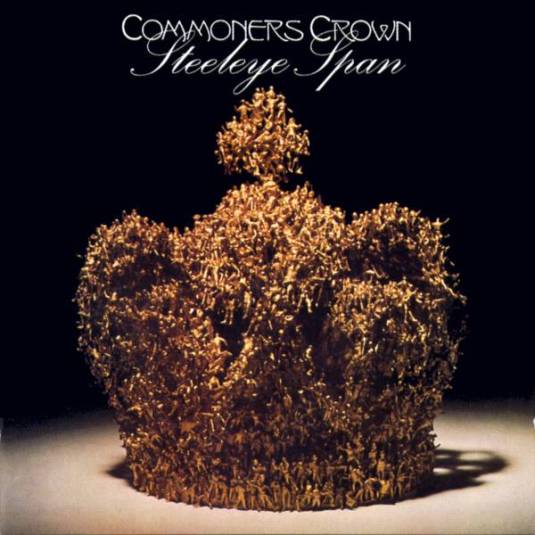
Unfortunately Steeleye Span’s finest album was blighted with what is unquestionably their worst album cover, especially given the fact that their previous record, Commoner’s Crown, was graced by a stunner of a cover featuring an exquisite sculpture of a crown comprised of hundreds of tiny human figures.
If the cover of All Around My Hat was also artistic it was so in a more abstract way. As the CD reissue’s liner notes insufficiently explain, the idea was that the album’s cover “…was designed to be viewed through three small holes cut in the inner sleeve which had to be held at a particular angle, or something like that, but it simply didn’t work, and looks as if the group were photographed in distorting mirrors at a fairground.” Okay then. Enough about the cover I think.
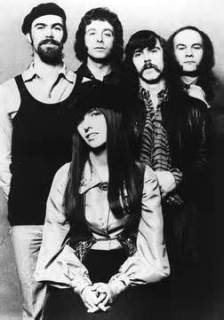
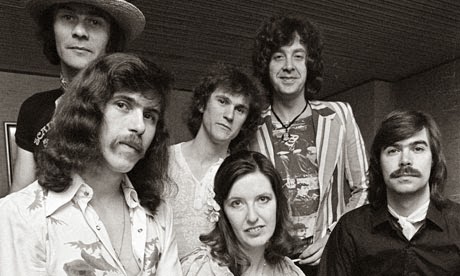
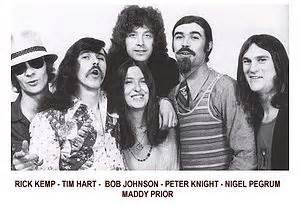
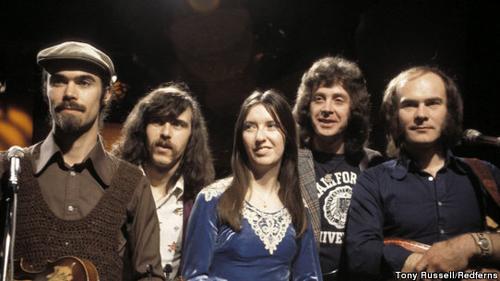
Steeleye Span were one of two main progenitors of 70’s British folk rock, with the other being Fairport Convention. Fairport, initially at least, had a bit more of a diversity of influences: they covered artists such as Dylan and Joni Mitchell on early albums. They also boasted a more distinguished pedigree in that their early lineup included immortal songbird (and ex-Strawb) Sandy Denny as well as a fast-emerging legend in teenage guitarist/songwriter Richard Thompson.
But while the consensus seems to be that Fairport were the more influential and “important” band, Steeleye Span’s music more often hewed close to traditional English folk song, and made for more consistently enjoyable listening. And where Fairport lost steam very early on as key members departed, Span’s work arced upward both artistically and commercially over their first eight albums, culminating with 1975’s high water mark, All Around My Hat.
There was never any confusing Steeleye Span’s–or indeed Fairport’s–intentions. As Richard Thompson explained in a recent interview in Prog magazine, “Prog rock was usually more classical-influenced–these were people who studied classical music and took it into the rock arena, with a harmonically intricate style. With Fairport, we couldn’t think of anything more radical to do than electrifying British roots music.”
This electrification of the country’s indigenous music had a parallel of course to what Dylan and The Band had been doing in America. And in England, Fairport and Steeleye Span weren’t the only artists of the time delving into collections of centuries-old murder ballads and presenting them to a new generation. Artists such as Bert Jansch and Pentangle did the same. But there was a sharp divide between the relative purism of those coffeehouse acoustic acts and the full-on electrification of Steeleye Span’s true folk/rock hybrid. The band re-worked ancient material in ways that people raised on contemporary rock music would find appealing. They augmented rock music’s traditional guitar/bass/drum sound with appropriately folksy mandolins, fiddles, accordions, recorders and the like for a bit of period flavor. But they were a rock band–one who could win over arena-sized crowds on tours supporting acts such as Jethro Tull.
If modernizing was indeed compromising, well–the band’s ascension from the coffeehouses to the arenas proved the validity of their instincts.
Steeleye Span were titans of a pioneering genre, and incalculably influential. Without the bands who first “plugged in” to modernize music of antiquity in England, it’s difficult to say if Ireland’s Pogues would even have come into being in the mid-80’s, which means no one to pave the way for bands like Flogging Molly, Dropkick Murphys and others today.
And they did so much more than plug in: effects pedals, stereo panning, Genesis-like instrument doubling, even avant-garde experimentation were part of their kitchen-sink approach (one of their songs features a chorus sung in two keys simultaneously, for example). And the ace up their sleeve was the multipart harmonies that make a capella breaks–and entire songs–highlights of their albums, and a band trademark (see “Cadgwith Anthem” below). These “folks” carried a big toolbox to work.
All Around My Hat charted for five months in the UK, peaking in the top ten and even spawning a top 5 hit single with its title track. Respected producer Mike Batt and engineer Geoff Emerick (a name familiar to Beatles fans) not only achieved a sound superior to that of the band’s previous work, but created at appropriate times a dramatic tension befitting the weighty bearing of the centuries-old lyrics.
It’s straightaway apparent from the first bars of “Black Jack Davey”, when a heavily-reverbed backbeat is augmented by castanets and shivering strings to set a stirring scene. Then the voice of the queen of British folk herself, Maddy Prior, alternates with band harmonies in the chorus of a song that perfectly sums up the band’s template. If you don’t like this song, you need listen no further.
But if you do, a rich trove of similar pleasures awaits.
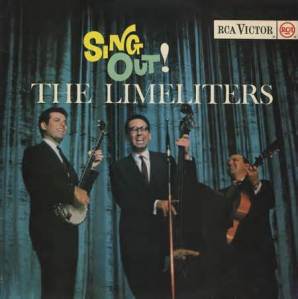
Folk group the Limeliters were formed in 1959 when Lou Gottlieb, who had recently earned a Ph.D in musicology (his dissertation was titled “Liturgical Polyphony of the 15th Century”) and was working with the Kingston Trio as an arranger, heard Alex Hassilev and Glenn Yarbrough performing in a nightclub. Lou’s idea that the three should work together making demos for the Kingston Trio soon changed course; they blended voices and talents so well they decided to begin performing together as a trio themselves. They quickly became a fixture at the Limelite Club in Aspen, Colorado, from which they took their name. Soon after they were signed to a recording contract, doing over 300 shows per year, and appearing on TV shows and Coke commercials.
Their first few albums were the typical topical folk of the time, perhaps a little less counterculture than some, but with a decidedly greater measure of frivolity. They were at their best in a live setting, where bass player Gottlieb’s articulate humor shone in his role as MC, folk music historian and master of casually witty between-song banter (see “Grace Darling” below).
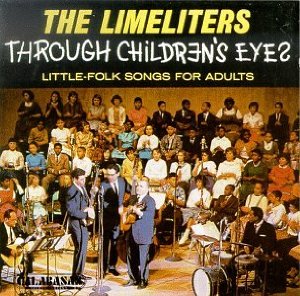
In 1962 the Limeliters released what is still the greatest children’s album I’ve ever heard and the one all three group members agreed was “the best album we’ve ever been associated with”. On a personal note, Through Children’s Eyes was a favorite of my father’s, has been passed down from me to my own children, and is currently the most requested minivan road trip music of my 2- and 3-year-old grandchildren. As four generations of my family will attest, this timeless album of “little-folk songs for adults” can’t miss with anyone exposed to it at a tender age.
Through Children’s Eyes features a selection of both folk standards of the day (“This Train”, “Morningtown Ride”, “The Riddle Song” and the closing “American the Beautiful”/”This Land is Your Land” medley) and lesser-known gems you likely won’t have heard elsewhere. The live performance, a benefit for the music program of the Berkeley, California school system, was recorded at the Berkeley Community Theater during Christmas week in 1961 with 70 Berkeley-area elementary school children. The resulting record (which hit #25 on the album charts) was so cherished by children that decades later the Limeliters found themselves signing worn album covers for middle-aged fans at concerts.
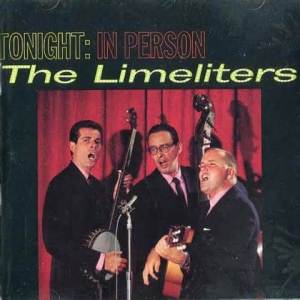
Ah, but that “decades later” came after several lineup changes, beginning shortly after the release of Through Children’s Eyes. With the Limeliters having survived a plane crash late in the year of its release, they began to reevaluate priorities. Yarbrough left for a solo career. Hassilev turned to producing and acting. As for Lou Gottlieb, he worked briefly for the San Francisco Chronicle as a classical music critic before co-founding, in 1966, Morningstar Ranch in California’s Sonoma County–an experiment in communal living. Yes, the rather dorky looking besuited upright bass player in the cover photos above, the guy who’d written his doctoral thesis on 15th century cyclic masses, formed a hippie commune–clothing optional.
A far cry indeed from the “lolli-lolli-lollipop tree” of ’62…assuming that wasn’t a veiled drug reference. No. I’d rather believe Dr. Gottlieb was a bafflingly multifaceted individual than comb my favorite children’s record for double-entendres. But not even the Beatles’ fast-track evolution can match the four-year image change between Lou of ’62 and the vaguely Mansonesque guy with the big vocabulary describing his anarchic dream here:
Even if you have no kids, and no particular use for a kids’ album, do check out the clever lesson the Limeliters and their kid chorus give grown-ups on “Hey Jimmy, Joe, John, Jim, Jack!” and their witty rendering of the story of English heroine “Grace Darling”. You don’t have to listen through children’s ears to enjoy this.



 Every Moment Has A Song