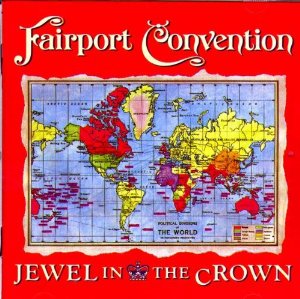
A band perhaps known as much for notable alumni (Sandy Denny, Richard Thompson) as for their actual recorded legacy, Fairport Convention nevertheless are among the most prominent of the bands who helped preserve England’s traditional folk song and expose new generations to it by melding it with contemporary rock.
By 1995 Fairport were almost thirty years into a career rife with lineup changes and fluctuations in quality of musical output. But Jewel in the Crown is a jewel indeed–a highlight of their later output.
The samples below represent Fairport’s typical mix of new contemporary writing and more traditional-sounding pastoral English folk, from the political (the smackdown of British colonization in the title track) to the traditional (“Kind Fortune”), to the newly-written tune that sounds like a traditional (“London Danny”) to the instrumental (the beautifully-rendered Ric Sanders fiddle tune, “Summer in December”).
It makes for a great introduction to the band, not to mention the genre. If it whets an appetite for British folk, you could do worse than to check out Steeleye Span’s All Around My Hat next.
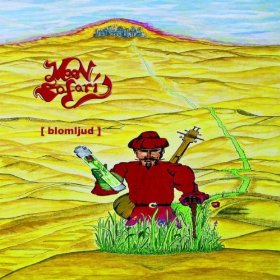
My current musical infatuation, and the stuff I’ve been playing at antisocial decibel levels lately, is that of Swedish prog band Moon Safari. For fans of sunny, uplifting, non-metal influenced prog (as well as bands like Styx from a bygone era) this prolific band is worth checking out.
Moon Safari feature perhaps the strongest vocals in all of progressive rock. Their harmonies are like nothing in the genre, sounding more like a combination of 70’s bands such as Ambrosia and 50’s close harmony acts like the Four Freshmen–or even the Beach Boys.
Songwriting too is an obvious strength. These Swedes have mastered classic long-form prog, but keep things appealing throughout, with guitar and synth lines that grow on the listener with repeated listening. You won’t find the staggering musicianship of Yes or ELP here–song, melody and harmony are the areas of greater focus. But then again, the only 20+ minute song I’ve ever found worth listening to from beginning to end was by this band and not one of the aforementioned classic acts.
They seem to keep to the type of release schedule more befitting a 70’s prog band as well, with a massive double album due this September adding to two other releases since 2010.
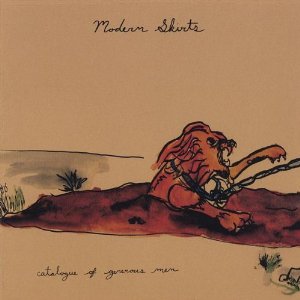
This is a little elegy for another band that deserved a little more love. Athens, Georgia’s Modern Skirts were built around the vocals of guitarist Jay Gulley and the keyboards of JoJo Glidewell, and for a couple albums their winning melodic indie pop formula showed great promise. The Skirts could muster two disparate moods effectively, and both the affecting melancholy and the rollicking feel-good piano driven vibe are represented in the attached songs.
The band’s third album, Gramahawk, however, was a pointed musical retrenchment. They weren’t the same gentle folk pop band they had been–it was like having a Pet Sounds dropped on fans waiting for another “Help Me, Rhonda”. Except I’m not sure it was good.
But Catalogue of Generous Men, their full-length debut, is heartbreakingly so, and deserved to break them on a wider scale. The frustrations of being a fan of such a band–seeing the CDs go out of print, watching in vain for a concert tour that brings them out of their own region to a nearby town–culminated for me today when I read they’d broken up just a couple months ago.
A song like “City Lights” is the perfect soundtrack for the moment of losing a band you love. Pardon my wallowing for a moment.
I invite you to share the high point in the career of one more talented group–and by all accounts a great bunch of guys too–who never grabbed the brass ring, but left us with a few golden moments.
What a joy it is to belatedly discover a really good album that you’d previously missed from a decade gone by.
Another great feeling is that of associating a newfound piece of music with a newfound friend (an “F.N.T.” if you will) who makes their entrance onto the stage of your life on cue just as the metaphorical needle hits the groove. Life is beautiful in that moment…
Recently I experienced the magical confluence of both experiences on one unforgettable day and evening. It was a reminder of just how much both friends and music can enrich our lives. Certainly I feel abundantly blessed on both counts.
So, about this album…
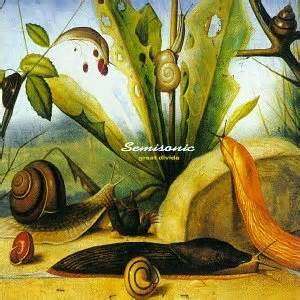
Semisonic are known mostly for their top ten 1998 hit “Closing Time”. And so often when a band’s career climaxes with a single massive hit, the work they did previous to it remains undiscovered by the masses.
I won’t argue for Great Divide to be recognized as some kind of lost masterpiece–just a real enjoyable listen for fans of 90’s rock. Or, as Rolling Stone described it, “a record of simple but sparkling modern pop.”
Hard to imagine this one missed the album charts completely.
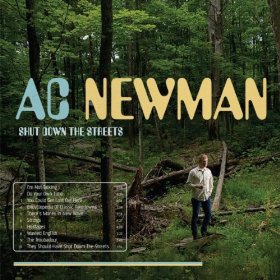
Vancouver’s A.C. Newman, front man and main writer of New Pornographers, deserves mention, along with James Mercer and Colin Meloy, as among the most gifted melodists of the contemporary indie rock scene. His always-interesting arrangements juxtapose ear-catching flourishes of all things angular, reedy and jangly with a firm rock backbone, placing it into the same baroque pop territory inhabited by Mercer’s Shins and Meloy’s Decemberists.
The lyrics are quirkily confounding at times, but set into wonderfully unforgettable melodies as they are here it somehow all feels right. “I’m Not Talking” in particular is a thing of beauty, the kind of song that renders music evangelist-types unable to sit still until they’ve shared it with as many people as will listen. With an intro that deliberates for just the right duration, making you wonder what the song is going to be, the payoff is that much bigger at the 30-second mark as the full band comes in on a reverb-sweetened riff. Newman knows the art the curtain-opening track.
Neko Case joins in on backing vocals, adding an always-welcome depth to the songs. She’s especially prominent in “Encyclopedia of Classic Takedowns”, which demonstrates right from its introductory hook Newman’s penchant for doubling instruments to create new textures–a hallmark of his work with the band as well.
Although 2004’s Slow Wonder is perhaps the most critically acclaimed of his three solo albums, to my ear this is his most mature and best work.
Ironically in the era of music’s greatest-ever availability, more quality stuff goes unheard than ever before. The proliferation of releases today, combined with the rock genre’s less dominant status in the marketplace, have resulted in some very good rock albums going almost unnoticed.
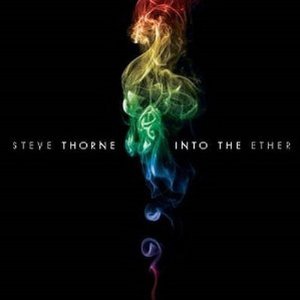
British songwriter Steve Thorne’s Into the Ether is just a few years old and already out of print. I’m convinced it’s a better album than 90% of what sat on record store shelves for years in any of the past few decades–but so it goes for a musician whose style almost seeks out those cracks to fall between. He’s too British to be mass-marketed to Americans, too prog for straight rock fans, not prog enough for hardcore prog fans, too rock to be marketed as a singer-songwriter, too much of a singer-songwriter to be marketed as a rocker. And he’s way too low-profile to get much notice.
But he’s too good to be ignored.
The multi-instrumentalist Thorne enlisted a who’s who of high-caliber prog talent to record his third solo record: Pete Trawavas (of Marillion, Kino and Transatlantic) Nick D’virgilio (Spock’s Beard) Gavin Harrison (Porcupine Tree, King Crimson) Tony Levin (King Crimson, Peter Gabriel) John Mitchell (Arena, It Bites, Frost, Kino)…and on and on. They insure that there’s no fill, break or solo that’s merely dashed off. Each song is well-served with cracking performances by this all-star progressive rock lineup.
But is it a progressive rock album? I’d say it merely straddles the prog’s border with singer-songwriter rock. Although rather dark and dour in tone, it doesn’t set out to be particularly challenging, and other than the 7/8 time signature of “Black Dahlia” and a 5/4 moment here or there, it mostly lacks the rhythmic complexities that typically mark that genre.
The upside of that is, while prog album reviewers often commend an album that they refer to as “a thoroughly uncomfortable listen” or some such, Thorne’s clear objective is to make appealing music, even if his message is often a less than cheerful one. It’s hard to imagine any fan of melodic 70’s rock not appreciating a song like “Victims”, even if it is a rumination on the void we create by our self-imposed isolation from each other.
But if “Victims” isn’t hopeless enough, “Curtain” ought to do it. So convincing is its album ending “all is futility” statement and so heartfelt is Thorne’s lyric about the desire to bring down the thick red drapes (I was born by such fluke and I’m ready to die…) I honestly wondered if he’d make another album following Ether (he did). Still, it is beautifully rendered, as is the rest of Into the Ether.



 Every Moment Has A Song