When Finneas and Ashe teamed up in 2025 for the duo project they called The Favors and the album The Dream, the results were pretty much what you’d expect from a Berklee-trained singer-songwriter and a guy with ten Grammys (and a couple Academy Awards for soundtrack work).
Finneas O’Connell is the older brother of Billie Eilish, and co-wrote and produced everything she released between 2019 and 2024. He’s also taken home awards for the Barbie movie and the James Bond film No Time to Die. All in addition to a successful solo career.
Finneas had previously produced and duetted with Ashe on some of her solo work, but The Dream is their first time recording as a proper duo.
The Dream‘s songs tell a linear story of a couple dealing with the aftermath of a breakup neither really wanted. I didn’t include its final song because…spoilers!
The album’s overall sound, recorded simply with electric piano, guitar, bass and drums, has a bit of a 70’s soft rock feel (in a good way) and the songs are well-written and drenched in harmonies.
If you hear a little Fleetwood Mac “Go Your Own Way”-type drama in the album’s subject matter and a little Stevie-Lindsey vibe in the vocal interplay, you’re not the only one.
Heartbreak and harmony are beautiful in combination.
Lead single “The Little Mess You Made” is a standout here, with Finneas and Ashe’s harmonies coming together in a simple but indelible chorus that’ll probably stick to you on first listen. The song blew up with over a million views on TikTok before it was even released.
The duo’s chemistry is on display in a 2025 Chicago Lollapalooza performance of the song:
Fingerpicking guitarists are underrated generally–which is weird because guitars were invented to be picked with fingers. But unless you were Steve Howe wedging an acoustic number into a concert or progressive rock album, as a disciple of Chet Atkins your work has been worshipped in the commercial catacombs for decades.
Pat Donohue is the fingerpicking guitarist’s guitarist. Chet Atkins called Pat “one of the greatest fingerpickers in the world today”.
In the liner notes of one of Donohue’s albums, Leo Kottke said:
“I first heard him on the radio and got upset. Then I heard him in concert somewhere and got more upset. He thinks harmonically, improvises beautifully, and writes. Disgusting.
Enjoy this record, but if you’re a guitar player, it’s going to haunt you.”
And if you’re not a guitar player, it may still haunt you. But in a good way.
If the sound of the strings vibrating in the hollow wood is your idea of real music; if the nimble runs and harmonics are something you appreciate; and if you like songwriting that’s well-crafted, with humor and authenticity, listen here.
The Master himself Mr. Atkins is Donohue’s guest on the mutually self-deprecating, chucklesome homage “Stealin’ from Chet”.
Pat’s facility for internal rhyme is especially evident in the love song “I Don’t Worry ‘Bout the Blues”.
“Touch ‘Em All” is a “touching” tribute to a ballplayer who was (at the time at least) a hero to all Minnesotans.
Things get heavy on the confessional “Love and Desire”, then lighthearted and frivolous on “Nothin'”.
“Stumblin’ Through” is archetypical Pat Donohue songcraft: injecting philosophical wisdom into charmingly rustic, toe-tapping folk music. It’s humorous. It’s chock full of internal rhymes. But it’s clearly real and from the heart of a writer–one with the gift of a relatable humanness.
Finally the instrumental “Summer’s End” showcases Donohue’s gift for a beautiful melody, with guitar harmonics adding a sublime radiance.
Back Roads is Pat Donohue at his best, which means fingerpicking folk guitar at its best.
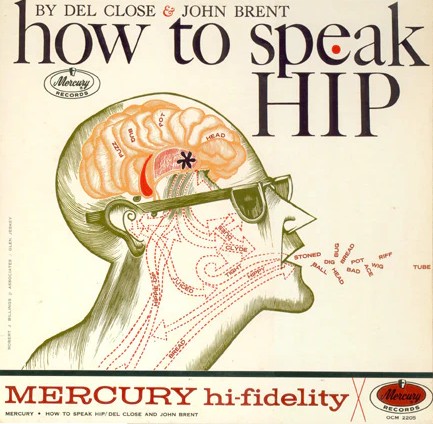
How to Speak Hip, a 1959 comedy album by Del Close and John Brent, was a satire of foreign language-learning records, with the “foreign language” being the parlance of “hip”.
Its lesson was intended, the introduction explains, “for English-speaking people who want to talk to, and be understood by, jazz musicians, hipsters, beatniks, juvenile delinquents and the criminal fringe”.
And if the record’s primary mission was comedy, it did a fair job of elucidating hip terms and culture.
Del Close
Comedian Del Close was an early member of the St. Louis comedy troupe that, upon moving to Chicago, changed its name to Second City. Close was cited as a mentor and inspiration by the likes of John Belushi, Dan Akroyd, Bill Murray and John Candy.
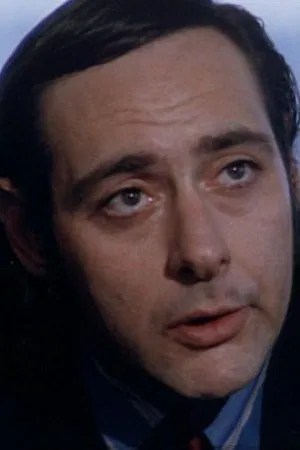
Close plays the “straight”–read “square”–role of host/interviewer while actor John Brent–known for roles in films such as Catch-22 and American Graffiti–plays hipster Geets Romo, who chafes at the rigid, formal structure of Close’s lesson.
John Brent
Geets’ reluctant participation and general disdain for the lesson (“let’s send out for some pizza”) makes for a hilarious listen, even while the objective of teaching the language of hip is actually achieved rather effectively despite.
The cult status of How to Speak Hip was enhanced by Beach Boy Brian Wilson, who was fond of quoting Geet’s “…and then we’ll get, you know, world peace”, from the record’s introduction.
Wilson can be heard referencing it in the Pet Sounds recording sessions:
In fact, the working title of the Pet Sounds track “Let’s Go Away For Awhile” was actually “Let’s Go Away For Awhile (And Then We’ll Have World Peace)”.
How to Speak Hip has been sampled and excerpted by DJ’s, rappers, jazz and electronic music artists over multiple decades.
It’s considered pretty hip.
Listen to: “Introduction”
Listen to: “Basic Hip”
Listen to: “Vocabulary Building”
Listen to: “The Loose Wig”
Listen to: “The Hang Up”
Listen to: “Put On, Put Down, Come On, Come Down, Bring Down”
The Tripwires are survivors of the 1990’s Seattle rock explosion, but don’t expect anything approximate to grunge here.
Instead, it’s lean power pop with smart lyrics and swagger, twin guitars dueling from right and left channels, catchy original melodies, and lots of harmonies.
For folks who like guitars deployed in an ebullient two-and-a-half minute burst rather than a plodding, bluesy dirge, John Ramberg and company have you covered.
One-album wonders Rockpile might be the best comparison, but honestly the Tripwires might do it better–and certainly more prolifically.
Comprised of members of bands such as Screaming Trees, the Minus 5, and Young Fresh Fellows, the Tripwires are that true anomaly: a “super group” that’s actually better than the sum of its parts.
Donovan Leitch had a nice run on the US and UK pop charts in the 1960’s, but by 1973 his top 40 days were well behind him.
That’s not to say he didn’t continue to write good songs.
But other than the criminally overlooked 2 LP collection of nursery rhymes and bucolic children’s fare HMS Donovan in 1971, his early 70’s releases were uneven–at times lacking the pretty melodies and poetic lyrical sensibility he was known for, and at others slathering a bit too much musical makeup over a song’s simple beauty.
What makes Donovan Live in Japan: Spring Tour 1973 such a satisfying–if obscure–live album, is that it not only puts beautiful, lyrical folk pop songwriting in a spare, sympathetic setting, but it plucks the musical diamonds from the rough of the uneven albums of the period to assemble one essential musical statement.
It may be Donovan’s best album. And it’s certainly this writer’s favorite live album, by any artist.
Unfortunate then that Epic Records only released it to the Japanese market, where Donovan remained very popular at the time. Despite being a sought-after collector’s item as an import, Live in Japan never saw vinyl release in the US.
Recorded at Osaka Festival Hall and Koseinenkin Hall in Osaka on March 25th and 26th of 1973, Live in Japan‘s setlist included material from the Cosmic Wheels and Essence to Essence albums, both from 1973, and two songs that would appear on 1974’s 7-Tease.
And the stripped-down arrangements–Donovan is the only musician on the stage and in the album credits–peel away any overproduction in the studio versions, bringing the artist’s warm vocals, capable guitar accompaniment and fine writing to the fore.
One could easily consider these live renderings definitive, especially since most of the studio versions remained relatively obscure (Donovan’s sales by this time weren’t what they’d once been).
Of its 14 songs, only set opener “Hurdy Gurdy Man” had been a top 40 hit (listen for a third verse, not on the hit version, and written by George Harrison while with Donovan in India).
This wasn’t a Greatest Hits tour, and the performance is a better one for it. Rather, it’s a folk singer playing folk songs, moving from beautiful ballad to lively jig and back again, and mesmerizing an adoring crowd with his gift.
“Mellow Yellow” would only have broken the wonderful spell he casts here.
Note: With only an exception or two, extraneous chatter, song intros, guitar tuning, etc. has been edited out for your greater enjoyment.
As I’ve written elsewhere, it’s astonishing to discover one of one’s absolute favorite artists as a sexagenarian. Typically the bands and singers we love most are locked in by age 25 or so, since the peak years of our musical curiosity, concert attendance and general socialization usually wind down along with the years of our formal education.
For most, taste lock has set in by about age 40. Musical rigor mortis. After that, you like what you like. And you hate what you don’t like.
Some of us are wired differently, never losing the love of discovery, always looking for the next thing to love. But even so we seldom attach ourselves to newly discovered music like we do in our chemically unbalanced, emotionally unregulated youth. And so we seldom discover absolute favorite artists at an advanced age.
But apparently there are exceptions.
Had it not been for that one employee at Blockbuster Music on McKnight Road in Pittsburgh, a treasure trove of Latin pop music would likely have never reached my ears–and so perhaps yours as well.
I was a DJ trying to have a go at a weekly Latin dancing night at a local Mexican restaurant. It was an ill-fated, poorly attended endeavor that lasted exactly one night.
But my music prep was earnest. Uncompromising. And expensive. Trusting the one guy in the CD store who knew what he was talking about regarding Latin music was a great move in the very long run–even if it never bore fruit at Cozumel restaurant.
His recommendations led me to Juan Luis Guerra, Ruben Blades, Carlos Vives, Los Manolos and, somewhat belatedly, Julieta Venegas. Guerra became my favorite Latin artist for the next twenty years. Venegas was more like a time bomb with an extremely long timer. She got buried in a CD drawer for two decades.
It was at that point that I signed on as one of the drivers of the company van my employer used to transport seasonal Guatemalan and Mexican coworkers who were in the US on work visas–several of whom had become friends.
In an effort to make the ride–and in a small way their American experience–a little more accommodating, I’d dug through an extensive music collection, full as it was of failed experiments like Cozumel.
Remembering a cute, catchy tune that had caught my attention all those years earlier, I pulled out two Julieta Venegas CDs and did a little research as I gave them a fresh listen.
I had no idea.
As the music began to stick in a way it never had previously, I read about the gold albums, the 8 Latin Grammys, the proficiency on 17 instruments…and realized Julieta Venegas deserved a deeper dive.
So why did I start by saying “this is tough”?
No matter what words I use to describe her music they’ll fall short of conveying how damn good it is.
Her first two albums, Aqui in 1998 and 2000’s Bueninvento were more jagged and rock oriented, earning critical praise from rock critics. In fact, Rolling Stone named Bueninvento the third-best album in the history of Spanish rock.
But beginning with Si in 2003 and this its 2006 follow-up, Venegas, in collaboration with producers Coti Sorokin and Cachorro López, has been making some of the most well-crafted, enjoyable Latin pop you’ll ever hear.
If Si was a commercial breakthrough, Limon y Sal was Venegas truly hitting her confident stride. Song after song it’s nothing but addictive melodies, harmonies and big, bright choruses that you don’t even have to know Spanish to enjoy.
If you do understand the words, or spend a little time looking up the translations, you’ll find the songs hitting you on another level.
Lead single “Me Voy”, a #1 single in Mexico and Spain, is probably the biggest hit of her career. And its sentiment–“you didn’t get me, so I’m leaving”–the simplest. But it does make a great singalong, especially at a Venegas concert.
The album’s second single “Limon y Sal” is about acceptance of a lover’s shortcomings and faults, but the message is couched in an exuberant, uplifting chorus that made the song a smash (#2 in Spain and Mexico):
I love you with lemon and salt I love you as you are There’s no need to change anything
“Dulce Compañia” too breaks out in a wonderfully ebullient singalong chorus:
You’re sweet company, and my soul thirsts I feel resurrected when you see me
Perhaps the most sympathetic performance of the beautiful “Mirame Bien” (“Look at me well”) was rendered for Venegas’ MTV Unplugged concert:
And single number three, the defiantly resolute “Eres Para Mi” (“You are for me”) matches a confident groove with self-assured lyric sentiment:
And I know that you are afraid and it is not a good time for you And for this that has been happening to us
But you’re for me The wind has told me
You’re for me I hear it all the time
Yes, the eight songs I include here are a lot. Truthfully, I cut a few others that I love. This album overflows with good songs, diverse arrangements and lyrics that explore all Julieta Venegas’ appointments with love, loneliness and self-discovery.
Oh, and we had some great sing-alongs in that van.