A Picture’s Worth a Thousand Words: Stories Behind Iconic Album Covers

Source: Amazon / Photo by Dezo Hoffman, Shutterstock

(via musicoholics)

Rubber Soul, The Beatles (1965)

Photographer Robert Freeman snapped the picture of the band in John Lennon’s garden. The stretched effect was actually a mistake made while the band was looking at Robert’s samples. He projected the image onto a cardboard cutout, but when the cardboard fell backwards, the image became stretched. The band ended up loving the image and felt like it was a perfect depiction of their new sound.

The album’s typography was designed by Charles Front. He used the title as inspiration and created a typeface style that was used for psychedelic and flower-power designs. Charles also added another hidden element to his lettering. The title reads “Road Abbey” if you hold the album upside down in front of a mirror…

Read more: A Picture’s Worth a Thousand Words: Stories Behind Iconic Album Covers – page 3 of 36 – Musicoholics

Jethro Tull’s Ian Anderson: My Life in 10 Songs

As the pioneering prog rockers celebrate their 50th anniversary with a tour and new box set, their leader reflects on the tracks that defined them

(via Rolling Stone) by Kory Grow

For Ian Anderson – prog rocker extraordinaire and the world’s best one-legged-stance flautist, bar none – a half-century career in music is no remarkable feat. “It’s not any particularly novel or unusual occurrence,” the Jethro Tull leader says nonchalantly through his dry British accent. “This year marks the anniversary of many other bands who did things around the same period of time. King Crimson started in 1968. So did Yes, Rush and Deep Purple. And of course it’s Led Zeppelin’s 50th anniversary too. So there we go.”

But what he fails to acknowledge is that none of those bands, no matter how out-there they got, were able to blend their hard-rock aspirations with the same levels of pomp, guile or unapologetic pretension as Jethro Tull. None scored FM-radio gold singing lyrics like “Lend me your ear while I call you a fool” (“The Witch’s Promise”) or by writing a 44-minute, tongue-in-cheek prog-rock song (“Thick as a Brick,” presented in two parts on the original LP and packaged in a fake newspaper) or by playing frilly flute solos over Renaissance-inspired folk-rock (“Songs From the Wood”).

In their 50 years, Jethro Tull have notched an astounding 15 gold or platinum albums in the U.S., as well as two Number One LPs. Their most famous song, “Aqualung,” has a guitar riff that’s as cutting and memorable as “Iron Man” and “Smoke on the Water,” and their music has influenced Black Sabbath, Iron Maiden, Porcupine Tree, Pearl Jam and Nick Cave, among others. Yet the band has not yet been inducted into the Rock and Roll Hall of Fame, and the only time it has won a Grammy was in the Hard Rock/Metal category – a concept that seemed so preposterous to Anderson that he didn’t bother to show up…

Read more: Jethro Tull’s Ian Anderson: My Life in 10 Songs – Rolling Stone

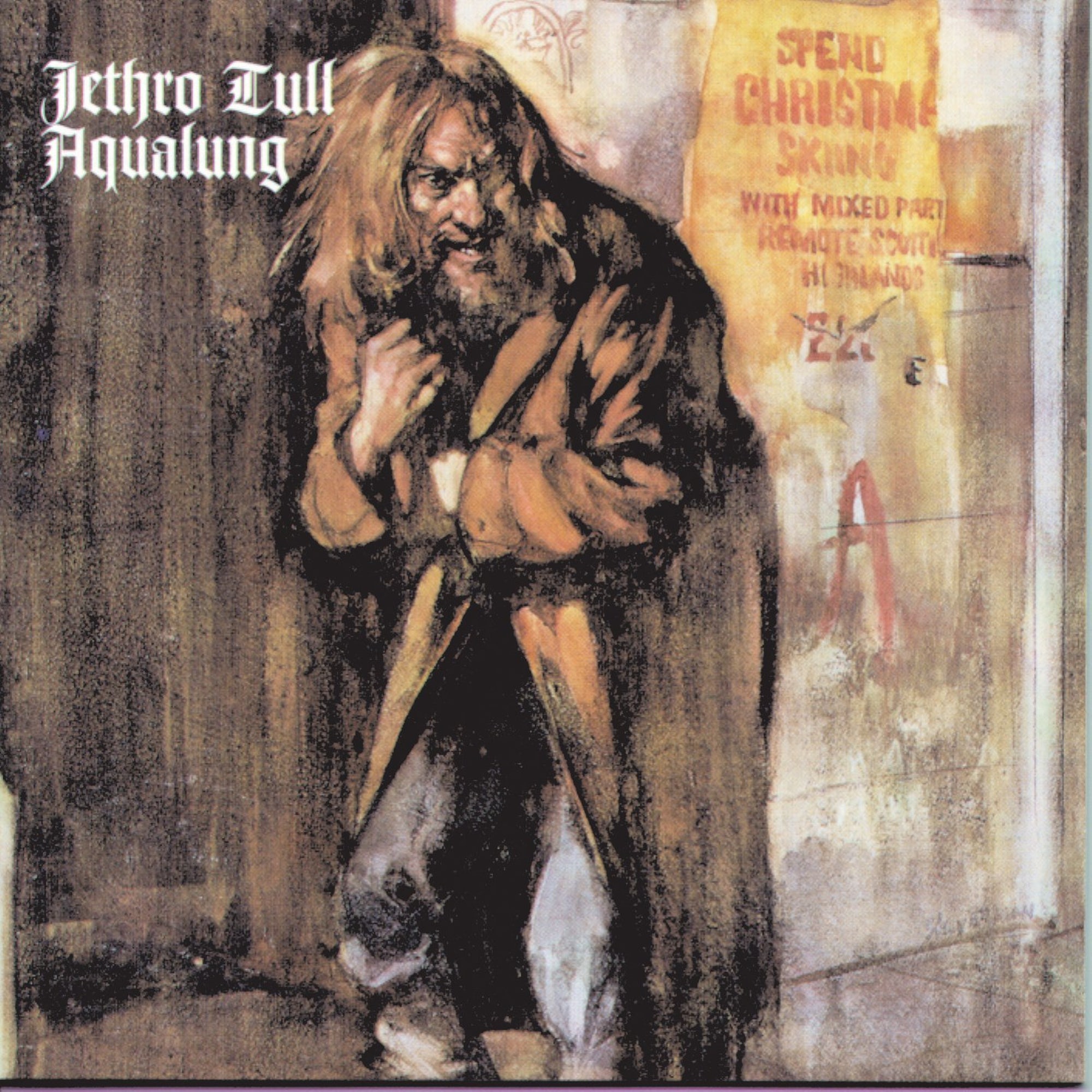
MY DAD PAINTED THE ICONIC COVER FOR JETHRO TULL’S ‘AQUALUNG,’ AND IT’S HAUNTED HIM EVER SINCE

(via The Outline) by Robert Silverman

Sometimes, my father, Burton Silverman, age 89, has trouble remembering certain things. He worries about this. My mother, a psychologist, 79, worries even more, parsing his speech patterns and emails for any clinical signs of cognitive impairment. He always hand waves away these concerns, partly for our benefit and partly because there is little to be done.

But as some details — the name of a former friend, where he last stashed his wallet — seem to fall just beyond his fingertips, dad’s focus has turned towards something less definable: his career. More to the point, the end of a career that has seen him become one of the more prominent realist painters of his time. And yet, for all the artwork he’s created, the accolades and awards, it bothers him, in a way he can’t really express and may not want to recognize, that one of the first lines in his obituary will mention a “throwaway gig,” from the winter of 1970: the artwork for Jethro Tull’s best-known and best-selling album, Aqualung

Read more: The painter behind Jethro Tull’s Aqualung cover is still haunted by its success | The Outline

On This Day…The Beatles’ ‘Rubber Soul’

(via Thisdayinmusic.com)

Following a well deserved holiday, John, Paul, George and Ringo returned to the studios in mid October 1965, not only to record their next album but also a new single – their first double A-side “Day Tripper” and “We Can Work It Out. ”

During these sessions, The Beatles took a major artistic leap forward, and when Rubber Soul was released in Dec 65, it presented a new, growing Beatles to the world, with a stunning collection of songs which introduced a new direction, sophistication and depth. Talking about the recording many years later Paul McCartney said, “We smoked a bit of pot, the first time we’d ever done that. We normally didn’t smoke when we were working.”

Read more: The Beatles – Rubber Soul | This Day In Music

Joe Walsh Had to Buy Maserati Because of ‘Life’s Been Good’

(via Ultimate Classic Rock) by Martin Kielty

Joe Walsh says he had to buy a Maserati after the success of 1978’s “Life’s Been Good.”

Taking a light-hearted look at the world of rock-star excess, the song notes that the Eagles star’s Maserati can do “185” – but he doesn’t drive it because he lost his license, and instead is being transported by limousine.

Read More: Joe Walsh Had to Buy Maserati Because of ‘Life’s Been Good’ (ultimateclassicrock.com)

30 Facts About ‘This Is Spinal Tap’

(via 80’s Kids) by Matt M

This Is Spinal Tap is one of the most well-known examples of the “Mockumentary” genre and pretty much started that genre all by itself. The film has gone down in history as a cult classic and is often quoted, especially when anyone wants to crack something up to 11! Let’s take a look back at this classic film with some facts that you may not have known…

30. The Stonehenge scene predates a similar incident involving Black Sabbath

For years, This Is Spinal Tap has been hailed as one of the funniest films ever thanks to its hilarious portrayal of the rock star lifestyle.

What makes the film all the more amusing is the fact that many of its most absurd moments are based on real incidents – although in one notable scene, the film uncannily predicts a rock’n’roll blunder which had yet to occur.

This includes the unforgettable Stonehenge sequence, in which a set designer (Anjelica Huston) builds a replica of the legendary monument based on a sketch from the band.

Unfortunately, the sketch provided gave the proportions in inches rather than feet, hence the band end up playing alongside a miniature Stonehenge on stage.

This scene was originally shot in 1982 for a short film which helped the filmmakers get a green light for the feature – but a year later, a bizarrely similar thing happened in real life to Black Sabbath.

The British rockers commissioned a replica of Stonehenge for their set on their 1983 tour – but as in This Is Spinal Tap, it wound up the wrong size due to an administrative error.

In Black Sabbath’s case, rather than having a model a fraction of the size of the real Stonehenge, theirs was more than twice as big as the real monument…

Read more: https://www.eightieskids.com/things-you-didnt-know-about-this-is-spinal-tap

See also: https://edcyphers.com/2012/12/05/this-is-spinal-tap-the-complete-script/

Previous Older Entries Next Newer Entries