Paul McCartney’s Heartfelt Words for Guitarist Henry McCullough

Irish guitarist Henry McCullough passed away Tuesday at age 72. McCullough was a former member of Paul McCartney and Wings and played on their 1973 Red Rose Speedway album. He is credited with the iconic solo on McCartney’s love song to Linda “My Love”.

His playing is also featured on Pink Floyd’s Dark Side of the Moon, among other things.

McCartney shared the following statement on Facebook:

“I was very sad to hear that Henry McCullough, our great Wings guitarist, passed away today. He was a pleasure to work with, a super-talented musician with a lovely sense of humour. The solo he played on ‘My Love’ was a classic that he made up on the spot in front of a live orchestra. Our deepest sympathies from my family to his.”

– Paul

Styx ‘Pieces of Eight’ 35th Anniversary Interview

styx

James Young, Tommy Shaw and Dennis DeYoung gather for the interview show In the Studio with Redbeard to discuss their 1978 platinum-selling conceptual LP Pieces of Eight:

http://www.inthestudio.net/redbeards-blog/styx-pieces-35th-anniversary-tommy-shaw-jamesjy-young/

10 of the Luckiest Music Fans of All Time

jovi

Think you’re special because your fave band signed your forearm at a post-gig meet-and-greet? Think again. Not all fans are created equal. Here are 10 of the luckiest.

1. The 12-year-old who performed onstage with Jay Z

When I was 12 I spent most evenings a) on MSN Messenger b) watching Neighbours and c) working on my Craig David fan site (true story). I was not hanging out with my idols on stage at massive arenas like this special kid from Maryland. Imagine turning up to school one morning and being like: “Oh yeah, last night I went to a Jay Z gig with a sign saying ‘Can I Rap For You?’ so he invited me up on stage and I performed ‘Clique’ in front of thousands of people. Then I asked if I could come backstage and he was like’ yeah, alright then’.” Mind. Blown.

Read more at http://www.nme.com/blogs/nme-blogs/10-of-the-luckiest-music-fans-of-all-time?utm_source=twitter&utm_medium=social#JrIARC0Ot5VE3c7p.99

This Day in Music: The Stones Unleash ‘Some Girls’

stones

(via This Day in Music)

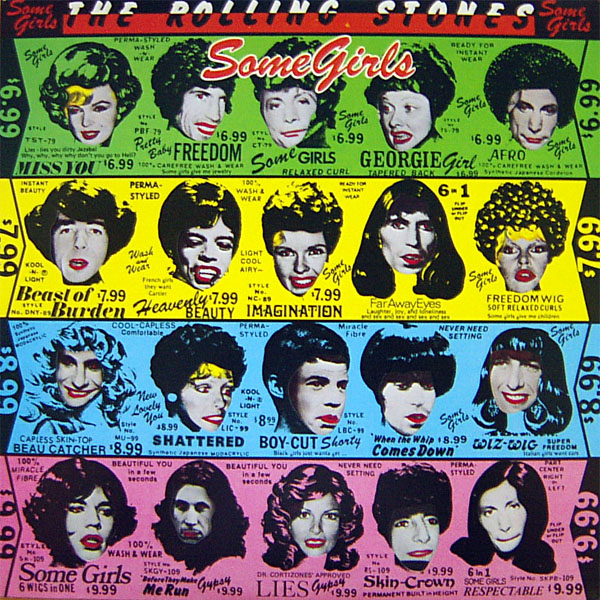
Some Girls saw the Stones back with a bang, on an explosive mission to show the world’s ‘new punks’ who was boss. Playing faster and dirtier than men of their age should, the Stones pulled out all the stops, invigorated by the provocations of these new upstarts, (most of whom had grown up on the Stones anyway).

Unleashed on the public in June 1978, the album’s cheeky artwork immediately landed the boys in trouble. Designed by Peter Corriston, who had had a run of eye-catching album covers, (Zeppelin’s Physical Graffiti, Rod Stewart’s Sing It Again Rod), its elaborate die-cut design featured The Rolling Stones in garish drag alongside select female celebrities and lingerie ads…

Read more: http://www.thisdayinmusic.com/pages/some_girls

____________

A great album, great comeback, and a great response to the late-70’s punk movement.
With a little disco, a little country and a little R&B mixed in, this was also one of the band’s most diverse albums.
Even if you’re a fan and know the hits, but have never listened to this classic all the way through, you really should. It’s a staggering accomplishment and IMO the band’s last truly great LP.

Can I Love Hip-Hop and Not Hate Women?

hip

(via Huffpost Women)

by Rich Hawkins

I love hip-hop music. I think when done well it can be lyrically the most progressive genre on the planet, and for me it has produced some of the best music of the last 30 years. With albums like The Miseducation Of Lauryn Hill and My Beautiful Dark Twisted Fantasy sitting among my favourites, I love the complexity of its subject and while I’m perhaps not the most typical fan, I do feel a real connection to the artists and music. But I also have an issue, and that is; can I, as somebody who loves and respects women, really have feminist sensibilities when I listen to the music I do?

This topic is something I’ve thought about for a while, but it was recently brought to the front of my mind while idly listening to music on my way to work. Within a playlist of all kinds of stuff, this lyric from The Weeknd found its way into my ear “I just f*cked two bitches ‘fore I saw you”. It isn’t by any stretch the most extreme lyric in hip-hop, but I actually found myself turning it off and removing the song from my playlist. It felt so aggressively disrespectful, and it made me start to really thinking about what I was listening to as I blindly flip between tracks and half listen to music…

Read more: http://www.huffingtonpost.com/rich-hawkins/can-i-love-hiphop-and-not_b_7697486.html

Which Rock Star Will Historians of the Future Remember?

rock

The most important musical form of the 20th century will
be nearly forgotten one day. People will probably learn
about the genre through one figure — but who might that be?

(via the New York Times Magazine)

MAY 23, 2016

lassifying anyone as the “most successful” at anything tends to reflect more on the source than the subject. So keep that in mind when I make the following statement: John Philip Sousa is the most successful American musician of all time.

Marching music is a maddeningly durable genre, recognizable to pretty much everyone who has lived in the United States for any period. It works as a sonic shorthand for any filmmaker hoping to evoke the late 19th century and serves as the auditory backdrop for national holidays, the circus and college football. It’s not “popular” music, but it’s entrenched within the popular experience. It will be no less fashionable tomorrow than it is today.

And this entire musical idiom is now encapsulated in one person: John Philip Sousa. Even the most cursory two-sentence description of marching music inevitably cites him by name. I have no data on this, but I would assert that if we were to ask the entire population of the United States to name every composer of marching music they could think of, 98 percent of the populace would name either one person (Sousa) or no one at all. There’s just no separation between the awareness of this person and the awareness of this music, and it’s hard to believe that will ever change…

Read more: http://www.nytimes.com/2016/05/29/magazine/which-rock-star-will-historians-of-the-future-remember.html?_r=0

_____________________________________

While I found this a worthwhile article with a fun premise, it’s a premise I don’t necessarily accept. True, we’ve reduced marching music to Sousa, as he was head and shoulders above his contemporaries in the field. And Marley will undoubtedly be used similarly as shorthand for reggae someday for the same reason.

But the phenomenon of a single artist becoming synonymous with a genre breaks down when you consider classical music.

Centuries later, the music of a wide variety of classical composers still lives on and no single one sums up the genre for us. Perhaps J.S. Bach represents the baroque period best, and Beethoven the romantic era, but Mozart will never be forgotten and none of these three, as great as they were, can sum up the genre the way Sousa does marching music.

I think it more likely rock music will similarly live on without being reduced to a single figure as representative. It’s rock music’s diversity that separates it from reggae and marching band music, and that diversity will afford it a more complex legacy.

Previous Older Entries Next Newer Entries