"There's a time in life for Hoagy Carmichael. There's a time in life for Claude Debussy. There's a time in life for Jerry Lee Lewis. There's a time in life for Destiny's Child. All these things have their moment." ~Elvis Costello
The songwriting partnership of John Lennon and Paul McCartney deservedly has hallowed status on the basis of the many classics the Beatles themselves recorded.
But as songwriters they remain perhaps under-appraised even so, considering their many other, lesser-known songwriting credits on hit songs they gave to others to perform–songs which might have added to the Beatles’ own lengthy list of hits had they chosen to release them themselves.
Paul was particularly active in promoting other fledgling acts by giving them hit songs, even though his compositions at the time were still credited to the Lennon/McCartney team. One such example is “Goodbye“, which he gave to an 18-year-old Mary Hopkin, and which was a #13 single in America (#2 UK) Here’s Mary’s recording:
…and Paul’s demo version:
Hopkin’s debut album was produced by McCartney and featured the massive worldwide hit “Those Were The Days”.
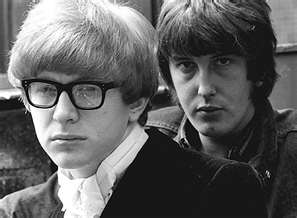
The sixties hit duo Peter and Gordon’s first three hit singles were all penned by Lennon and McCartney, although if you listen to Beatles demo versions you hear Paul singing the lead vocals, a pretty sure sign (judging from the Beatles’ catalogue itself) that he was at least the primary and perhaps sole writer of these songs also:
“A World Without Love“, a number 1 hit in 1964, almost certainly would have topped the charts in Beatle-recorded form as well. It’s a British Invasion classic:
(Peter Asher is the Austin Powers-looking gent at left)
Here’s the Beatles’ demo version:
The other two Peter and Gordon hits written by the Beatles:
“Nobody I Know” (#12 US hit):
…and “I Don’t Want To See You Again” (#16 US):
Another British Invasion act, Billy J. Kramer and The Dakotas, were produced by George Martin and recorded many Lennon/McCartney songs. Bad To Me (below) reached number 1 in England (#9 US) and its sound is pure 1964 Beatles.
The “J” in Billy J. Kramer, by the way, was the suggestion of John Lennon, who thought it gave Billy a tougher image. (Lennon also gave the band The Cyrkle its name. Maybe Beatle-influenced band nomenclature is an article unto itself…)
“I’ll Be On My Way”, “I Call Your Name”, “I’ll Keep You Satisfied”, and “From A Window“, all recorded by the Dakotas, were Lennon/McCartney songs. And their recording of George Harrison’s “Do You Want To Know A Secret” was also a number 2 hit in the UK.
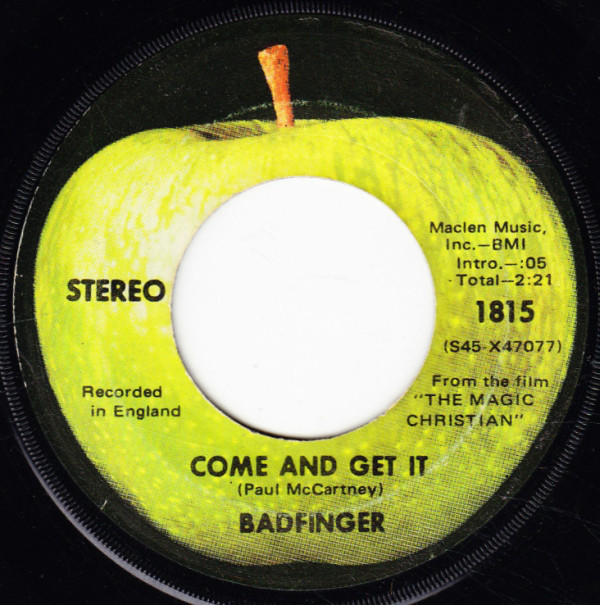
Badfinger, who, like Mary Hopkin were signed to the Beatles’ Apple Records, had their career jump-started in 1969 when Paul McCartney gave away another (#7 US) hit, “Come And Get It“.
Beatle fans who’ve never heard the demo will find that Badfinger pretty much stuck to Paul’s blueprint:
This is by no means a complete list. It’s merely meant to point out that Lennon and McCartney weren’t just hitmakers as Beatles. From the mid-60’s through the early 70’s their songwriting was here, there and everywhere.
In 1968, Paul Saltzman was a lost soul. The son of a Canadian TV weatherman, he was working as a sound engineer for the National Film Board of Canada in India when he received a “Dear John” letter from the woman he thought was going to be his wife. “I was devastated,” he says. “Then someone on the crew said: ‘Have you tried meditation for the heartbreak?’”
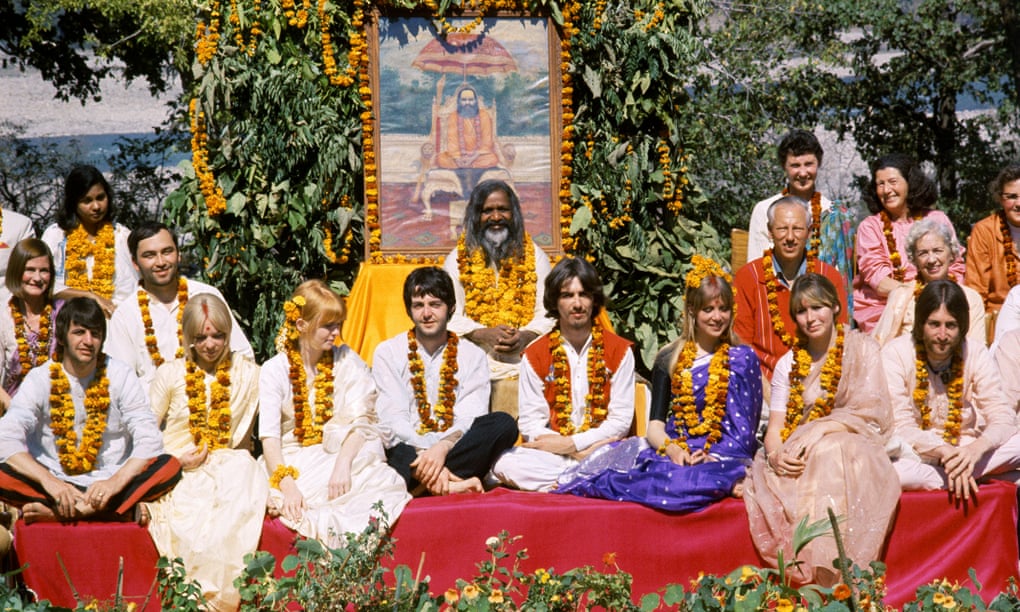
Saltzman went to see the Maharishi Mahesh Yogi – the founder of transcendental meditation – speak at New Delhi University. Emboldened by promises of “inner rejuvenation”, Saltzman then travelled to the International Academy of Meditation in Rishikesh. It was closed, due to the arrival of the Beatles.
As explained by Paul McCartney in the Beatles book Anthology, the exhausted group, still coming to terms with the suicide of their manager Brian Epstein in August 1967, had arrived in Rishikesh with wives and girlfriends to “find the answer” through the teachings of the Maharishi, whom Paul, George and John had first encountered at a lecture at the London Hilton. “There was a feeling of: ‘It’s great to be famous [and] rich,” said McCartney, “but what it’s all for?’”
In the almost 60 years since Bob Dylan released his debut album, countless words have been spilled on his singular legacy. There are books and movies and over half a century’s worth of music journalism trying to dissect the mystery and pin down the multitudes. College courses unpack his lyrics. A Presidential Medal Of Freedom and a Nobel Prize and who knows how many other honors mark Dylan’s towering, seismic presence as not just a musician but a cultural and literary icon of the American Century. All of which is to say: You and I both know about Bob Dylan, and there’s little I could say to celebrate his 80th birthday that hasn’t been said many times before.
Instead, we chose to celebrate the occasion by surveying a vast array of musicians on their favorite Bob Dylan song. (Technically, there are picks from 86 musicians here, but we didn’t want to wait another six years to publish this. Consider it a bonus.) Below, you’ll find singer-songwriters working in a tradition most obviously indebted to Dylan, but you’ll also find young country stars and ascendent art-rockers and jazz boundary-pushers. You’ll find David Byrne writing an essay about one of Dylan’s most recent songs, and you’ll find David Crosby remembering the first time he saw Dylan play in the Village, and a whole lot more. All spoke to Dylan’s incomparable influence, the way he kicked open some kind of door or another no matter what form an artist works in. We were excited and stunned by all the thoughtful responses we received for this project, and we think you will be too. Happy birthday Bob Dylan!
An edit of Beatles interviews from 1969 to 1970. Each Beatle generally sounds positive and supportive of each others’ songs and solo projects, but also realistic about the business issues they had been going through.
They also seem surprisingly open to making more Beatles songs and albums in 1970 and beyond.
This audio seems to contradict a central myth of the Beatles that they made Abbey Road thinking it would be their last album.
01 John Lennon (Everett Is Here, September 1969) 0:00
02 Paul McCartney (Scene And Heard, September 1969) 0:31
03 George Harrison (Scene And Heard, October 1969) 11:42
04 John Lennon (Scene And Heard, October 1969) 22:23
05 John Lennon (Scene And Heard, February 1970) 26:55
06 George Harrison (Scene And Heard, March 1970) 30:31
07 Ringo Starr (Scene And Heard, March 1970) 36:23
08 George Harrison (The Beatles Today, March 1970) 38:33
The best songs of the 60s? Surely an impossible task. And it is. So we’ll say at the beginning that this list doesn’t purport to be the definitive top 100 songs of the 60s. Instead, what we’re hoping to provide is a window into a decade that changed music forever and a pathway for future discovery.
Two important things that are worth mentioning. The first: We wanted each song we included to have some sort of popular impact, either in the decade it was released (or importance in the following decades). That means most of the jazz you’ll find on this list hit the Billboard charts. The second: We’ve only allowed one song per artist in an effort to pay tribute to as many folks as possible.
With that preamble out of the way, enjoy the list!
100: Roger Miller – King of the Road (1965)
Roger Miller’s “King of the Road” shines a light on the traveling man. The track, a delightful country-pop crossover, tells the story of a nomadic hobo, untethered from all obligations and material goods. The song’s most famous line, “I’m a man of means, by no means, king of the road” was bitingly cynical, reveling in the freedom of refusing to conform to societal norms. The smooth-as-whiskey melody and straightforward instrumentation has made it a reliable cover for country stars and rock bands alike, with artists as diverse as Glen Campbell and Reverend Horton Heat covering the tune. The song’s stripped-down style allows for many different interpretations, but it’s Miller’s original, built around the singer’s charmingly beautiful voice, that remains the definitive “King of the Road.”
99: Georgie Fame & The Blue Flames – Yeh, Yeh (1964)
Georgie Fame and his band, The Blue Flames, found the perfect intersection of pop, jazz, and R&B. Audiences agreed. The group’s version of “Yeh Yeh,” topped the Beatles’ “I Feel Fine” on the UK chart, ending a five-week run from the Liverpool chaps. Shortly after topping the UK charts, “Yeh, Yeh” reached #21 on the Billboard Pop charts, proving that the song was more than a UK wonder. The band truly came into their own once Fame ditched his piano for a Hammond organ, a decision that was directly inspired by Booker T. & The M.G.’s “Green Onions.”
98: Jackie Wilson – (Your Love Keeps Lifting Me) Higher and Higher (1967)
The instrumentation for Jackie Wilson’s “(Your Love Keeps Lifting Me) Higher and Higher” is as crisp as it gets. The bass sounds like it was recorded in a hermetically sealed vacuum, while the iconic conga groove pops without a crinkle or crack. All Wilson had to do was show up. And show up he did. The instrumental for the 1967 hit was written by Gary Jackson, Raynard Miner, and Carl Smith. The song was first offered to The Dells, but was never released. Wilson came in, and originally sang the tune as a ballad. It wasn’t until he reframed his performance as the uptempo, soul-charge you hear today that the song was deemed fit for release and became a 60s classic…